I accept the challenge. Let him come.
Germaine Cellier, a statement published in the newspaper L’Impartial in 1948, reproduced by Auparfum in 2022 (translated from the Japanese translation)
In 1948, Germaine Cellier responded with these words to an olfactory contest proposed by an Argentine perfumer. It was a bold challenge: identify the contents and proportions of an array of perfumes. More memorable than who won or lost is her unhesitating readiness to meet her opponent.
Bandit, exposing the bitterness of leather. Vent Vert, like green leaves stirring all at once. Fracas, depicting the dense whiteness of tuberose. Cellier’s creations have the strength to assert a different expression with every work, rather than pile up similar scents.
In the male-dominated perfume industry of the first half of the twentieth century, she carved out a place for herself with chemical knowledge and bold instincts. Becoming unforgettable mattered more than fitting neatly together. Following her life and work reveals a surprisingly expansive freedom within the small world of perfume.
- A Life in Perfumery
- Born in Bordeaux, Trained in Chemistry
- From Selling Fragrance Materials to Creating Perfumes
- Bandit’s Striking Wartime Debut
- Clashes with Jean Carles, Then Exarôme
- Painting Bold Colors with Short Formulas
- Bandit: Beauty Within the Bitterness of Leather
- Vent Vert: A “Green Wind” with Leaves in the Leading Role
- Fracas: Making Tuberose Unforgettable
- Jolie Madame and Balmain’s Image of a Woman
- Another Life Among Artists
- Free Speech and the Fragrances Left Behind
- Fragrance Creations
- References
A Life in Perfumery
Born in Bordeaux, Trained in Chemistry
Cellier was born on March 26, 1909, on rue de Vaucouleurs in Bordeaux, France. Her full name was Louise Charlotte Germaine Cellier. Her father Georges worked for a tram company, and her mother Jeanne worked in commerce.
Biographical accounts of the family describe her father as free-spirited and extravagant, and her mother as practical and strong-willed. Her mother is said to have gone out to work even in her forties to support the household. It is a family scene suggestive of Cellier’s own flamboyance and inner strength, though it cannot alone explain her later character.
One early olfactory memory passed down concerns a small member of the pink family growing near the sea. Her niece, journalist Martine Azoulai, says that her aunt recalled the scent of “sand pinks” smelled in hills near Marseille and wanted to make perfume. Before the splendid bouquets, perhaps there was the spicy smell of a wildflower.
Her schooling took her from Créon in Gironde to Saint-Martin d’Étampes in Essonne. She completed primary education with excellent results in 1921 and received a certificate of complementary education from the Paul Bert school in Bois-Colombes in 1924.
She then pursued specialist studies at the École Scientia in Paris. On October 14, 1925, she qualified as a chemistry assistant; the following year, 1926, as a bacteriology assistant. She was then living with her parents in Argenteuil. Although later described as an intuitive genius, Cellier began with concrete training in understanding the substances handled in a laboratory.
From Selling Fragrance Materials to Creating Perfumes
In the 1930s, Cellier joined Roure Bertrand Dupont, a fragrance company that would later become part of Givaudan. In Jean Sfiras’s laboratory, she worked on tasks including classifying distillation fractions of synthetic fragrance materials and gained experience making blends of ingredients known as bases.
At the time, a major part of the perfume industry’s structure involved perfume houses such as Caron, Coty, Houbigant and Guerlain selling finished perfumes, while fragrance companies supplied ingredients and bases.
Roure’s leader Louis Amic sought to expand that relationship. A fragrance company would create a finished scent, and a couturier would release it under the couturier’s own name. He actively nurtured a form of collaboration that seems entirely natural today.
Cellier’s talent flourished amid this change. What awaited her was not only the technical work of making a scent, but the task of turning a dressmaker’s ideal of a woman, the atmosphere of the time and a house’s character into a single creation.
In 1943, she briefly left Roure to work on soap fragrances at Colgate-Palmolive. Her stay lasted only three months, however, before she returned to Roure. Having also experienced creating scents for everyday products, she found in couture perfumes the setting that would produce her signature works.
Bandit’s Striking Wartime Debut
A major turning point was meeting couturier Robert Piguet, who had gained experience under Paul Poiret before opening his own house. In 1944, while the Second World War was still under way, Cellier created Bandit for Piguet.
Its name means a brigand or outlaw. True to that name, its heart had a bitter, sharp texture recalling leather. It was a strong, provocative creation that could not be confined to an image of a demure woman dressed in flowers.
These words of Cellier’s are reported about Bandit.
In five minutes, on the corner of a table.
Germaine Cellier, words reported about the creation of Bandit, in La Voix du Parfum (translated from the Japanese translation)
Rather than a record counting every trial before completion, the remark survives as a characteristically bold recollection. It conveys the spirit of a creator who grasped a fragrance’s outline without hesitation.
In the same year, 1944, the weekly 7 Jours ran a headline to the effect that Cellier was taking men’s monopoly on the “best nose” away from them. Reporting at the time also noted that couturiers bought the secrets of fragrances and claimed to have created them, while perfumers’ pay was modest compared with the sales generated. Behind glamorous success lay a structure in which creators’ names and their work were not necessarily valued equally.
Clashes with Jean Carles, Then Exarôme
Roure had another perfumer with a strong personality: Jean Carles. He developed a systematic method of learning materials and left a major mark on perfumery education.
Cellier, by contrast, is described as someone who trusted instinct more than rules. That did not mean she lacked knowledge. Having studied chemistry, she held strong judgments of her own about how to use that knowledge.
Their relationship was strained, and Cellier did not hold back in criticizing colleagues. Later records recount that meetings under Amic could sometimes become stormy.
In 1946, Cellier was put in charge of Exarôme, a Roure subsidiary. A mansion at the corner of rue du Rouvray and boulevard Victor-Hugo in Neuilly-sur-Seine became her creative base. Keeping her and Carles apart was also one reason for providing this setting.
She had not left the company to start a brand of her own. Within Roure’s organization, she gained a place to work with assistants at her own pace. From it came a succession of creations from the late 1940s through the 1960s.
Painting Bold Colors with Short Formulas
One key to understanding Cellier’s perfumes is her bold use of ingredients. Rather than arranging each material discreetly, she brought a particular scent strongly to the fore, creating an impression unlike what came before. This is the idea of the “overdose,” a term often translated into Japanese as excessive use.
Perfumer Pierre Bourdon likens her expression to painting.
If Coty laid the foundations of modern perfumery through Cubism, Cellier embodied Fauvism.
Pierre Bourdon, quoted in a profile by Martine Azoulai, reproduced by Auparfum in 2022 (translated from the Japanese translation)
Fauvism is a painting movement known for vivid color and freedom of expression. What Bourdon saw was the clear structure and expressive strength of Cellier’s scents.
Perfume critic Mark Behnke also compares Carles and Cellier through music: Carles resembles jazz in which each note is distinct, while Cellier is closer to Phil Spector’s sound, with thickly layered notes pressing toward the listener. This is a critic’s interpretation, but it suggests the pleasure of smelling their perfumes as though listening to them side by side.
Cellier, described as preferring short formulas, did not make simple fragrances. The bases of the time themselves consisted of multiple ingredients. Fewer entries on a formula sheet do not necessarily mean fewer components at work in the scent.
Bandit: Beauty Within the Bitterness of Leather
An important material supporting Bandit’s leather character is isobutyl quinoline, a synthetic ingredient with greenness, bitterness and an animalic leather texture. How it is used can greatly change the impression of the whole fragrance.
Some sources give its proportion in the formula of the time as 1%, while perfume-history articles give 2.5%. The figures vary, but many accounts agree that a conspicuous amount of the material created the sharp character of this leather chypre.
Leather’s bitterness and dark depth are layered over floral softness. Guy Robert is reported to have called it “beautiful but merciless,” perhaps because of this quality of attracting while refusing easy approach.
At the launch show, models are said to have appeared wearing masks and carrying knives or toy pistols. There is also a famous anecdote that Cellier found inspiration backstage in the smell of the models’ underwear. This latter account is a creation legend repeatedly retold in later perfume criticism. It speaks to a history of understanding Bandit not simply as a reproduction of leather, but in relation to the human body and a challenge to established images of femininity.
Its association with lesbian women is also part of that reception history. How a perfume was received, however, is separate from its creator’s private life. The work’s boldness is fully apparent without speculating about Cellier’s sexual orientation.
Vent Vert: A “Green Wind” with Leaves in the Leading Role
Vent Vert was created for Pierre Balmain in 1947. Its name means “green wind.” True to the name, the greenness of plants spreads to the forefront, making it a pioneering green fragrance.
At its center was galbanum, a resinous fragrance material obtained from plants in the Apiaceae family, with a sharp greenness like a snapped stem or crushed leaves. Perfume-history accounts describe its use here at the bold proportion of 8%.
Greenery, once a backdrop supporting flowers, takes the leading role and stirs the air. Floral contours are layered over impressions of grass, buds and damp leaves. The work opened up Cellier’s strength in a different direction from Bandit’s dark leather.
It is also often discussed alongside René Gruau’s illustrations, and Cellier herself is said to have suggested the presentation using a green felt bag. It was a couture-like idea connecting the greenery within the fragrance to visible green.
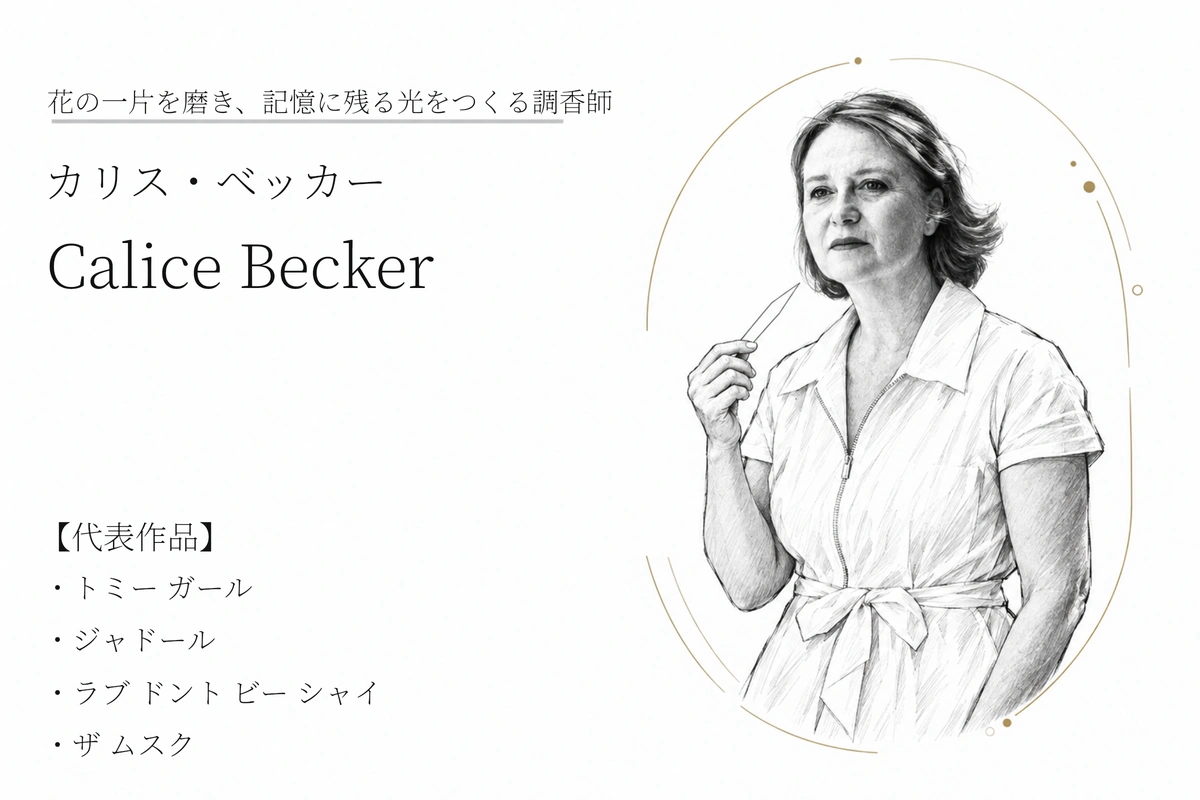
Vent Vert’s formula has subsequently undergone repeated revisions, partly because some formerly used bases became unavailable. The 1991 version is attributed to Calice Becker, and the 1999 revision to Nathalie Feisthauer. Although the fragrance has changed through different periods, the original’s bold presentation of plant greenness remains a major reference point for green scents.
Fracas: Making Tuberose Unforgettable
Fracas (1948) is a tuberose perfume created for Robert Piguet. Its name carries meanings such as noise, a loud crash and an uproar. Rather than quietly offering a delicate flower, it has the presence of white flowers changing the atmosphere around them.
Cellier is said to have dedicated it to actress Edwige Feuillère, also known for her daring appearance in the 1935 film Lucrezia Borgia.
Tuberose is not simply a sweet, splendid flower. Milky roundness, greenness and a density suggesting ripe fruit or human skin coexist within it. Fracas expanded that complexity with scents including orange blossom, jasmine, iris and violet leaf.
Chandler Burr’s account describes materials such as Indian tuberose, Tunisian orange blossom, French jasmine and Italian iris, alongside animalic elements suggesting civet and the role of synthetic ingredients creating a milky-white texture.
Auparfum’s perfume history also draws attention to the bold use of lactones such as peach-like C-14 and coconut-like C-18. Rather than building flowers solely from flowers, textures recalling fruit, milk and skin deepen their presence.
In creating a tuberose perfume for his own brand, Frédéric Malle expressed Fracas’s enormous influence this way.
Everyone who makes a tuberose perfume is trying to imitate the classic, Fracas.
Frédéric Malle, Women’s Wear Daily, September 30, 2005, reproduced by Now Smell This in 2006 (translated from the Japanese translation)
This does not, of course, mean that every later tuberose perfume smells the same. It expresses how large Fracas loomed: any new creation had to confront it first.
Burr awarded Fracas five stars in The New York Times, praising its character, persistence on skin and diffusion around the wearer. Names including Madonna, Sofia Coppola and Isabella Blow also appear as wearers in perfume-history articles. This is a fragrance whose scent alone can conjure an image of the person wearing it.
Its sales and formula history have not been continuous. In 1999, Fashion Fragrances & Cosmetics, then the owner of Piguet’s perfumes, released reconstructed versions of Fracas and Bandit. Burr’s 2008 article introduced Aurélien Guichard as the perfumer responsible for the new version. Cellier’s work also lives on through the efforts of later perfumers to carry it forward.
Jolie Madame and Balmain’s Image of a Woman
Jolie Madame appeared from Balmain in 1953. Although it has a leather-chypre outline related to Bandit, violet gives it a softer, more dressed and composed expression.
Behind the leather lies a violet texture brought by ionone materials. There is also a depth faintly recalling tobacco, in a composition where flowers and leather enhance each other. Victoria Frolova of Bois de Jasmin describes it as suggesting Bandit’s charming younger sister.
Pierre Balmain’s own words also convey that image of a woman.
A scent of adventure, for nights of passion and enchantment.
Pierre Balmain on Jolie Madame, recorded in La Voix du Parfum (translated from the Japanese translation)
Cellier’s relationship with Balmain was not limited to this one fragrance. Élysées 64-83 (1946), named after the house’s telephone number, is known as an early work with a fur-like texture. Eau de verveine citronnelle (1951), a refreshing creation using verbena boldly, led to Monsieur Balmain in 1964.
Then, in 1967, came Miss Balmain. Over many years, Cellier continued to make fragrances with different expressions for a single house: leather, green leaves, herbs and flowers.
Nina Ricci’s first perfume, Cœur Joie (1946), was also her work. Its crystal bottle was created by René Lalique’s son Marc Lalique. In Balenciaga’s La Fuite des Heures (1949), she combined herbs and jasmine. Bold leather and tuberose alone cannot measure the breadth of her work.
Another Life Among Artists
Cellier’s life also contained rich connections beyond the laboratory. She mixed with writer Jean Cocteau, actor François Périer and actress Maria Casarès, among others, and modeled for painter André Derain.
Actress Yolande Laffon and her husband Pierre Brisson, a director of Le Figaro, were also in her circle. She was close to painter and journalist Jean Oberlé, through whom she met Christian Boussus, with whom she would later share many years.
Boussus was a French left-handed tennis player active in the 1920s and 1930s, and was also named to France’s Davis Cup team. He and Cellier never married but are said to have lived together for about thirty years. In 1955, they moved to 8 rue du Boccador in Paris.
She dressed elegantly: Balmain suits, furs, large rings and hats by her friend Rose Valois. At the same time, she smoked Gauloises, drank Johnnie Walker and used slang in conversation. Refined appearance coexisted with fearless language.
Packaging designer Pierre Dinand remembers Cellier this way.
She was elegant and formidable, like Chanel.
Pierre Dinand, in a comment under his own name on a Bois de Jasmin article, March 8, 2013 (translated from the Japanese translation)
She read the satirical newspaper Le Canard enchaîné and listened to Europe 1 radio. She loved dogs and strolled through the market in Neuilly. Her long-haired dachshunds were named Cléopâtre, Félix and Valentin, and she is also said to have kept a parrot. At the market, her imposing presence earned her an affectionate, lady-like nickname.
On holiday she went to Pyla, enjoying cards, pétanque and miniature golf. Accounts also describe her seeking out things friends wanted and giving generously. Her life had far too much color to paint her portrait solely in harsh words and clashes with colleagues.
Free Speech and the Fragrances Left Behind
Cellier died of pulmonary edema at Beaujon Hospital in Clichy on June 12, 1976. She was 67. She is buried with her parents in Pau.
She cannot be called history’s first woman perfumer. Yet she was certainly an important pioneer whose work and name both became widely known in a predominantly male industry.
Perfumer Jeannine Mongin expressed Cellier’s freedom in these words.
Her private life was free, which was unusual at the time. And her thinking was free, which was even more unusual.
Jeannine Mongin, in a record of a lecture at the Osmothèque, quoted by La Voix du Parfum (translated from the Japanese translation)
Her life was also portrayed in the 2023 graphic novel Germaine Cellier: The Audacity of a Perfumer (Germaine Cellier – L’audace d’une parfumeuse), written by Béatrice Égémar and illustrated by Sandrine Revel. Later initiatives in the fragrance world also seek to carry her presence forward, including Sainte Cellier, the perfume shop bearing her name.
Bandit’s leather, Vent Vert’s greenery and Fracas’s white flowers: entirely different materials, yet a shared refusal to make fragrance small. The freedom Cellier left behind exists not only in biography. Smelling her work, we can still encounter its strong contours today.
Fragrance Creations
Creation names are given in their original language on first appearance. Years generally refer to the original release; reissues and reformulated versions are distinguished in the notes.
| Year | Brand | Creation | Notes |
|---|---|---|---|
| 1943 | Colgate-Palmolive | Soap fragrances (names unknown) | Created during her approximately three-month stay. Individual product names are unknown. |
| 1944 | Robert Piguet | Bandit | A leather chypre emphasizing the leather character of isobutyl quinoline. |
| 1945 | Robert Piguet | Visa | Some sources give the original release year as 1946 or 1947. Distinct from later reformulated versions. |
| 1946 | Pierre Balmain | Élysées 64-83 | Named after the house’s telephone number. |
| 1946 | Nina Ricci | Cœur Joie | The brand’s first perfume. Bottle by Marc Lalique. |
| 1947 | Pierre Balmain | Vent Vert | A pioneering green fragrance using galbanum boldly. |
| 1948 | Robert Piguet | Fracas | A signature creation with tuberose as its theme. |
| 1949 | Balenciaga | La Fuite des Heures | A composition combining herbs and jasmine. |
| 1951 | Pierre Balmain | Eau de verveine citronnelle | Used a high proportion of verbena and led to the later Monsieur Balmain. |
| 1952 | Nina Ricci | Fille d’Ève | Some sources credit Cellier, while others attribute it to Jacques Bercia and Michel Hy. |
| 1953 | Pierre Balmain | Jolie Madame | A leather chypre layering the expressions of violet and leather. |
| Said to date from the 1950s | Hermès | Eau d’Herbes | Listed in perfume-history sources. Release year and details are unknown. |
| Said to date from the 1950s–1960s | Elizabeth Arden | Multiple creations (names unknown) | Work for the American market is reported. |
| 1963 | Robert Piguet | Cravache | A woody fragrance for men. Distinct from later reformulated versions. |
| 1964 | Pierre Balmain | Monsieur Balmain | A men’s fragrance with the freshness of citrus and herbs. |
| 1967 | Pierre Balmain | Miss Balmain | A major late-career creation. |
References
- Auparfum: Histoire de parfumeurs : Germaine Cellier, parfumeuse fougueuse — Jessica Mignot and Olivier R. P. David, 2022. A biography based on public records, Osmothèque writings and contemporary newspapers, among other sources.
- La Voix du Parfum: Germaine Cellier… une star du parfum en toute liberté — Her niece’s recollections, Mongin’s portrait, and remarks about Bandit and Jolie Madame.
- La Gardenia nell’Occhiello: The Masters of Perfume: Germaine Cellier — Part 1, Part 2, Part 3 — Ermano Picco, 2017.
- Cafleurebon: Germaine Cellier and Jean Carles Fragrance War at Roure — Her relationship with Jean Carles and a comparison of their styles.
- Bois de Jasmin: Germaine Cellier : Perfumer, Femme Fatale and Bandit — Victoria Frolova, 2005. Includes a comment under Pierre Dinand’s name.
- Perfume Shrine: Germaine Cellier (1909–1976): Innovator and Iconoclast — Elena Vosnaki, 2009.
- Perfume Projects: Germaine Cellier — A perfumer profile referring to Guy Robert’s writings and other sources.
- Perfume Projects: “Nina” and Robert Ricci — Cœur Joie and Marc Lalique.
- Now Smell This: Robert Piguet Fracas — an appreciation — Robin, 2006. Reproduces Frédéric Malle’s 2005 statement.
- Wikipedia: Germaine Cellier — Birth and death dates, list of creations and the 1999 relaunch.
- Wikipedia: Fracas — Bibliographic information including Chandler Burr’s 2008 review.
- Kafkaesque: Robert Piguet Bandit — Beautiful but Brutal — 2013. Reception of Bandit and its creation legend.
- Perfume Shrine: Outlaws and Brigands — Bandit by Piguet — 2008.
- Bois de Jasmin: Balmain Jolie Madame — 2006.
- Fragrantica: Vent Vert — Information on the 1991 version.
- Auparfum: Piguet réédite Visa et Cravache — 2007. Introductions to the originals and reissued versions.
- Cafleurebon: Pierre Balmain Élysées 64-83 — 2018. Refers to Pierre Balmain’s autobiography.
- Cafleurebon: Vintage Nina Ricci Fille d’Ève — 2021. A source with a different perfumer attribution.
- Now Smell This: Nina Ricci Fille d’Ève — 2011.
- Cafleurebon: Miss Balmain — The Scent of Sedition — Discussion of a late-career work.
- Into The Gloss: History Lesson — The Scent of Fracas — Fracas’s background and influence.
- db4tennis: Christian Boussus — His tennis career and life with Cellier.
- Wikipedia: Yolande Laffon — Name spelling and a short biography.
- Nathan: Germaine Cellier — L’audace d’une parfumeuse — The publisher’s introduction to the book.
- Sainte Cellier: Raison d’être — The origin of the shop’s name and its respect for creativity.