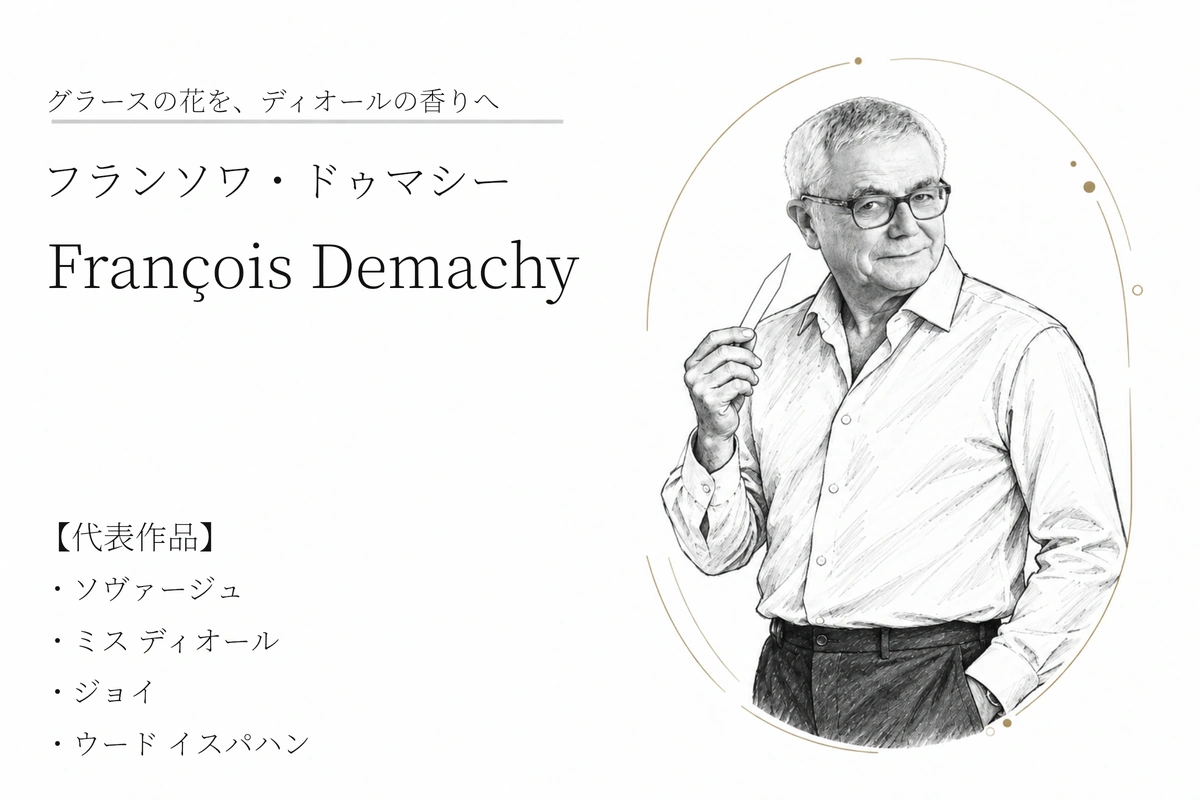
“Fragrance is time and space. It takes us back to a time or place where we once were. People have that emotional connection with scent. What makes our work interesting is being able to touch people’s lives. That has tremendous power.”
Harry Frémont, from an interview with The Fragrance Foundation, 2017
From Cannes in the south of France. His year of birth has not been made public.
A perfume someone wore as a student. A scent a mother loved to wear. Harry Frémont’s work is deeply intertwined with such everyday memories.
CK One, Romance, Grey Vetiver: behind creations loved across genders and generations was a perfumer seeking not only glamour but also a scent that would remain comfortable on the skin.
It all began with flowers in a garden in southern France. A boy who dreamed of becoming a gardener became a perfumer, worked with numerous brands in New York, and eventually returned to the garden. Love of nature runs throughout Frémont’s life.
- A Career in Perfumery
- Major Creations and Their Background
- New West for Him: An Early Work Anticipating Aquatic Scents
- CK One: Sensuality on the Skin beneath Freshness
- Romance: A Mother’s Memory and the Fragrance of Someone’s Youth
- Tuscan Leather: An Attachment to Leather Dating Back to the Beginning
- Grey Vetiver: When He Could Use Enough of the Material He Wanted
- Modern Muse: Two Ways In, Flowers and Woods
- Mon Paris: The Exhilaration of Love through Collaboration
- Returning to the Garden
- Incidentally…
- Perfume Creations
- References
A Career in Perfumery
A Garden in Cannes and a Father Who Created with His Hands
Frémont grew up in Cannes in the south of France. Wildflowers and garden plants were close at hand from early childhood. By around five, he was absorbed in gardening, discovering the pleasure of understanding nature as he watched flowers and trees grow.
His father was skilled with his hands, painting, making sculptures, and even building a house. Watching this taught him that working with one’s hands and applying oneself with enthusiasm can create beautiful things.
In 2017, when The Fragrance Foundation interviewed him in his New York office, watercolors of Cannes and the Riviera painted by his then 93-year-old father hung there. Even far from home, his father’s work and the landscapes of southern France remained close by.
He originally hoped to work in landscape design. But after failing the entrance examination for a school training engineers in horticulture and landscaping, he studied biology at the Université de Nice. At the time, he wanted to remain in southern France and was looking for work available there.
He discovered the perfume world through a neighbor of his parents. This person, involved in the fragrance industry, introduced him to an acquaintance in Grasse, through whom he learned of ISIPCA, the school of perfume, cosmetics, and flavorings in Versailles. His biology studies allowed him to enter directly into the second year, although he says he knew almost nothing about perfume when he enrolled.
The Scent of Lilac Turns a Profession into a Passion
A decisive moment came in a class taught by Monique Schlienger. Also the founder of the fragrance education institution Cinquième Sens, she gave him an assignment to recreate the scent of lilac.
Frémont combined the materials he had been given, making small trials. Then, while comparing them on smelling strips, something happened.
“One of them suddenly smelled exactly like my memory of the lilac that bloomed in my garden every spring. That settled it. I had found a new profession and a new passion.”
Harry Frémont, from an interview with Fragroom, 2023
Mixing ingredients had become an act of recalling a childhood landscape. Here, too, we can see the origin of his opening words about the connection between scent and memory.
At the same school, he met Sylvie, who would become his wife. Learning about perfume and meeting the person with whom he would share his life began in the same place.
He graduated from ISIPCA in 1981. In 1982, he joined the Paris office of Haarmann & Reimer, a fragrance company that would become part of today’s Symrise. His first job was as an assistant compounding another perfumer’s formulas.
He did not leave school and immediately learn creation as the apprentice of a famous perfumer. According to Frémont, after graduation he had neither a particular mentor nor a long-term training program, developing his abilities alongside practical work.
In his spare time, he pursued his own creations, learning the structures of successful perfumes through gas chromatography analysis. He smelled widely among department-store perfumes, investigating what kinds of composition drew people in.
These efforts led to consecutive wins in a competition for young perfumers. In his 2023 interview, he recalled winning the Société Française des Parfumeurs competition in 1983 and 1984. Some biographical accounts, however, give 1984 and 1985, so the records differ on the award years.
In 1985, after four months of training in Germany, the company formally gave him the title of perfumer. Although he spent a long time learning independently, he was not self-taught in the sense of having received no education or training.
From Geneva to New York
The first perfume Frémont sent out into the world appears not to have been a major release for a famous brand. What he remembers is a men’s perfume made for a little-known client during his Haarmann & Reimer years.
In an unusual black bottle, it was woody, with a smoky leather character. Even though he could not remember its name, he remembered using good-quality materials. His interest in leather scents, later explored at Tom Ford, seems already to have been present then.
In 1987, he joined Firmenich and began working in Geneva. Then, in 1990, he moved to New York with his wife and three daughters. Their names, Lauren, Joy, and Estée, also came from commercially available perfumes.
That year, Firmenich opened its Creative Center in Manhattan. As the first resident perfumer responsible for fine fragrance at the New York office, Frémont began working directly with American clients.
In Geneva, he had been somewhat sheltered from direct dealings with clients. In New York, however, creating a good smell was not enough to do the job. He needed to listen to what clients wanted and explain his own proposals in words.
A turning point came when Patrick Firmenich told him he was too stubborn. Frémont replied that he had convictions, but later reconsidered.
“I realized that to win more projects, I had to listen more closely to clients. There is a fine line between having convictions and simply being stubborn. It was a decisive moment.”
Harry Frémont, from an interview with The Fragrance Foundation, 2017
After this experience, he became more receptive to others’ views, adjusting his work to the specific wishes of clients and consumers. Rather than an unyielding attitude, the ability to translate what he heard into scent broadened his work.
Initially, Firmenich was a newcomer in the American market. Even so, results began to appear around 1992–1993. Work for Calvin Klein, Ralph Lauren, Estée Lauder, and other brands gradually strengthened the New York office’s presence.
Frémont, too, came to work across many fields: not only luxury department-store perfumes, but fashion brands, specialty retailers, mass-market products, celebrity fragrances, and niche. Behind this was a desire to understand distribution, packaging, marketing, and consumers’ lives as well as the fragrance itself.
Shaping Scent like Clay
Frémont sees creation as closer to sculpture than to music or painting. In 2011, he said the following about his work with the jewelry brand David Yurman.
“For me, it is closer to sculpting with clay. I always imagine a fragrance in space. First I make a basic olfactory shape, then add materials here and there.”
Harry Frémont, from an interview with ÇaFleureBon, 2011
David Yurman himself had originally worked in sculpture. Frémont says this common ground gave him a greater connection than he felt when working with certain fashion designers, making the process enjoyable and productive.
Rather than seeing a scent simply as a list of materials, he sees it as a shape spreading through space. He adds ingredients, adjusting the outline and balance. This approach also has something in common with combining plants in a garden.
Yet it is not enough simply for that shape to expand greatly. Frémont has repeatedly questioned the tendency to judge a perfume’s strength in place of its quality.
“I have always opposed perfumes that are too strong, almost aggressive, and overwhelm their surroundings. Unfortunately, for many people, strength means quality and is valued more than the character of the scent itself. Strength works against beauty. That is the difficulty in making perfume.”
Harry Frémont, from an interview with Fragroom, 2023
Rather than a rule applying to all perfumes, this is an aesthetic Frémont has valued. His goal was a scent with personality and persistence that would not burden either the wearer or those nearby.
Materials were important in achieving that. Rather than approving only of natural ingredients, he valued both naturals obtained through new extraction techniques and synthetic materials such as musks and woody notes. Being able to use a rich palette of ingredients sufficiently was essential.
He also questions how little of the budget goes to the scent itself compared with advertising and the bottle. This does not mean expensive materials necessarily make a great perfume. His view was that creativity, together with a budget that allows the materials to be used well, expands the possibilities of what can be created.
Major Creations and Their Background
New West for Him: An Early Work Anticipating Aquatic Scents
Aramis’ New West for Him, released in 1988, is a major men’s fragrance from Frémont’s early career.
It is an aromatic scent, layering marine notes with the cool freshness of mint, bergamot, lavender, and other materials. It expressed freshness from a different direction than powerful, dense men’s fragrances.
Michael Edwards, known for fragrance classification, also presents it as a work that opened up a lineage of watery scents. It is regarded as a pioneering perfume in considering the aquatic fragrances that later became widespread.
The fragrance Frémont himself describes as his first creation, however, is the men’s perfume from his Haarmann & Reimer years discussed above. New West for Him is perhaps best understood as an important early work through which his presence became known.
CK One: Sensuality on the Skin beneath Freshness
CK One, from 1994, was co-created with Alberto Morillas. The concept of a fragrance that men and women could use without distinction emerged from Calvin Klein’s planning, which examined the lifestyles and values of young people at the time.
In response to a brief received in 1993, Morillas’ formula became the starting point. Ann Gottlieb, leading the fragrance development, also participated, and Frémont joined the team refining the final form, bringing a new perspective. Development took around eight months.
The difficult part was handling citrus. The citrus freshness now readily accepted could, in America at the time, risk suggesting household cleaning products.
“In America, people were afraid of citrus because they associated it with things like dishwashing detergent. [Passage omitted] What mattered was making citrus sophisticated.”
Harry Frémont, from an interview with Global Cosmetic Industry, 2010
Not too much like sweet candy, yet not like detergent either: seeking that balance, they layered a green-tea impression over citrus to create a transparent fragrance.
Frémont sees the reason for its enduring popularity in the combination of freshness and lasting power on the skin. Woods, musk, and a very small amount of vanilla hide sensuality beneath its light surface. Without pushing itself forward forcefully, the scent remains around the wearer.
CK One reportedly recorded sales of more than $5 million in the first ten days after launch. Annual sales are said to have been approximately $90 million in the mid-1990s and, even in 2007, approximately $30 million a year in the United States, making it a major success.
In 2024, CK One Essence also appeared for the thirtieth anniversary. Although a separate, later development, it shows the original fragrance connecting with subsequent generations.
Romance: A Mother’s Memory and the Fragrance of Someone’s Youth
Ralph Lauren’s Romance launched in 1998. For Frémont, it was a creation in his sixteenth year of work.
He had admired the world of Ralph Lauren since arriving in New York. For him, he says, the brand represented the dream of a prosperous life in America.
Romance is a multilayered scent that can seem fruity, chypre, or floral, depending on who encounters it. Frémont says he was not consciously aware of every aspect while making it. Several elements working simultaneously created a character that did not fit neatly into a single category.
By then, his confidence in his technical abilities had also grown. He describes it as a time when he could handle difficult challenges better than before, while retaining an unaffected, fresh sensibility.
Yet what made this fragrance special was not only an achievement in composition.
“Years later, many women told me they wore this perfume in high school or college, and that it mattered to how they wanted to be seen at the time. My mother wore it too, and whenever I smelled it, I remembered her. Thinking of those stories, smelling it in the street, and its success, what could be more special?”
Harry Frémont, from an interview with Fragroom, 2023
For its perfumer, it became a memory of his mother; for its wearers, a link to their younger selves. Romance is also a direct expression of the connection between fragrance and life described at the beginning.
Tuscan Leather: An Attachment to Leather Dating Back to the Beginning
Tuscan Leather appeared in Tom Ford’s Private Blend collection in 2007. It was co-created with Jacques Cavallier Belletrud.
Frémont’s fondness for leather fragrances also emerges in his memory of his first men’s perfume. Here, a leather impression is layered with smoky elements and balsamic warmth, becoming a scent with a dense presence.
The perfume criticism site Bois de Jasmin describes its development as revealing the overall picture relatively quickly, then retaining a leather-centered character. It might also be understood as a work that gives a strongly outlined sense of what Frémont calls a shape in space.
Grey Vetiver: When He Could Use Enough of the Material He Wanted
Tom Ford’s Grey Vetiver Eau de Parfum, launched in 2009, is a creation Frémont cites as particularly fulfilling. Although from the same brand as Tuscan Leather, it is not part of Private Blend.
At its heart is a long-standing attachment to vetiver.
“I have long been strongly drawn to vetiver. The roots are what is extracted. When you smell it, you feel the earth. It is also like the smell of fire. It is one of those primordial things imprinted in people’s minds.”
Harry Frémont, from an interview with Global Cosmetic Industry, 2010
The impetus was a brief from Karyn Khoury, who oversaw fragrance development at Estée Lauder. Frémont says he had previously proposed perfumes starring high-quality vetiver, but the cost of the material often stood in the way.
What he wanted to use was Firmenich’s carbon-dioxide-extracted vetiver. He valued its purity and depth as close to his ideal. Unlike the earthiness he perceived in conventional extracts, he thought it could express the vetiver he had imagined.
Using the required amount raised the ingredient budget. But after he explained the situation, Khoury approved its use. Vetiver was thus combined with high-quality clary sage and a proprietary Firmenich woody ingredient, forming a fragrance that brought out the materials’ personalities.
The existence of a new ingredient alone does not make a creation. A relationship with a client who understood its virtues and supported using enough of it was also necessary.
In 2010, Grey Vetiver won Perfume Extraordinaire of the Year at the FiFi Awards. It was an occasion when the idea of using materials’ potential to create distinctive, wearable fragrance was recognized in a finished work.
Incidentally, Frémont had previously participated in the competition to develop the same brand’s Black Orchid. However, he clearly states that their proposal lost to Givaudan; this does not mean he created the Black Orchid that was released.
Modern Muse: Two Ways In, Flowers and Woods
Estée Lauder’s Modern Muse launched in 2013. The brand presented a concept of a dual impression.
One way in is a fresh floral centered on jasmine; the other is a calmer side of woods and musk. It was introduced as a fragrance in which different people might initially be drawn to different parts.
The combination of jasmine sambac and patchouli links bright flowers with deep woodiness. The brand explained that the creative aim was to give it two impressions rather than have them converge into one.
Articles at launch presented it as Frémont’s creation. Some perfume databases, however, also list Olivier Cresp as a co-perfumer.
Mon Paris: The Exhilaration of Love through Collaboration
Yves Saint Laurent’s Mon Paris, from 2016, was co-created by three perfumers: Frémont, Cresp, and Dora Baghriche.
Bright fruit suggesting strawberry and raspberry is layered with a floral impression inspired by datura and elements of white flowers, supported by patchouli and white musk. It was presented as a white chypre linking fruity lightness with a chypre-like structure.
Even toward the end of a long career, Frémont continued collaborating with perfumers of different generations and experience rather than retreating into solitary creation. His experience of bringing a fresh perspective to CK One remained connected with his way of working afterward.
Returning to the Garden
In 2017, The Fragrance Foundation presented Frémont with its Perfumer of the Year Lifetime Achievement Award, honoring his many years of achievement as a perfumer.
The award recognized work that, from the days when the New York office was still small, built relationships with clients and created scents across many price points and markets. His approach involved not simply leaving behind numerous creations but considering how fragrance reaches people.
Earlier, Vera Wang Eau de Parfum in 2003, Kenneth Cole Black for Men in 2004, and Juicy Couture Eau de Parfum in 2007 had also been recognized at the FiFi Awards. Including collaborative work, he achieved results in women’s and men’s fragrances and across different brand worlds.
Then, in 2018, he left Firmenich and retired.
He had not lost his passion for making perfume. Yet, he says, as the way work was organized changed and numerous projects and flankers progressed simultaneously, the creative process became less fulfilling. After 28 years in New York, a new chapter living with his family in California awaited.
In his 2023 interview, the pleasure he describes in retirement is gardening. Northern California’s Mediterranean climate, he says, feels like reliving his childhood in Cannes. He grows roses and vegetables and waits for wildflower seeds sown before the rain to bloom in spring.
Asked whether perfumery resembles gardening, Frémont answered yes without hesitation.
“Both require patience. And you need a vision of what you want to create. You must choose plants with the right colors to combine, ensuring one does not overwhelm another. Color and scent are remarkably alike. If you combine them well, you can truly express emotions.”
Harry Frémont, from an interview with Fragroom, 2023
In a garden, there is no client to express wishes in words. Even so, he reads the signs from soil and plants, observes, and decides what is needed. In understanding another living thing and intervening appropriately, the work is continuous with perfumery.
From recreating lilac as a student to working with major New York brands and tending a California garden, Frémont has passed on what he received from nature in another form. Beyond glittering success, the goal of his fragrances, too, was everyday comfort.
“My foremost goal is to use good-quality ingredients to create bright, optimistic fragrances that men and women will enjoy wearing. I want to make perfumes that make wearers feel comfortable with themselves, and that people around them can enjoy too.”
Harry Frémont, from an interview with The Fragrance Foundation, 2017
Incidentally…
- He says he does not always wear perfume in retirement. In 2023, he said he generally enjoyed fresh air and occasionally wore creations of his own such as Ralph Lauren Purple Label, from 2003.
- When traveling, he has also worn Calvin Klein’s Eternity for Men and Giorgio Armani’s Acqua di Giò, from 1996. These are mentioned as favorites he wears, not as his own creations.
- Among his favorite artists, he names Georgia O’Keeffe, known for paintings of flowers.
- A 2009 profile names Jean Couturier’s Coriandre as a favorite perfume, and Morillas and Edmond Roudnitska as perfumers he admires.
- Among flowers, he has an affinity for mimosa, Bulgarian rose, jasmine sambac, and broom. His Instagram posts showing his garden were also one of the things that led to the 2023 interview.
Perfume Creations
Major works are listed by launch year. Names, launch timing, and co-perfumer credits may differ between brands and publications. “─” means that no co-perfumer is listed.
| Year | Brand | Fragrance | Co-perfumers |
|---|---|---|---|
| 1988 | Aramis | New West for Him | ─ |
| 1989 | Gabriela Sabatini | Gabriela Sabatini | ─ |
| 1994 | Calvin Klein | CK One | Alberto Morillas |
| 1994 | Ralph Lauren | Polo Sport | ─ |
| 1994 | Halston | Catalyst for Men | Ilias Ermenidis |
| 1998 | Ralph Lauren | Romance | ─ |
| 1998 | Lancôme | Ô oui! | ─ |
| 1999 | Tommy Hilfiger | Freedom for Him | ─ |
| 1999 | Valentino | Very Valentino for Men | ─ |
| 2000 | Lancôme | Miracle | Alberto Morillas |
| 2000 | Lucky Brand | Lucky You for Women | ─ |
| 2001 | Liz Claiborne | Mambo for Women | ─ |
| 2001 | Michael Kors | Michael for Men | ─ |
| 2001 | Ralph Lauren | Glamorous | ─ |
| 2002 | Vera Wang | Vera Wang Eau de Parfum | Jean-Claude Delville |
| 2002 | Giorgio Armani | Sensi | Alberto Morillas |
| 2002 | Victoria’s Secret | Body by Victoria | ─ |
| 2003 | Kenneth Cole | Black for Men | Sabine de Tscharner |
| 2003 | Liz Claiborne | Spark for Men | ─ |
| 2003 | Ralph Lauren | Purple Label | ─ |
| 2004 | Calvin Klein | Eternity Moment | Jacques Cavallier Belletrud |
| 2004 | Victoria’s Secret | Basic Instinct | ─ |
| 2005 | Avon | Extraordinary | ─ |
| 2005 | Tommy Bahama | Tommy Bahama for Men | ─ |
| 2005 | Gant | Adventure | ─ |
| 2006 | Juicy Couture | Juicy Couture Eau de Parfum | ─ |
| 2006 | Vera Wang | Princess | Ilias Ermenidis |
| 2006 | Banana Republic | Black Walnut for Men | ─ |
| 2006 | Bath & Body Works | Japanese Cherry Blossom | ─ |
| 2007 | Tom Ford | Noir de Noir | Jacques Cavallier Belletrud; Olivier Cresp is also sometimes listed |
| 2007 | Tom Ford | Tuscan Leather | Jacques Cavallier Belletrud |
| 2007 | Calvin Klein | Calvin Klein Man | Jacques Cavallier Belletrud; Ann Gottlieb also participated in development |
| 2007 | Gwen Stefani | L by L.A.M.B. | ─ |
| 2007 | Ann Taylor | Possibilities | ─ |
| 2007 | Ralph Lauren | Polo Explorer | Honorine Blanc |
| 2008 | David Yurman | David Yurman Eau de Parfum | ─ |
| 2008 | Diesel | Fuel for Life Unlimited | Olivier Cresp, Jacques Cavallier Belletrud |
| 2008 | Gwen Stefani | Harajuku Lovers Baby | ─ |
| 2009 | 50 Cent | Power | ─ |
| 2009 | Tom Ford | Grey Vetiver Eau de Parfum | ─ |
| 2009 | Tom Ford | White Suede | ─ |
| 2009 | Bath & Body Works | Twilight Woods | Honorine Blanc, Jane Konnyu |
| 2009 | Jennifer Lopez | My Glow | ─ |
| 2009 | Banana Republic | Republic of Women | ─ |
| 2009 | Donna Karan | DKNY Men | Alberto Morillas |
| 2009 | Usher | VIP | ─ |
| 2009 | Lancôme | Miracle Tendre Voyage | Alberto Morillas |
| 2010 | Britney Spears | Radiance | Honorine Blanc |
| 2010 | Celine Dion | Pure Brilliance | ─ |
| 2011 | Britney Spears | Cosmic Radiance | Honorine Blanc |
| 2011 | David Yurman | Delicate Essence | ─ |
| 2011 | David Yurman | Exotic Essence | ─ |
| 2011 | David Yurman | Fresh Essence | ─ |
| 2012 | Rihanna | Nude | ─ |
| 2012 | Estée Lauder | Bronze Goddess Capri | ─ |
| 2012 | Vince Camuto | Vince Camuto for Men | ─ |
| 2012 | Nautica | Aqua Rush | ─ |
| 2013 | Estée Lauder | Modern Muse | Some sources describe a co-creation with Olivier Cresp |
| 2013 | Michael Kors | Sexy Amber | ─ |
| 2013 | Michael Kors | Glam Jasmine | ─ |
| 2013 | Marc Jacobs | Daisy Sunshine | ─ |
| 2013 | Clean | First Blush | ─ |
| 2013 | Clean | White Woods | ─ |
| 2014 | Michael Kors | Michael Kors for Men (2014 version) | ─ |
| 2015 | Eric Buterbaugh | Velvet Lavender | ─ |
| 2015 | Pinrose | Secret Genius | ─ |
| 2016 | Yves Saint Laurent | Mon Paris Eau de Parfum | Olivier Cresp, Dora Baghriche |
| 2016 | Avon | Prima | Frank Voelkl |
| 2016 | Ralph Lauren | Portrait of New York – Vetiver | ─ |
| 2016 | Ralph Lauren | Portrait of New York – White Lily | ─ |
| 2016 | Kenneth Cole | Black Bold | ─ |
| 2017 | Calvin Klein | CK All | Alberto Morillas |
| 2017 | Avon | Viva La Vita | ─ |
| 2018 | Oscar de la Renta | Bella Blanca | ─ |
| 2019 | Oscar de la Renta | Bella Rosa | ─ |
Lucky You is also sometimes listed under Liz Claiborne. The years in the catalogue are launch years, not necessarily years of creation. Bella Rosa, released after his retirement in 2018, is also credited to Frémont.
References
- The Fragrance Foundation — Lifetime Achievement Perfumer: Harry Frémont(2017)
- Fragroom — Harry Frémont Interview: Master At Work(2023)
- S-Perfume — Harry Fremont(HAF)
- Cinquième Sens — Fragrance education institution, official website
- CaFleureBon — Behind the Bottle: Harry Fremont on David Yurman The Essence Collection(2011)
- CaFleureBon — Profiles in American Perfumery: Master Perfumer Harry Fremont of Firmenich(2014)
- Global Cosmetic Industry — Quality: Key to Connecting with Fragrance Consumers(2010)
- Global Cosmetic Industry — From the Note a Symphony is Born(2010)
- Global Cosmetic Industry — Universal Scent Appeal
- Perfume Shrine — Questions & Answers with perfumer Harry Fremont of Firmenich(2009)
- Perfumer & Flavorist — Harry Fremont Receives 2017 Lifetime Achievement Award
- The Fragrance Foundation — Perfume Extraordinaire of the Year: Award records
- Wikipedia — CK One
- Bois de Jasmin — Tom Ford Private Blend Tuscan Leather: Fragrance Review(2011)
- The Moodie Davitt Report — Estée Lauder seeks fragrant inspiration from new Modern Muse(2013)
- Now Smell This — Estée Lauder Modern Muse: perfume review(2013)
- Fragrantica — Modern Muse: Co-perfumer credits
- Scent Decant — Noir de Noir: Co-perfumer listing
- The Scented Salamander — Calvin Klein Man(2007)
- Now Smell This — Ralph Lauren Polo & Polo Explorer: fragrance reviews(2007)
- Premium Beauty News — Yves Saint Laurent returns with a light, airy take on Mon Paris(2017)
- Fragrantica — Oscar de la Renta Bella Rosa(2019)
- Now Smell This — Harry Fremont: Perfumer profile and fragrance list
- Fragrantica — Harry Fremont: Fragrance list
- Fragrantica — Lucky You for Women: Brand and launch year
- Parfumo — Harry Frémont: Fragrance list