

Students need to understand the reasons why the perfumer may have chosen a particular material.
Patrice Revillard, graduate and perfume-creation teacher (2021)
Composing a perfume formula and bringing that perfume into the world as a product are two different tasks. Between them lie the work of evaluation, manufacturing, quality, costing, packaging, and sales. École Supérieure du Parfum & de la Cosmétique (ESPC) is a private higher education institution in France where students learn how these activities connect.
The school began in Paris in 2011, linking perfume creation with management, and later expanded to Grasse. Today, cosmetics formulation and quality, as well as perfume and cosmetics marketing, are also pillars of its teaching. It is a school not only for aspiring perfumers, but also for people who will evaluate fragrances, develop products, and build brands.
- Basic Information
- The Origins of a School Connecting Creation and Management
- From Understanding Raw Materials to Bringing Products into Being
- Study Routes According to Goals and Previous Education
- Professional Certifications and University Master’s Degrees
- Checking Applications and Costs
- Short Courses and Continuing Education
- Key Milestones
- References
Basic Information
- Official name: École Supérieure du Parfum & de la Cosmétique (abbreviated ESPC)
- Japanese pronunciation guide: エコール・シュペリウール・デュ・パルファン&ドゥ・ラ・コスメティック
- Established: 2011. Formerly named École Supérieure du Parfum (ESP)
- People involved in its founding: Maurice Alhadève, Chantal Artignan, and others. Established with the support of École de Condé
- Institutional status: A private specialist higher education institution within the AD Education network
- Locations: Paris (3–5 rue Cambronne) and Grasse (18 boulevard du Jeu de Ballon)
- Types of education: Long-term professional programs open to general applicants, continuing education for working professionals, and short programs. It is not a training institution exclusively for employees of fragrance companies
- Official website: École Supérieure du Parfum & de la Cosmétique
The Origins of a School Connecting Creation and Management
2011: Bringing Together Experience in the Fragrance Industry and Education
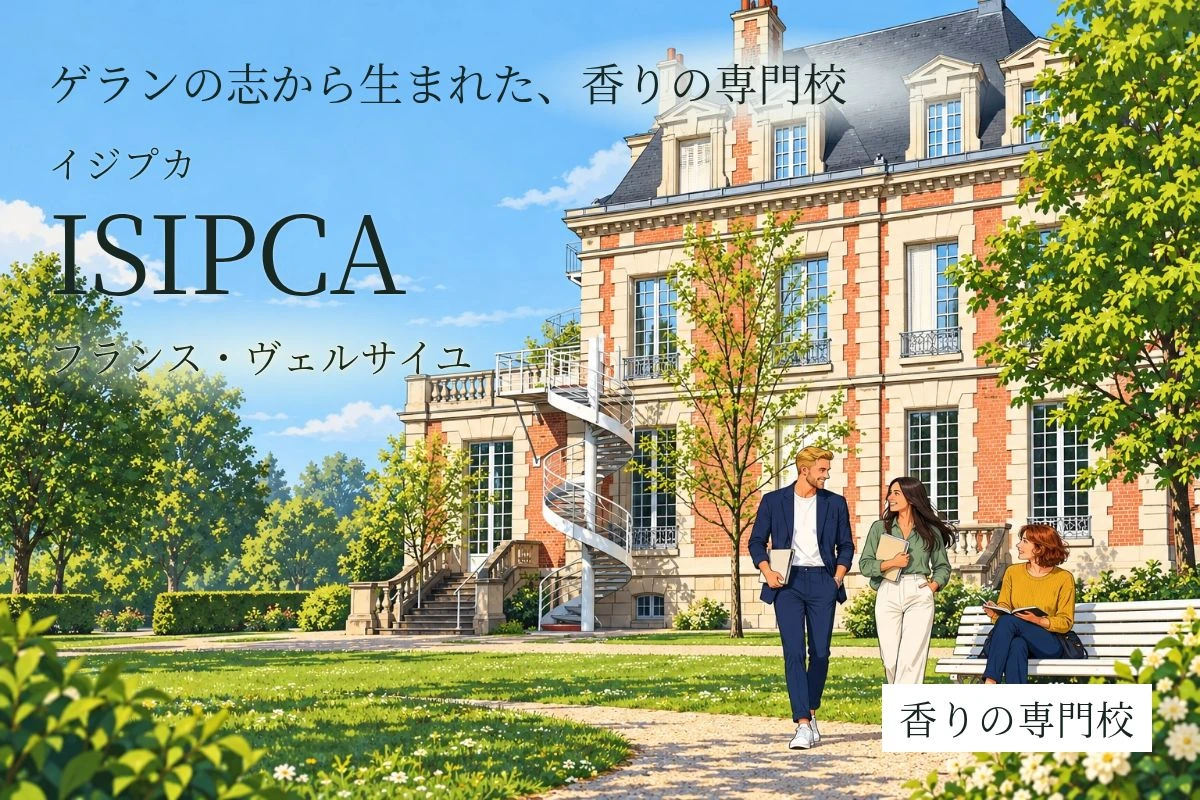
Maurice Alhadève, who took part in founding the school, knew both the educational and business sides of perfumery. Alhadève held management roles in the Unilever Group’s perfume and cosmetics business, and also worked at fragrance-creation companies including IFF, Créations Aromatiques, and Haarmann & Reimer. Later, Alhadève headed ISIPCA (in Japanese) in Versailles. Interparfums’ 2019 annual report introduces Alhadève as ESP’s co-founder and president. The school’s current information identifies Alhadève as chair of the advisory board that discusses educational content with industry representatives.
Another central figure in developing the school’s teaching was Chantal Artignan. After studying biochemistry and biology and working as a researcher in Quebec, Artignan moved to ISIPCA and subsequently joined ESP’s founding team. With experience in understanding fragrance materials through science, Artignan helped build an education that addressed both creation and how products are brought to market. The two founders’ experience at ISIPCA thus informed the new school.
Opening in Paris in 2011 with the support of École de Condé, ESP identified a need for education connecting creation and marketing through conversations with people in the fragrance industry. Its response was the five-year “Création & Management” program, spanning everything from raw materials to a product’s launch.
People who work in fragrance evaluation need to understand what a perfumer is trying to create while also communicating what brands and markets are looking for. In 2021, Artignan described this role as one of the important career paths the school prepared students for. The ability to smell raw materials and the ability to explain a scent to others come together in product development.
Our school must not be only for a social elite.
Chantal Artignan, the school’s director at the time (2021)
These words were spoken in the context of considering private-school fees and access to education. At the time, Artignan discussed plans for grants and arrangements to support students’ activities. Current information includes installment payments and alternance, which combines study with work at a company. Even as such arrangements change, the question of how to turn an interest in creation into an opportunity to learn continues alongside the school’s educational work.
2018: Connecting with Industry in Grasse
The encounter that led to a second campus in Grasse owed much to the efforts of perfumer Fabrice Pellegrin and wife Sandrine. The couple brought the idea for a Grasse campus to the city and helped arrange a meeting in Paris in the summer of 2017. The city and the fragrance-industry association Prodarom also supported its establishment, and the Grasse campus opened on October 1, 2018.
The idea was to create a place for students to learn in a region with industries that grow, extract, and blend fragrance materials. It also meant passing on the work of perfume-making within the region. The current Grasse campus is on boulevard du Jeu de Ballon in the city center and has laboratories for olfactory practice and chemistry. Training the nose to perceive scent and learning analytical and measurement techniques take place on the same campus.
Paris and Grasse are two campuses of the same school. Their program offerings, however, are not identical. While the current five-year perfume program is available at both, the five-year cosmetics program and the two-year English-language perfume program are listed for Paris.
2024: Adding Cosmetics to the Official Name
In April 2024, the school announced its new name, “École Supérieure du Parfum & de la Cosmétique.” In September of that year, it introduced a long-term program in cosmetics formulation and management and a program in perfume and cosmetics marketing.
This was not the first time cosmetics had appeared in the curriculum. Since its foundation, the school had offered practical work in making scented cosmetics, and cosmetics were also part of the FESAPCA program with UVSQ. The new name and programs expanded the cosmetics field within its existing teaching, opening a more specialized route into formulation, quality, production, and business.
From Understanding Raw Materials to Bringing Products into Being
Learning the Structure of Classic Perfumes and Why Materials Are Chosen
Learning to recognize scents is the starting point. Students identify natural and synthetic fragrance materials and create accords, coherent olfactory combinations of several materials. Beyond that, they consider which materials to combine, and how, to achieve the desired scent.
Patrice Revillard, who went on to teach perfume creation after graduating, explained in 2021 that classes studied important classics and considered the structure of fragrances such as Yves Saint Laurent’s Paris. Students learn not only to reconstruct a fragrance, but also about the cost of a formula, IFRA standards, and how to respond when materials can no longer be used. Studying great perfumes is also training in understanding the choices and constraints that gave rise to them.
The current five-year perfume program likewise begins with scientific foundations and olfactory practice before moving on to creation, evaluation, regulations, and product development. In its later stages, students can pursue a direction focused on formulation or one that explores perfume planning and marketing in greater depth. The same knowledge of scent is applied in different settings according to the work students hope to do after graduation.
Connecting Cosmetics Formulation, Quality, and Production
In the Paris cosmetics program, the first year covers fragrance-material identification, accords, and cosmetics formulation, with deeper specialization from the second year. Making creams, gels, and makeup products requires understanding not only scent, but also how ingredients work, their relationship with the skin, stability, safety, and manufacturing conditions.
The school’s practical work addresses both these physicochemical properties and sensory qualities such as texture and scent. In the later stages, students learn product evaluation, quality control, regulations, marketing, and the management of teams and businesses, moving between study and practical work in companies. The questions broaden from how to make a pleasantly scented prototype to how to design a product that can be manufactured consistently.
Learning Between School and the Workplace
Industry is involved not only in providing placements but also in educational content. Companies and industry organizations, including Dior, L’Oréal, IFF, DSM–Firmenich, Takasago, and Givaudan, participate in the school’s advisory board, supporting the development of teaching aligned with professional practice.
The Paris campus information for the five-year perfume program includes a company placement of at least two months at a single company in each of the second and third years, and a placement of at least four months and no more than six months in the fourth year. The fifth year follows an alternance arrangement, usually with one day a week at school and four days at a company, as well as intensive classes. Alternance combines practical work under an employment contract with a company and formal education. Its contractual and funding arrangements differ from those of a placement undertaken while a student pays ordinary tuition fees.
In 2021, students also worked on a project with the packaging school ESEPAC to consider how perfume could be distributed and sampled after the COVID-19 pandemic. The task extended to thinking about how people encounter fragrance.
Study Routes According to Goals and Previous Education
The following is based on official information checked on October 12, 2026. Entry routes into long-term programs differ for people beginning professional perfume studies, those who have already studied perfumery or cosmetics, and those with a university education in science.
Five-Year Perfume and Cosmetics Programs
Création & Management pour l’industrie du Parfum is a five-year perfume program offered in Paris and Grasse. It is taught in French, and first-year entry is open to holders of all types of French baccalauréat, with additional science tuition for those from non-scientific backgrounds. Selection considers academic results, interest in the fragrance industry, olfactory knowledge, career goals, and English proficiency through an application review and interview.
Formulation & Management pour l’industrie cosmétique is a five-year program in Paris, providing an entry route for those wishing to deepen their knowledge of cosmetics formulation, evaluation, quality, and production. As with the perfume program, first-year entry is open to holders of all types of French baccalauréat, combining supplementary science teaching with practical work.
Applications for entry into later years have different prerequisites. For the second and third years of both programs, the stated conditions include Bac+1 and Bac+2, respectively, in chemistry; for the fourth year, they specify Bac+3 or an RNCP Level 6 qualification in perfumery or cosmetics. Which entry route corresponds to a Japanese educational background is determined through the school’s individual assessment.
The English-Language Perfume Program and the Specialized Marketing Program
Paris’s Creation & Management for the Perfume Industry is a two-year program taught entirely in English. It corresponds to the school’s fourth and fifth years, with entry requiring Bac+3 or an RNCP Level 6 qualification in perfumery or cosmetics, together with sufficient English proficiency. It is not a two-year introduction to perfumery for school-leavers. The first year includes a company placement of at least four months, and the second is described as combining study at school with work at a company. International applicants need to confirm the enrollment arrangements and company contracts that apply to them when applying.
Mastère Marketing des parfums & produits cosmétiques is a two-year program for people aiming to work in product or brand planning, marketing, and communication. It combines online classes with intensive learning at school and in the field, with alternance in both years. The usual teaching-week pattern is one day of study and four days at a company, with five weeks of intensive learning each year.
Entry requires Bac+3 or an RNCP Level 6 qualification in business, marketing, or communication. The ability to read, write, and speak English is also a condition. While the 2024 launch announcement and the current fee schedule list Paris and Grasse, the campus field on the current program page shows Paris. It is worth checking with the school where intensive classes take place and in which language, according to the mode of study selected. This program, which incorporates online learning, should not be assumed to have the same conditions as the perfume program taught entirely in English.
FESAPCA: A University Master’s Program After a Science Bachelor’s Degree
FESAPCA is a specialized pathway within Université Paris-Saclay’s national master’s degree in “Chimie et sciences du vivant,” delivered by Université de Versailles Saint-Quentin-en-Yvelines (UVSQ) in partnership with ESPC. ESPC provides professionally oriented education, UVSQ provides scientific teaching, and CFA AD supports apprenticeship learning. There are three options: perfumery, cosmetics, and food flavorings. This university master’s degree is distinct from the school’s own five-year programs.
The two-year program is taught in French, with teaching sites in Versailles and Paris. M1 applicants need 180 ECTS earned in a bachelor’s course such as chemistry, physical chemistry, or biology and chemistry, or a course of study recognized as equivalent. There is a written test in chemistry and general knowledge of the chosen field, followed by an interview on the applicant’s motivation; an alternance contract with a company is also a condition of admission. Université Paris-Saclay’s 2026 admissions information states that applicants must be 29 or younger when the contract is signed. Work and teaching generally alternate in two-month periods, with around five months in a company between M1 and M2.
For M1 entry in the 2026–2027 academic year, the first application period ran from January 15 to February 17, 2026, and the second from February 17 to March 16. Université Paris-Saclay’s M1 information also lists an Inception application period of June 19–25. All of these had ended by the date of checking. The next academic year’s schedule must not be inferred from these dates; applicants need to consult UVSQ’s application and admission requirements.
Professional Certifications and University Master’s Degrees
The five-year perfume and cosmetics programs and the two-year English-language program lead toward the professional certification “Créateur–Manager en parfumerie et cosmétique.” RNCP is France’s register of professional certifications, and Level 7 indicates the qualification level. The use of Mastère or Master in a program’s name does not in itself make it a national university master’s degree.
| Programs concerned | Official certification or degree | Registration period |
|---|---|---|
| Long-term perfume and cosmetics programs, English-language perfume program | Créateur–Manager en parfumerie et cosmétique / RNCP37850, Level 7. Certifying bodies: Parfums Enseignement and ADE Holding | Decision of July 19, 2023 to July 19, 2028 |
| Marketing program | Manager des stratégies marketing et communication / RNCP38504, Level 7. Certifying bodies listed by France compétences: MediaSchool Paris, ECS, MediaSchool Group | Decision of December 21, 2023 to December 21, 2028 |
| UVSQ’s FESAPCA program | Université Paris-Saclay’s national master’s degree, “Master – Chimie et sciences du vivant.” Relevant registration: RNCP38705, Level 7 | The current registration covers programs from May 1, 2024. Registration expires on April 30, 2029 |
Professional certification is obtained by passing the assessments for the required competency blocks. Studying some competency blocks in a short course is different from obtaining the complete certification. FESAPCA, on the other hand, is a university master’s program, with degree requirements including 120 ECTS after a bachelor’s degree. None of these qualifications guarantees employment as a perfumer at a particular company.
Checking Applications and Costs
Language Requirements and Admission Years for International Students
General applications are separate from Parcoursup and involve requesting an interview through the school’s admissions page. International students submit their educational background, grades, CV, statement of motivation, and other materials, and are assessed according to the conditions of each program. French B2 is the guideline for French-language programs. The currently linked international-student form for 2025–2026 also requires proof of English at B2 or higher for English-language programs.
As of October 12, 2026, the international admissions page displays a September 2026 deadline, while some entry-year references and forms still refer to earlier academic years. The appearance of the following year’s fees in a fee schedule does not mean that international admissions dates for that year have been finalized. The next intake, forms to submit, language evidence, and company-contract conditions need to be checked with the international admissions office.
Tuition Varies by Academic Year, Campus, and Enrollment Arrangement
The official fees webpage lists rates for 2027–2028, while the downloadable PDF on that page lists rates for 2026–2027. The following figures are annual amounts including VAT, payable in a single installment, for their respective academic years. Tuition is reviewed every year: these are not five-year totals calculated by simply multiplying the annual fee at entry by five.
| Program and year of study | 2026–2027 PDF | 2027–2028 web fee schedule |
|---|---|---|
| Paris perfume program, Years 1–4 | €9,700 per year | €9,900 per year |
| Grasse perfume program, Years 1–4 | €8,800 per year | €8,980 per year |
| Paris cosmetics program, Years 1–3 | €9,700 per year | €9,900 per year |
| Two-year English-language perfume program, Paris | €11,000 per year | €11,550 per year |
| Two-year marketing program | €10,000 per year | €10,500 per year |
| Perfume program, Year 5, alternance | €12,000 | €12,700 |
The 2027–2028 web fee schedule also shows a training cost of €12,000 per year for FESAPCA. Under alternance, companies and vocational-training funding schemes can cover costs, so the figure in the fee schedule should not be treated as the amount the student personally pays. Applicants should check the company contract, the scope of funding, and costs associated with university registration. Figures for the fourth and fifth years of the cosmetics program have not been inferred here from the first- to third-year figures in this schedule.
The same web fee schedule lists an initial administration fee of €500 for standard programs and €200 for alternance, with an olfactory-practice kit and a technical package for access to IT tools included in tuition. However, the linked non-EU international-student form for 2025–2026 has separate conditions: a €1,200 registration fee and a €2,000 advance payment deducted from tuition. International students should not determine their next-year costs from the general fee schedule alone, but check the international application conditions for the relevant academic year.
Short Courses and Continuing Education
Separate from the long-term programs, continuing education is available for working professionals and people returning to study. The published listing gives “Accords parfumés et évaluation” as 265 hours, starting at €7,800, and “Développer des produits parfumés” as 140 hours, starting at €6,570. Both are face-to-face courses in Paris. The latter is described as a course for people with a grounding in perfume-making who want to deepen their learning from market analysis through product creation and evaluation.
The listing does not specify the academic year to which these prices apply. They should be treated as general information confirmed as published on October 12, 2026; the next dates, language, selection process, fees, and scope of the certificate awarded on completion need to be checked for each course. The RNCP Level 7 associated with the long-term programs cannot simply be taken to be the qualification awarded on completion of every short course.
The school’s international information also includes a five-day intensive program called “French Fragrance Summer Session.” It offers an introduction through olfactory workshops, perfume history, raw materials, the language used to describe scents, and creation. Its purpose differs from long-term professional training. The next dates and entry conditions should be checked through the school’s international-program information.
Key Milestones
- 2011: École Supérieure du Parfum is established in Paris. It begins a five-year education in creation and management covering the journey from raw materials to a product’s launch.
- October 1, 2018: The Grasse campus opens with support from the city and the fragrance industry.
- December 27, 2018 / January 4, 2019: A ministerial order on the RNCP registration of “Créateur–Manager en parfumerie et cosmétique” is adopted and published in the Official Journal on January 4, 2019. The registration is given effect from July 1, 2016.
- July 19, 2023: The professional certification is registered as RNCP37850, Level 7. Registration expires on July 19, 2028.
- April 3, 2024: The school announces its new name, École Supérieure du Parfum & de la Cosmétique, and new cosmetics and marketing programs.
- September 2024: The cosmetics formulation and management program and the perfume and cosmetics marketing program open.
References
- Essencional: Education interviews with Chantal Artignan and Patrice Revillard (March 5, 2021)
- Official school website: Founding history, industry advisory board, and educational aims
- Official school website in English: School history and education in creation and management
- Interparfums: 2019 annual report, Maurice Alhadève’s career (biographical profile)
- Nez: Chantal Artignan’s career and views on education (June 25, 2021)
- Jérôme Viaud, Mayor of Grasse: How the Grasse campus opened (October 1, 2018)
- Official school website: The Grasse campus environment and practical facilities
- AD Education: Announcement of the name change and new cosmetics and marketing programs (April 3, 2024)
- Official school website: Five-year perfume creation and management program
- Official school website: Five-year cosmetics formulation and management program
- Official school website: Two-year English-language perfume program
- Official school website: Perfume and cosmetics marketing program
- Official school website: FESAPCA program in partnership with UVSQ
- Université Paris-Saclay: The status of FESAPCA and 2026 admissions information
- UVSQ: FESAPCA M1, teaching language, and curriculum
- UVSQ: FESAPCA M2
- UVSQ: FESAPCA applications and admission requirements for 2026–2027
- France compétences: RNCP37850, “Créateur–Manager en parfumerie et cosmétique”
- France compétences: RNCP38504, “Manager des stratégies marketing et communication”
- France compétences: RNCP38705, “Master – Chimie et sciences du vivant”
- Official school website: Professional certifications and the FESAPCA national master’s degree
- Official school website: Application procedures and international admissions
- Official school website: Non-EU international-student application form for 2025–2026, language evidence, and registration costs
- Official school website: 2027–2028 fee schedule, responsibility for costs, and funding arrangements
- Official school website: 2026–2027 fee schedule (PDF)
- Official school website: Continuing-education courses, hours, and published fees
- Official school website: International education and the five-day French Fragrance Summer Session
コメント