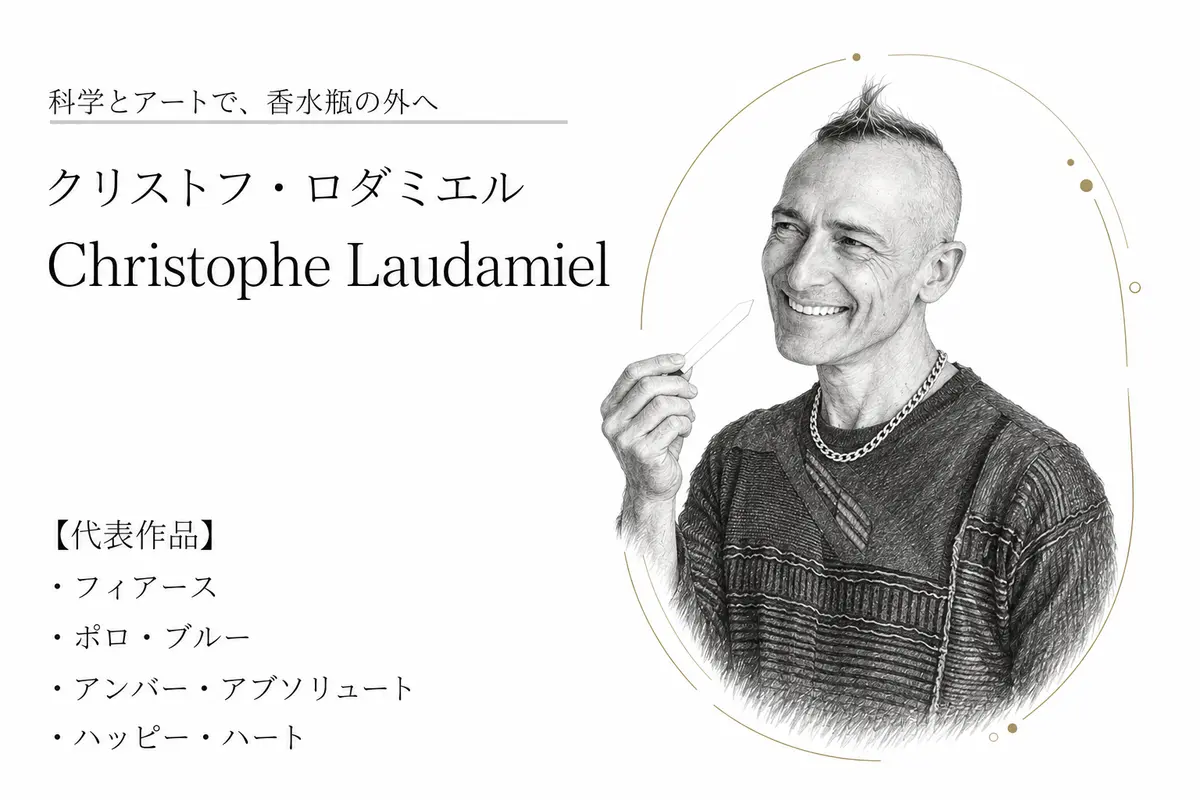
“I want to explore olfactory worlds that no one has ever thought of.”
— Antoine Lie
Year of birth: 1966
Giorgio Armani’s Armani Code and Etat Libre d’Orange’s Sécrétions Magnifiques. One is a sophisticated men’s perfume; the other is a controversial work known for scents recalling blood, sweat, and saliva. Antoine Lie created these two profoundly different fragrances.
Yet Lie is not simply searching for smells that surprise people. A single sniff should reveal what a perfume is trying to convey. Within its beauty, there should be something arresting that is not easily forgotten. That attitude has remained consistent from work at major fragrance companies to independent creation.
- A Life in Perfumery
- Major Creations and Their Stories
- Armani Code (2004): Leather Lingering within Sophistication
- Crystal Noir (2004): White Flowers and Dark Contours
- Sécrétions Magnifiques (2006): Portraying Love from Inside the Body
- Wonderwood (2010): Layering Woods to Create a World of Wood
- Ma Bête (2016): A Collision of Flowers and Beast
- Rose de Jamal (2019): Shining a Light on the Ingredient’s Maker
- Continuing to Explore Scent’s Boundaries after Independence
- Incidentally…
- Perfume Creations
- References
A Life in Perfumery
The Smells a Boy from Strasbourg Remembered
Lie was born in 1966 in Strasbourg, in Alsace in northeastern France. Both parents were teachers, and the family had no connection to the fragrance industry. Nevertheless, Lie recalls a strong interest in smells from the earliest remembered childhood.
One of the oldest memories is the smell of a teddy bear in a cot. Lie also remembers the living room’s leather sofa and the carpet crawled across, although the scenes themselves reportedly cannot be recalled. Before eating, Lie always checked the smell and refused food if it was not appealing. This seems to have made for a demanding child for Lie’s mother.
That mother also introduced Lie to perfume. Drawn to the fragrances worn by Lie’s mother, including Chanel’s N°19 and Yves Saint Laurent’s Opium, Lie began wondering how such scents could be made.
Weekends were spent in the nearby Vosges mountains, surrounded by the smells of soil, trees, grass, and damp plants. Lie has said that these experiences also inform the earthy and leather-like dark textures favored in later work.
Studying Chemistry and Entering the Roure School
The conscious wish to become a perfumer emerged at around 12 or 13. Newspaper and magazine articles revealed that making perfume was a profession. But a boy living far from the fragrance industry did not know how to enter it.
Hearing that the perfume industry was connected with chemistry, Lie began studying the subject. According to Lie, chemistry itself was not a particular love. It was a path chosen to approach the desired profession.
The turning point came with learning that Roure, the fragrance company in Grasse, had an internal perfumery school. After earning a chemistry degree in 1988, Lie studied there and gained experience under Jean Guichard. Roure would later be integrated into Givaudan.
In a quiet classroom with few students, Lie learned not only to memorize ingredients, but to take time thinking through the construction of formulas. The school sought to open its doors to applicants without industry connections, and Lie’s passion and motivation were valued.
Experience with the American Market and Major Fragrance Companies
In 1993, Lie went to America under Jean Amic. There, Lie learned to construct formulas efficiently for the American market. It was a period when practical commercial perfume development was added to the foundational education received in Grasse.
After returning to France, Lie also spent about two years at the perfumery school of International Flavors & Fragrances, hereafter IFF. According to a biography published by a retailer, Lie returned to Givaudan in 2003 and created numerous fragrances there until 2011.
Armani Code and Versace’s Crystal Noir appeared in 2004. Meanwhile, work with Comme des Garçons revealed another possibility: here was a place where smells such as iron, concrete, and plastic, rarely given leading roles in perfume before, could be handled openly.
In a 2013 interview, Lie said that the creative freedom offered by the Comme des Garçons team had prompted exploration of new olfactory territories. Commercial success and experimental scents were not opposites for him; they developed together.
From Takasago to Independence
In 2011, Lie moved to Takasago International Corporation. Working as a senior perfumer at vice-president level, Lie handled a wide range of commissions, from global to niche brands.
As the career progressed, however, Lie began questioning the way work was organized in large companies. When consumer-test results and short-term profits take priority, there is less room for perfumers themselves to spend time exploring new scents. This is a criticism Lie has repeated in several interviews.
He compared the combination of generous corporate benefits and creative restrictions to a “golden cage.” This was not an objective assessment of fragrance companies as a whole, but a personal impression formed while working in that environment.
In 2018, Lie became independent, establishing Antoine Lie Olfactive Experience, commonly known as ALOE, and gaining the ability to choose whom to work with and what to create. Financial responsibility would now be personal, but for Lie it was a choice to regain creative freedom.
Collaborations with Eris Parfums and Les Indémodables exemplify current activities. At the latter, Lie serves as creation director, also creating with proprietary natural extracts handled by L’Atelier Français des Matières.
Thinking of Perfume as a “Living Sculpture”
In an Eris Parfums interview, Lie described the work in these words:
“Perfume is a living sculpture.”
— Antoine Lie
He imagines a three-dimensional form: how an invisible scent occupies space. Does it spread widely, have density, or move softly? Structure comes first, then ingredients give it texture and color.
Lie therefore considers the personal approach abstract, rather than realistic or extremely minimalist. Rather than recreating a travel destination exactly, the aim is to awaken unfamiliar sensations in the body and emotions of the person smelling the perfume.
Creation also requires enough time. In an interview with PlezuroMag, Lie recalled learning at school to think through formulas without rushing. Going for a walk or visiting an exhibition also becomes valuable time to think away from the desk.
Layering the Expression of Naturals onto a Synthetic Framework
Lie does not consider natural fragrance materials the only beautiful ones. Drawn to artificial smells such as metal and vinyl, Lie has actively used the expressive possibilities of synthetic materials.
In an interview with TANK, however, Lie explained that their use had changed. Earlier work was characterized by the unexpected qualities of synthetics, whereas more recent work uses them as a structural framework, leaving natural materials to provide flesh and expression.
This approach also connects with a love of older perfumes. What Lie wants to recover is not the old formulas themselves, but the determination to give each work a clear identity. Rather than making similar scents to suit a trend, the aim is to inherit the boldness of the classics through contemporary materials and techniques.
Major Creations and Their Stories
Armani Code (2004): Leather Lingering within Sophistication
Armani Code is a men’s fragrance originally introduced as Armani Black Code. From the brightness of bergamot and lemon, it moves through star anise, a scent suggesting olive blossom, and guaiac wood, toward the warmth of leather, tonka bean, and tobacco.
The perfume database Fragrantica lists Lie, while some sources describe a collaboration with Antoine Maisondieu and Clément Gavarry. In 2006, it was named Fragrance of the Year in the Men’s Luxe category at the FiFi Awards.
Lie’s creations do not always have a provocative face. Here, within widely appealing sophistication, an impression of leather warmth remains. It is an essential perfume for understanding the range of the work.
Crystal Noir (2004): White Flowers and Dark Contours
Crystal Noir, also introduced in 2004, is another major Lie creation. White flowers recalling gardenia are layered with impressions of spice and warm woody amber.
The notes listed by Fragrantica move from pepper, ginger, and cardamom to coconut, gardenia, and orange blossom, settling into sandalwood, musk, and amber. Note descriptions differ by concentration and period of sale, however, so this is treated here as a portrait of the 2004 creation.
Rather than ending with soft white flowers alone, it adds the shadows of spices and woods. That contrast produces a fragrance that is sensual yet clearly defined.
Sécrétions Magnifiques (2006): Portraying Love from Inside the Body
Etat Libre d’Orange founder Etienne de Swardt proposed a provocative perfume that could be liked by only a very small number of people.
Lie considered what happens inside the body when someone falls in love. Instead of decorating romance with roses or orange blossom, the attempt was to express that sensation through smells recalling blood, sweat, saliva, and semen. This does not mean actual bodily fluids are ingredients; these are olfactory expressions created by combining fragrance materials.
An iodic, sea-like impression, metallic coldness, and milky softness. Some people feel strong disgust at this combination, while others find originality. Lie has explained that a smell recalling breast milk was added to bring the whole together.
Lie emphasizes that the work was not simply intended to make people uncomfortable. There is beauty in what happens inside the body, too. It was an attempt to make that idea work as a perfume.
Wonderwood (2010): Layering Woods to Create a World of Wood
Comme des Garçons’ Wonderwood boldly layers woody scents. The woody impressions of sandalwood, cedar, guaiac wood, vetiver, and other materials are given depth and diffusion by synthetics.
Rather than copying a single tree, the perfume combines the textures of various woods to create a new world of wood. Even as dryness, smoothness, and smoky shadows overlap, wood’s presence remains consistently at its center.
It also offers a relatively accessible example of Lie’s three-dimensional approach to scent. Natural and synthetic materials are not assessed separately; both support one structure.
Ma Bête (2016): A Collision of Flowers and Beast
Eris Parfums founder Barbara Herman has researched vintage perfume and introduced its bold expression through the book Scent and Subversion. Ma Bête is one of the early creations connecting that interest with contemporary perfume.
Floral scents including Tunisian neroli, aldehydes, spices, and jasmine are layered with an animalic accord composed by Lie. The official description presents a bold use of that animalic combination at a proportion of 50%. This does not mean that the finished perfume’s overall fragrance concentration is 50%.
“Ma Bête is a ferocious beast with a raunchy elegance.”
— Antoine Lie
Flowers and beast do not cancel each other out; each emphasizes the other’s presence. The creation explores a raw sensuality beyond the reach of a merely polished, beautiful scent.
Rose de Jamal (2019): Shining a Light on the Ingredient’s Maker
Les Indémodables’ Rose de Jamal pays tribute to Moroccan ingredient producer Jamal Chaboun. Centered on Moroccan Damask rose absolute, it combines nanah mint, also used locally in drinks, with cedar, lavender, and pink pepper.
According to the retailer Luckyscent’s description, rose absolute is used at 5.5%, and the material used in one bottle is said to represent approximately 500 grams of fresh rose buds, equivalent to at least 100 flowers.
Despite placing so much weight on rose, the aim is not merely the scent of a sweet bouquet. Adding the coolness and green qualities of mint draws out an expression closer to the living plant. The name also preserves that of the person who grows and extracts the ingredient, someone usually less visible to the public.
Continuing to Explore Scent’s Boundaries after Independence
For Puredistance, Lie has created Black, White, Warszawa, Aenotus, Gold, and other perfumes. Lie has described the appeal of this collaboration as being able to understand the client’s values and secure the necessary time and materials.
Work around the transition to independence, including Trudon’s Bruma and Aphélie and Les Indémodables’ Vanille Havane, cannot be contained within a single olfactory family.
An interest in connecting perfume with other arts also continues. In work with Georgian industrial designer Zviad Tsikolia, Lie has described using smells recalling gunpowder, iron, and burnt plastic for a collection addressing the reality of war.
These works cannot be summed up simply as eccentric. Lie wants perfumers to be recognized as individual expressive artists, like painters, sculptors, or musicians. Both the ability to finish perfume as a wearable product and a willingness to question that framework support his work.
Incidentally…
- Favorite materials named by Lie include vetiver, leather, iris, and sandalwood, as well as the more unexpected vinyl, metal, and ether. Clearly, nature and the artificial are not treated as separate worlds.
- The motto given in a Nose Paris interview was “Make sure you have no regrets.” Those words also echo in the choice to move from a stable corporate career to independence.
- Lie also enjoys psychedelic music of the 1970s and new wave of the 1980s, reportedly sometimes listening to Brian Eno’s experimental music to help spark ideas.
- Lie has appeared in conversations with perfume critic Persolaise and on the Perfume Room podcast. A 2024 conversation with Herman covered Eris Parfums’ Delta of Venus, working as an independent perfumer, and other topics.
Perfume Creations
Major creations are listed chronologically below. Years generally indicate the first release. A “—” in the co-perfumer column means that the consulted source does not list a co-creator; it does not uniformly assert sole authorship.
| Year | Brand | Creation | Co-perfumer |
|---|---|---|---|
| 1999 | Ralph Lauren | Romance for Men | Some sources name Antoine Maisondieu and others |
| 2002 | Elizabeth Arden | Ardenbeauty | — |
| 2004 | Giorgio Armani | Armani Code (formerly Armani Black Code) | Some sources name Antoine Maisondieu and Clément Gavarry |
| 2004 | Versace | Crystal Noir | — |
| 2004 | Paul Smith | Paul Smith London for Men | — |
| 2005 | Burberry | Brit Gold | — |
| 2006 | Salvador Dalí | Purplelips | — |
| 2006 | Etat Libre d’Orange | Sécrétions Magnifiques | — |
| 2006 | Etat Libre d’Orange | Rien | — |
| 2006 | Etat Libre d’Orange | Divin’Enfant | — |
| 2007 | Salvador Dalí | Black Sun | — |
| 2007 | Salvador Dalí | Purplelips Sensual | — |
| 2007 | Comme des Garçons | 8 88 | — |
| 2008 | Etat Libre d’Orange | Bendelirious | — |
| 2008 | Van Cleef & Arpels | First Premier Bouquet | — |
| 2008 | Comme des Garçons | Series 8: Energy C – Grapefruit | — |
| 2008 | Comme des Garçons | Series 8: Energy C – Lime | — |
| 2010 | Montana | Montana 80 | — |
| 2010 | Comme des Garçons | Wonderwood | — |
| 2011 | Comme des Garçons | Comme des Garçons (2011 version) | — |
| 2012 | Nu_be (later One of those) | [¹H] Hydrogen | — |
| 2012 | Nu_be | [⁸O] Oxygen | — |
| 2013 | Nu_be | [¹⁶S] Sulphur | — |
| 2013 | Nu_be | [⁸⁰Hg] Mercury | — |
| 2013 | Puredistance | Black | — |
| 2014 | UerMi | XX±Latex | — |
| 2015 | Kenzo | Totem Blue | Jean Jacques |
| 2015 | Jusbox | Use Abuse | — |
| 2015 | Puredistance | White | — |
| 2016 | Puredistance | Warszawa | — |
| 2016 | Eris Parfums | Ma Bête | — |
| 2016 | Eris Parfums | Belle de Jour | — |
| 2016 | Eris Parfums | Night Flower | — |
| 2017 | Eris Parfums | Mx. | — |
| 2017 | Trudon | Bruma | — |
| 2018 | Folie à Plusieurs | Post Tenebras Lux | — |
| 2019 | Puredistance | Aenotus | — |
| 2019 | Puredistance | Gold | — |
| 2019 | Eris Parfums | Mxxx. | — |
| 2019 | Les Indémodables | Rose de Jamal | — |
| 2020 | Les Indémodables | Vanille Havane | — |
| 2021 | Eris Parfums | Green Spell | — |
| 2021 | Trudon | Aphélie | — |
| 2021 | Les Indémodables | Ambre Suprême | — |
| 2022 | Eris Parfums | Scorpio Rising | — |
| 2022 | Les Abstraits | Belle Âme | — |
| 2022 | Les Abstraits | La Douleur Exquise | — |
| 2022 | Puredistance | M V2Q | — |
| 2023 | Houbigant | Patchouli Sauvage | — |
| 2023 | Houbigant | Oud Or | — |
| 2023 | Les Indémodables | Patchouli Noisette | — |
| 2023 | Eris Parfums | Delta of Venus | — |
| 2024 | Les Indémodables | Oranger Sirocco | — |
| 2024 | Les Indémodables | Vanille Havane Cœur de Oud | — |
| 2024 | Trudon | Absolu | — |
| 2025 | Les Indémodables | Vanille Havane Cuir des Abysses | — |
| 2025 | Puredistance | Ysayo | — |
| 2025 | Perris Monte Carlo | Balsamir | — |
| 2025 | Maison de L’Asie | L’Ibasho | — |
| 2026 | Zoologist | Chameleon Tropical Blooms Edition | — |
| 2026 | Les Indémodables | Café Arabesque | — |
| 2026 | Eris Parfums | Mother’s Milk | — |
References
- ERIS Parfums, “INTERVIEW: ANTOINE LIE, PERFUMER (PART 1)” (opening quotation, creative philosophy, independence, mother’s perfumes, and music)
- ERIS Parfums, “INTERVIEW: ANTOINE LIE, PERFUMER (PART II)”
- Puredistance, “INTERVIEW WITH ANTOINE LIE” (2013; childhood, work with Comme des Garçons, and Black)
- Nose Paris, “Antoine Lie” interview (motto, favorite materials, and teddy-bear memory)
- PlezuroMag, “‘Time Is the Most Important Ingredient’: How Antoine Lie Redefines the Role of the Perfumer” (parents, Vosges mountains, education, time, and freedom)
- Wikipedia français, “Antoine Lie” (birth year and birthplace)
- Aus Liebe zum Duft, “Trudon – Aphélie” (career from 1988 onward, mentor, and 2003 return to Givaudan)
- Les Indémodables, “Antoine Lie” (2018 independence and role at the brand)
- TANK, “Antoine Lie” (Sécrétions Magnifiques, naturals and synthetics, and work with Tsikolia)
- Perfumer & Flavorist, “Vanguard Perfumery: Blue-Sky Smelling with Antoine Lie”
- Basenotes, “Greatest Hits: Antoine Lie”
- Fragrantica, “Armani Code” (2004 version, notes, and 2006 award)
- The Scent of Man, “Giorgio Armani – Armani Black Code / Armani Code (2004)” (alternative co-perfumer credits)
- Fragrantica, “Crystal Noir”
- Fragrantica, “Wonderwood”
- CaFleureBon, “NEW FRAGRANCE: Comme des Garcons Wonderwood”
- Fragrantica, “Sécrétions Magnifiques”
- ERIS Parfums, “MA BÊTE Eau de Parfum” (composition description and the perfumer’s words)
- Luckyscent, “Rose de Jamal” (materials, composition description, and background to the name)
- Puredistance, “Interview With Antoine Lie About Puredistance YSAYO”
- ERIS Parfums, “MOTHER’S MILK Extrait de Parfum”
- Persolaise, “Antoine Lie Live Interview”
- Persolaise, “Barbara Herman & Antoine Lie Live Interview”
- Perfume Room, “157. The Free-Spirited Perfumer”
- Parfumo, “Antoine Lie – All Perfumes and Facts” (works list)
- Parfumo, “Antoine Lie”, page 2
- Parfumo, “Antoine Lie”, page 3
- Parfumo, “Antoine Lie”, page 4
- Parfumo, “Antoine Lie”, page 5
- Parfumo, “Antoine Lie”, page 6
- Parfumo, “Totem Blue” (co-created with Jean Jacques)
- Parfumo, “Use Abuse”
- Parfumo, “Café Arabesque”