

the only school in the world at the time open to people like me who were not from Grasse.
Francis Kurkdjian (2020, recalling how he discovered ISIPCA; translated from French)
A boy who discovered the profession of perfume-making and wrote to fashion houses eventually found his way to a school in Versailles. For Francis Kurkdjian, ISIPCA was a way into perfumery from outside Grasse, the heart of the fragrance industry. Even for perfume lovers familiar with its alumni, the school means more than simply having trained famous perfumers.
Learning the smells of raw materials, putting perceived differences into words, building a formula and testing it as a product: this process involves not only creation, but also science, evaluation, manufacturing and an understanding of consumers. The education Jean-Jacques Guerlain began in 1970 expanded from perfume into cosmetics and food flavourings, and now offers several routes into these professions.
Key Facts
- Name: ISIPCA. Institut Supérieur International du Parfum, de la Cosmétique et de l’Aromatique alimentaire (International Higher Institute of Perfume, Cosmetics and Food Flavourings)
- Founded: 1970, originally as ISIP (Institut Supérieur International du Parfum)
- Founder: Jean-Jacques Guerlain
- Main location: Versailles, France, with a further site in Paris
- Fields of study: perfume, cosmetics, food flavourings and related science, technology and marketing
- Institutional framework: part of the CCI Paris Île-de-France education group. The École Supérieure de la Production de la Mode et du Luxe, which brings together ISIPCA and La Fabrique, is involved in administration and certification
- Official website: ISIPCA
Jean-Jacques Guerlain and the School’s Origins
Turning Perfumery Knowledge into a Language That Can Be Taught
Jean-Jacques Guerlain helped connect not only the perfume world, but also French craftsmanship more broadly. In 1954 he helped establish Comité Colbert to promote the power of craft and creativity in post-war France. It provided a meeting place where houses working in perfume, fashion, jewellery, tableware and other fields could exchange knowledge.
In 1970 he established a school in Versailles to pass perfumery knowledge on to the next generation. ISIPCA’s educators describe its founding ambition as opening up knowledge previously handed down among a limited circle to people who wished to learn. Guerlain also emphasised ways of describing scent and developing a vocabulary for smells.
Being able to smell a fragrance does not make it easy to share the experience with others. Saying “I like it” or “strong” does not adequately convey differences between materials or indicate how a formula should be adjusted. Teaching that connects remembering smells with putting them into words lays the groundwork for creators, fragrance evaluators, technicians and product planners to work together.
From Perfume to Cosmetics and Food Flavourings
The school began under the name ISIP. In 1984 the Versailles–Val-d’Oise–Yvelines Chamber of Commerce and Industry took it over, and it became ISIPCA, a name encompassing perfume, cosmetics and food flavourings. This marked a milestone in its ties with industry, leading to its place in today’s Paris Île-de-France Chamber of Commerce and Industry education group.
University partnerships developed in stages too. In 1993 the school established science and technology programmes with Université de Versailles Saint-Quentin-en-Yvelines (UVSQ), expanding into postgraduate study in 1995. A Master programme in formulation and sensory evaluation, among others, followed in 2004. This combination of the school’s technical teaching and university science education continues in several current partnerships.
Perfume, cosmetics and food flavourings are not interchangeable professions simply because they share knowledge of raw materials. Perfumery addresses the composition of smells and their behaviour on skin and in products; cosmetics involve formulation, texture and stability; food flavourings concern flavour when added to food. Recognising these differences, ISIPCA offers routes from a shared scientific foundation into specialist study.
Perfumers as Teachers, Graduates as Creators
Practising fragrance creators also helped sustain the school’s teaching. Monique Schlienger, who studied under Jean Carles, taught at ISIPCA and founded Cinquième Sens. Isabelle Doyen taught there for many years, mentoring Francis Kurkdjian and Mathilde Laurent. Doyen is herself a creator known for her work with Goutal and, later, Voyages Imaginaires.
Kurkdjian, quoted at the beginning, learned of ISIPCA after discovering perfume-making as a profession and writing to fashion houses. In September 1993 he began work at Quest as an apprentice perfumer. Work that eventually led to Le Male followed, but it was not his school graduation project: it grew from a combination of his work in industry and a connection made through separate studies in luxury marketing.
The foundations learned at school and the practical work of creation experienced in a company: graduates’ careers reveal how the two are connected. Rather than an in-house corporate training school, ISIPCA is an institution open to general applications, preparing people for a variety of companies and professions.
Learning Sensory Skills and Techniques in Versailles
Smelling Materials and Testing Them in Products
The Versailles campus has practical facilities for perfume, cosmetics, food flavourings, physicochemical analysis and sensory evaluation. Perfumery students work on creation and evaluation, studying both fine fragrances worn on skin and scents used in products such as body care and home care. In cosmetics practicals they formulate creams, gels and make-up, testing pH, viscosity, stability and texture.
Here, sensory evaluation means using human senses to assess products’ characteristics and differences. The ability to imagine a scent needs to develop alongside the ability to compare samples under consistent conditions and explain the results. Practical classes, group projects, oral presentations and experience in industry turn personal sensory impressions into something that can be shared professionally.
Perfume history is also part of this environment. The Osmothèque, the perfume conservation institution that opened on 26 April 1990, has deep ties to the ISIPCA campus. It preserves and shares not only perfumes still available, but also those that have disappeared. Students have opportunities to encounter this culture and participate in its activities. Knowing earlier creations provides a basis for considering what makes a new scent different.
Learning Between School and Industry
Some programmes use alternance, a work-study arrangement alternating school classes with employment in a company. This system, which involves an employment contract, differs from a fixed-term internship. Since tuition funding and selection procedures also differ, it matters which study format a programme uses, not simply which school offers it.
Collaborative projects also provide practice in bringing different professions together. In MOKU, presented in 2026, 70 students from ISIPCA, La Fabrique and GOBELINS Paris spent around two years taking a brand from concept to reality. They brought together expertise in perfume and cosmetics, fashion and visual communication, with students also coordinating the overall project. The learning extends beyond creating a scent to considering the product and experience it will become.
The school’s scientific platform also researches the chemical and sensory characteristics of natural materials, extraction methods mindful of environmental impact, and relationships between senses and emotions. Supercritical carbon dioxide extraction, for example, uses carbon dioxide whose properties have been altered through temperature and pressure to extract components from a material. Alongside teaching students to smell materials is research into how those materials are obtained, analysed and used.
Main Programmes: Choosing by Goals and Educational Background
The following main entry routes were checked against official materials on 12 October 2026. The Bac is France’s secondary-school leaving and university entrance qualification, not a bachelor’s degree. Bac +3 indicates approximately three subsequent years of higher education; each programme assesses whether an overseas qualification meets its entry requirements. It is also important to distinguish applications having closed for a stated academic year from the school announcing a future intake.
Routes into Laboratory Technology, Creation and Evaluation
Technicien spécialisé des laboratoires Parfum, Cosmétique et Arômes is a two-year programme leading towards laboratory technical roles involving formula-based trials, analysis and quality control. The September 2026–July 2028 programme is intended for Bac holders, with science studies or supplementary science tuition recommended. Selection involves an application and motivation interview, together with the required company contract. Teaching is in French, with alternating two-week periods at school and in a company. Employers cover tuition for alternance students, who pay no tuition themselves, apart from consumables and similar expenses. The qualification is the level 5 vocational certification RNCP41339; applications for 2026/27 have closed.
A representative route into creation, evaluation and development is Manager des process de création et de développement des produits parfum, cosmétique ou arômes. In the five-year September 2026–August 2031 programme, the first two years share a common curriculum, students specialise in perfume, cosmetics or food flavourings in year three, and deepen their specialism through alternance in years four and five. Internships last two months in year two and six months in year three.
Entry requires the Bac or an equivalent qualification. Applicants with an arts or creative educational background and an interest in science are also eligible; international applicants need French at DELF B2 level or above. Selection includes an application and interview. Listed tuition is €9,900 a year for the first three years, with a €280 application fee. Tuition for the final two years is funded through the required company contract. Applications for 2026/27 have closed.
Those who already hold a science qualification equivalent to Bac +3 can also pursue the same certification through the two-year Création et Évaluation programme. The September 2026–August 2028 information also requires substantial professional experience in the specialist field, with selection through an application, written tests in science and industry knowledge, among other subjects, and an interview. International applicants require French at B2 or above. It is an alternance programme, with tuition covered by employers. Applications for 2026/27 have also closed.
These creation and development programmes lead to the level 7 vocational certification RNCP37789, formally titled “Manager des process de création et de développement des produits parfum, cosmétique ou arômes”. The certifying body is the École Supérieure de la Production de la Mode et du Luxe, and the qualification is registered in France’s national directory of vocational certifications, the RNCP. Its level 7 classification should not be equated with a national master’s degree awarded by a university.
SDC: Perfumery in English, and EFCM: Connecting Science and Business
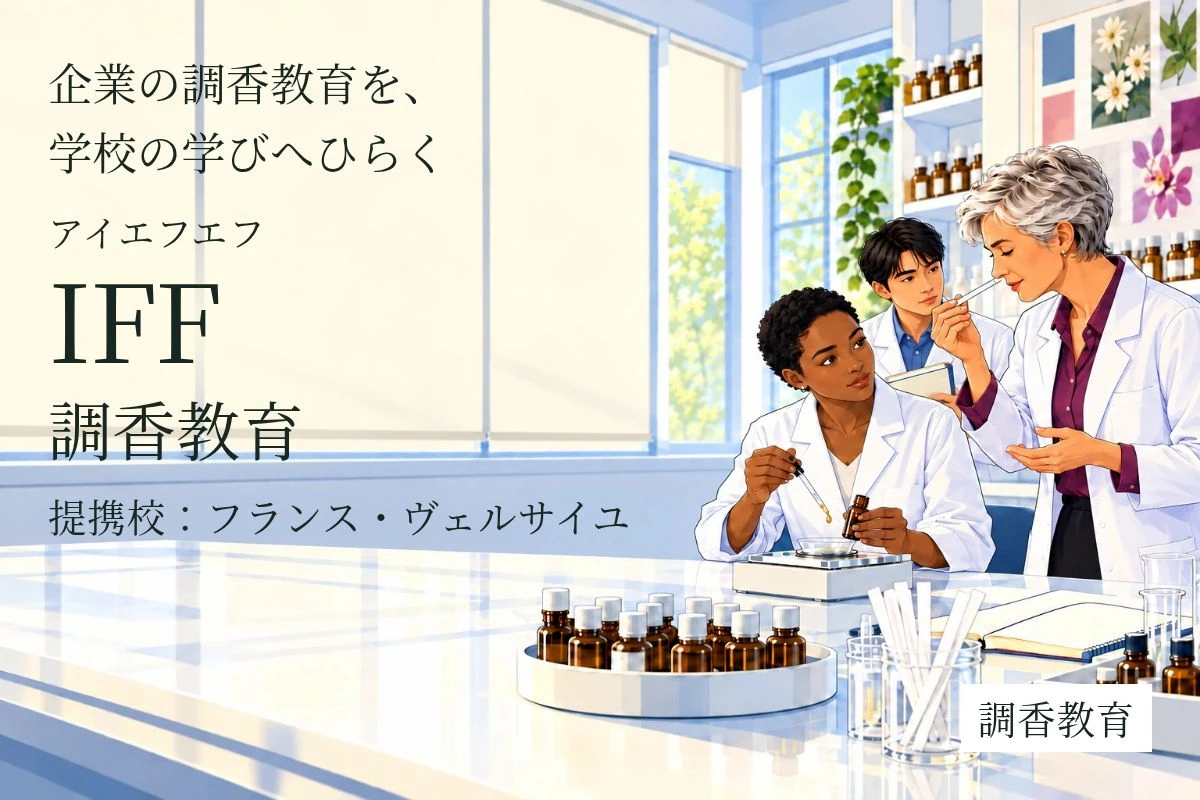
Scent Design & Creation (SDC) is an programme open to public applications launched in partnership with IFF in 2016. Over three years, students study fragrance materials, formulation, evaluation, science and the process from a client brief to a finished product, in English. Listed placements include two months in retail, four months in technical work and four months under perfumer supervision at an IFF creative centre. It leads to the level 7 vocational certification RNCP37789.
The program trains profiles that combine creativity, olfactory culture and technical expertise.
Nicholas Salado, General Director of ISIPCA (2026, on SDC)
For October 2026–November 2029, the French-language page lists tuition of €12,500 a year, or €37,500 over three years, plus a non-refundable €280 application fee. After an application review and online interview, candidates attend olfactory tests, a creative presentation and a selection interview at IFF. Professional experience in perfumery is not required. English requirements are IELTS 6.5, TOEFL iBT 80 or TOEIC 850.
There are important inconsistencies in entry requirements and application dates. The detailed French-language criteria prioritise science backgrounds but also consider arts and humanities, while IFF’s announcement of 16 June 2026 says a scientific background is not required. Yet the programme summary still specifies a science Bac +2, and the English page retains wording about a science education. The French page also pairs “applications opening soon” with a deadline of 31 May 2026, while the English page says applications for the 2025–2028 programme are closed. Applicants need to confirm the available intake and educational requirements with the admissions office.
SDC is separate from IFF University, the internal corporate learning framework established in 2017. The relationship between the open programme and in-house training is also discussed in our article on perfumery education at IFF.
Another English-language route is the European Fragrance and Cosmetics Master (EFCM). Year one takes place in Versailles, combining ISIPCA’s technical teaching with UVSQ’s science education; in year two students study business and marketing at the University of Padua. Applicants need a science bachelor’s degree or equivalent worth 180 ECTS, and selection involves an application and, where necessary, an interview. The school’s September 2026–December 2028 information lists tuition of €24,500 for two years, plus a €200 application fee. The stated deadline of 8 May 2026 has passed and should not be treated as the conditions of a currently open intake.
EFCM awards UVSQ’s university-specific diploma (DU) and the University of Padua’s Master of Business Management (MBM). The former differs from a French national master’s degree, and the current school page states that it is not RNCP-registered. The latter is classified as an Italian Master universitario di primo livello. Both school and university information specify TOEFL iBT 80, while UVSQ also gives requirements for other English tests. There is an optional internship in year one and a compulsory internship in year two, but the latter’s duration varies: different sections of the school’s information give five to six months or four months, while Padua specifies at least four months. Applicants should check the conditions for their intended year.
Researching Natural Materials and Marketing Perfume
For those interested in raw-material research, Matières Premières Naturelles Cosmétiques (MPNC) offers one route. Run collaboratively by UVSQ and ISIPCA within Université Paris-Saclay’s “Chimie et sciences du vivant” Master, it covers the chemistry and biology of natural materials, extraction, analysis and product development. It is a national master’s degree awarded by Université Paris-Saclay, corresponding to RNCP38705, and is a different type of qualification from the creation and development vocational certification.
The school’s September 2026–August 2028 information requires 180 ECTS in subjects such as chemistry or biology for M1 entry, and qualifications including 240 ECTS in a relevant field for entry to M2. Admission involves an application, a written science test, an interview and the required company contract. Teaching is mainly in French, although the university’s M2 information also lists English as a teaching language. Employers cover alternance tuition, and the published application period for M1 entry in 2026 has already ended.
For a focus on planning and markets, there is Marketing international de la parfumerie et de la cosmétique (MIPC), the M2 year of the Master Management. This national master’s programme, offered by CY Cergy Paris Université with ISIPCA and ESSEC, covers brands, consumers, markets and product development. It is a one-year programme combining teaching in French and some English with work in a company.
The school’s September 2026–August 2027 information targets applicants with the equivalent of Bac +4 in management and marketing or science and technology, and requires IAE-MESSAGE results, an application, an interview and a company contract. Employers cover alternance tuition. Applications for 2026/27 are listed as closed, and CY’s stated deadline was 20 March 2026. Even where the school page includes a field indicating the next application opening, it should not be read as confirmation of the following year’s conditions.
Short Courses for Building Perfume Knowledge
There are also ways to learn about understanding and communicating perfume before embarking on long-term vocational education. Perfumery Course Online is a short course of seven live classes in English, totalling 21 hours. A session is advertised for 7–15 December 2026 at a listed cost of €1,400. It has no special prerequisites and is intended for perfume enthusiasts and people working in sales and marketing. It covers history, raw materials, ways of describing scent and the market, with assessment through online quizzes. Applications require the designated registration documents and are accepted, subject to availability, until 11 working days before the start.
This is separate from long-term education leading to vocational certification or a national master’s degree. Do you want to study perfumery or evaluation as a profession, pursue research, develop products, or deepen your knowledge of perfume? The routes into ISIPCA become clearer when those goals are considered alongside previous education.
Milestones
- 1970: ISIP, the school’s predecessor, is founded at Jean-Jacques Guerlain’s initiative.
- 1984: The Versailles–Val-d’Oise–Yvelines Chamber of Commerce and Industry takes over the school, which becomes ISIPCA.
- 26 April 1990: The Osmothèque perfume conservation institution, closely linked to the school, opens.
- 1993: Science and technology programmes begin with UVSQ. Postgraduate programmes follow in 1995.
- 2004: A Master programme in formulation and sensory evaluation and related Licence programmes develop with UVSQ.
- 2016: Scent Design & Creation launches in partnership with IFF.
- 19 July 2023: RNCP37789, the vocational certification cited by the current creation and development programmes, is registered.
- 24 September 2025: RNCP41339, the technical programme’s current vocational certification, is registered.
- 2026: SDC with IFF marks its tenth anniversary, and the cross-school MOKU project is presented.
References
- Francis Kurkdjian on discovering ISIPCA — The Fragrance Foundation France (2020)
- History of ISIPCA’s programmes — ISIPCA Alumni
- School history, educational values and administration — ISIPCA
- The Versailles and Paris campuses — ISIPCA
- Jean-Jacques Guerlain and the 1954 foundation — Comité Colbert
- Educators on the school’s founding and learning — Marie Bénédicte Gauthier / The Fragrance Foundation France (20 March 2024)
- Monique Schlienger’s training and teaching — Cinquième Sens partner Scent.Academy
- Isabelle Doyen’s creative work and teaching at ISIPCA — Voyages Imaginaires
- Practical work in perfume, cosmetics and food flavourings — ISIPCA
- The Osmothèque’s opening and activities — Osmothèque
- The collaborative MOKU project — ISIPCA (6 July 2026)
- Research into natural materials, extraction and sensory perception — ISIPCA
- The two-year technical programme — ISIPCA
- Technical vocational certification RNCP41339 — France compétences
- The five-year creation and development programme — ISIPCA
- The two-year creation and evaluation programme — ISIPCA
- Creation and development vocational certification RNCP37789 — France compétences
- SDC’s tenth anniversary, entry requirements and Salado’s remarks — IFF (16 June 2026)
- Scent Design & Creation: French-language information — ISIPCA
- The same programme’s English-language information — ISIPCA
- The 2016 partnership programme and IFF University in 2017 — IFF 2017 Sustainability Report, page 65
- EFCM programme, fees and selection — ISIPCA
- EFCM’s DU, awarding institution and English requirements — UVSQ (updated February 2026)
- EFCM’s second year, MBM framework and internship — Università di Padova
- The master’s programme in natural materials — ISIPCA
- MPNC M1, applications and science education — UVSQ
- MPNC M2, teaching languages and research — Université Paris-Saclay
- National certification for Master Chimie et sciences du vivant — France compétences
- MIPC university programme, teaching and entry requirements — CY Cergy Paris Université
- MIPC information for 2026/27 — ISIPCA
- Current national certification for Master Management — France compétences
- Perfumery Course Online: December 2026 information — ISIPCA
コメント