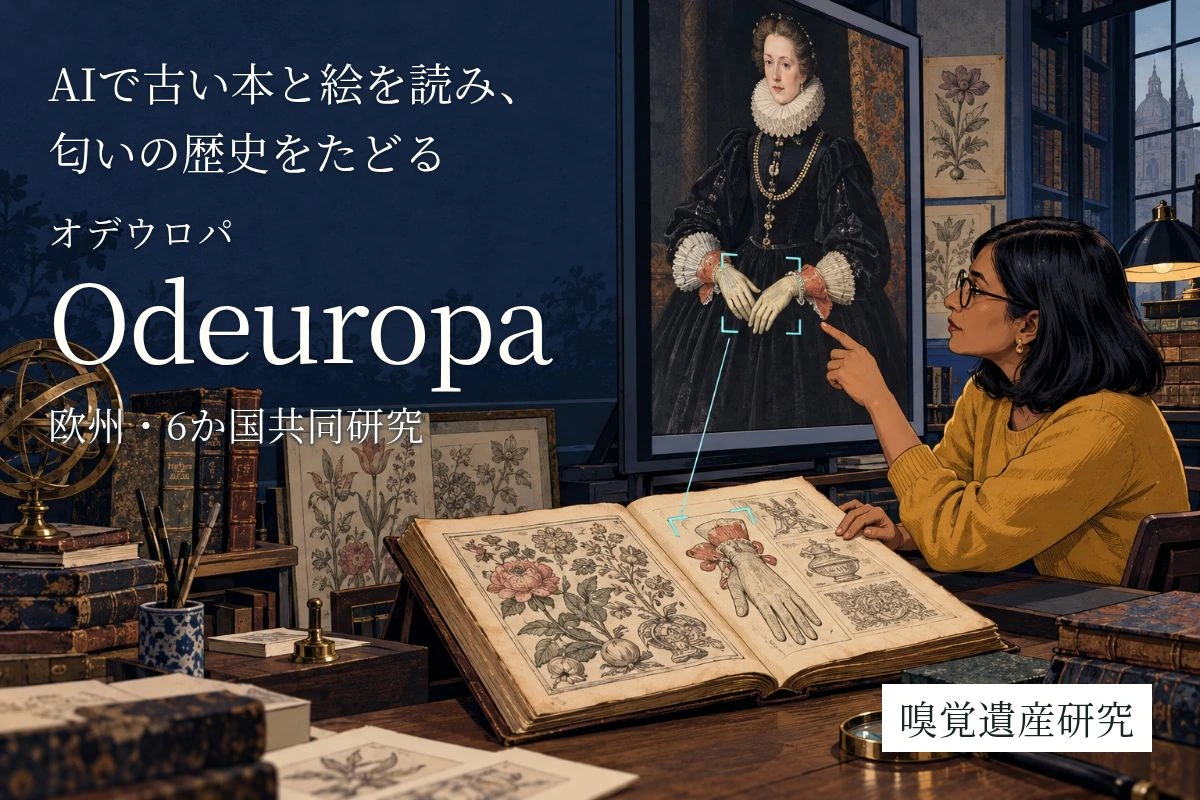
“Fortunately, we can confirm through advertisements of the time and catalogues …” Oliveira explains that these sources establish when and where perfumes were made over the years.
Afonso Oliveira; short excerpt followed by a paraphrase
Even after a perfume has been used up, its bottle still has things to tell us: marks on the base, the shape of the stopper, lettering on a paper label, the decoration inside a box. A container that conveys a fragrance’s name can also document glassworking techniques, ways of presenting merchandise and everyday life in a particular place.
The IPBA, or International Perfume Bottle Association, brings together people who collect such objects to exchange discoveries and knowledge. Its activities are not simply about displaying expensive masterpieces. How do you investigate an unidentified bottle, and preserve your findings so that someone else can check them? Its magazine, gatherings and online resources show how individual collections can contribute to the record of perfume culture.
- IPBA at a Glance
- 1988: An Invitation on a Noticeboard
- What Collectors Look for in Bottles, Boxes and Labels
- Turning Individual Discoveries into Shared Knowledge
- Gatherings Where Collectors Bring Their Unanswered Questions
- Even the Logo Provides a Way to Learn Together
- The Boundary Between Public and Members’ Resources
- References
IPBA at a Glance
Official name: International Perfume Bottle Association
Abbreviation: IPBA, pronounced as individual letters
Founded: July 1988, Las Vegas, Nevada, USA
Adoption of its present name: 1994
Organization: a nonprofit run by an elected, volunteer board of directors
Main interests: perfume and scent bottles, compacts, purses and related paper ephemera
Official website: International Perfume Bottle Association
The IPBA discussed here is an organization devoted to researching and collecting perfume bottles and objects associated with personal adornment. Its starting point differs from that of an industry association for perfume manufacturers or perfumers.
1988: An Invitation on a Noticeboard
From Looking for Bottles to Looking for Fellow Collectors
In July 1988, Fran Peters, who was attending a bottle collectors’ convention in Las Vegas, posted an invitation on the venue’s noticeboard. She wanted people interested in perfume bottles to attend a specialist gathering. Seventeen responded, and they discussed bringing together others who shared their interest.
The first tasks were modest but practical. Joyce Geeser publicized the group through antiques publications and issued a newsletter, Perfume and Scent Bottle News. Jeane Parris handled membership and financial records, while perfume-bottle dealer Jean Sloan told her customers about the new group. By the end of its first year, membership had reached approximately 375.
The sequence is revealing. Rather than building an impressive exhibition venue and then attracting people, they first established ways to stay in touch, circulate written news and keep records. The exchange of information came first, anticipating today’s magazine and databases.
The First Convention and an International Name
The first annual convention took place in Dearborn, Michigan, in 1989, when officers were elected. The organization’s original name referred to collectors of perfume and scent bottles; its present name had not yet been adopted.
Under Phyllis Dohanian, who became president in 1991, the organization took on a more formal structure. In 1992, its name changed to recognize its international membership, and in 1993 it received approval to incorporate in Illinois. On May 13, 1994, members at the annual convention in Reston, Virginia, approved the present name, International Perfume Bottle Association. Thus, 1988 marks the beginning of its activities, while 1994 is the year its current name was chosen.
| Year | Principal Developments |
|---|---|
| 1988 | A collectors’ group is formed in Las Vegas. Work begins on a newsletter and membership records. |
| 1989 | The first annual convention is held in Dearborn. |
| 1993 | Approval to incorporate is received from Illinois. |
| 1994 | The name International Perfume Bottle Association is approved. |
| 1995 | Recognition as a nonprofit under section 501(c)(3) of the US tax code is granted. |
What Collectors Look for in Bottles, Boxes and Labels
Reading Stoppers and Marks Together
When identifying a bottle, its decorative front does not always reveal everything. The IPBA’s collecting guide recommends checking whether a numbered stopper matches the number on the bottle’s base, and paying attention to how the stopper fits. These checks help establish whether a different stopper or atomizer component may have been added.
Boxes and paper labels also warrant examination. The guide draws attention to boxes that seem too new and ribbons that look unusually fresh for an old object. An impression of beautiful preservation is not the same as evidence that the original combination survives. The possibility of reproductions or replacement parts needs to be considered alongside knowledge of the object.
These observations are not simply about competing over condition. Checking the bottle, stopper and wrapping as separate elements allows us to reconsider how the product originally appeared. Information that would be lost if a box were discarded can itself become part of a collection.
Advertisements Supply Context That a Bottle Alone Cannot
Paper materials designed for short-term use, such as advertisements, labels, cards and catalogues, are known as ephemera. For collectors, paper intended to be thrown away can provide clues to a bottle’s date and its original presentation.
In the autumn 2023 issue of Perfume Bottle Quarterly, Joan Turco discussed collecting vintage magazine advertisements. Advertisements preserve not only pictures of bottles but also unusual boxes and the relationship between fragrance names and imagery. Turco described how an advertisement for Schiaparelli’s Le Roy Soleil deepened her interest in a creation she did not yet own. Research can begin with the paper that introduced an object, even without possession of the object itself.
Oliveira, who contributed to the same issue, aimed to gather the cultural heritage of Portugal’s perfume industry into a book and preserve it for the future. The opening excerpt comes from that article. Collected objects can be compared with contemporary advertisements and catalogues. Establishing when and where they were made, rather than simply describing their beauty, connects individual bottles with the perfume history of a country or region.
Turning Individual Discoveries into Shared Knowledge
The Magazine and Publication Archives
The IPBA’s magazine, Perfume Bottle Quarterly, or PBQ, appears four times a year. It provides a lasting home for writing about bottle collecting. The publicly available autumn 2023 issue, for example, brings together work by members with different specialisms, including bottle forms, magazine advertisements, Japanese figural containers and Portugal’s perfume industry.
The publication has not, however, always had the same title. Its founding newsletter was called Perfume and Scent Bottle News. Although the official publication archive brings together material dating back to 1988, this does not mean the present magazine title has been used since that year.
The members’ archive includes not only the US magazine but also publications from the Australian and British chapters, news from specialist groups such as compact collectors, and Mini-Scents from 1991 to 1998. An article-search facility is also available. It turns knowledge held in one person’s memory into writing that others can find by subject.
The Virtual Museum’s Record Fields
The official FAQ describes the members’ Virtual Museum as a system that records photographs alongside an object’s type, material, designer or manufacturer, marks, provenance, labels, date and dimensions, among other details. Company histories, trade catalogues and advertisements are also included.
These fields show why an object’s name alone is insufficient. Materials, dimensions and marks provide a basis for comparing similar-looking pieces. They also allow later researchers to reconsider which characteristics supported an identification.
The public introductory pages include an Australian face-powder box, an enamel-decorated Japanese scent container and a Moroccan rosewater sprinkler. Rather than a picture book devoted only to famous French perfumes, the museum takes a cross-regional approach to objects associated with scent and grooming.
Leaving an Object Ready for the Next Investigation
Preserving knowledge does not have to begin with a large database. The IPBA’s public guide explains how to assign each object a number and record its description, maker, size, date and acquisition date in a ledger, spreadsheet or card file. Photographs should carry the same number, with multiple images documenting distinctive details.
The important thing is to keep objects and records connected. A photograph of an intriguing mark is difficult to use for comparison if you can no longer tell which bottle it belongs to. The small practical task of connecting a collection with records that can be checked later helps sustain research.
Gatherings Where Collectors Bring Their Unanswered Questions
Treasures Found and Learning for New Collectors
Annual conventions include lectures, round-table discussions, sales exhibitions and auctions. Among these, Treasures Found illustrates the IPBA’s approach to sharing knowledge. Experts examine objects and consider their origins and makers.
The 2021 virtual convention program explicitly described the event as an opportunity to hear expert opinions on an object’s history and manufacturer, rather than its monetary value. Other collectors’ knowledge responds to an owner’s question about what an object is. An individual uncertainty becomes a learning opportunity for everyone present.
The official FAQ also introduces the beginner’s session Collecting Perfume Bottles, Compacts, Purses and Other Vanity Items 101. Although full convention participation is for members, some activities, including this introductory session and the sales exhibition, offer public access. The dates and scope of that access should be checked in each year’s announcements.
Research Linking Factory Records with Surviving Objects
The 2021 convention also scheduled a presentation by Brian Severn on perfume bottles from the Harrach glassworks. According to the program, it covered more than a century of bottles, drawing on two summers spent studying factory records and museum collections.
The materials listed included factory design books, sales photographs, original drawings, and surviving bottles and dressing-table objects. An impression that two forms look alike can be tested against records left by their makers. Bringing collectors’ objects together with factory documentation opens a route into manufacturing history. At the time, this presentation was advertised as a live event that would not be recorded. It should not be treated as a lecture that remains available to watch today.
Learning from Contemporary Designers, Too
The IPBA’s online educational programs extend beyond identifying antique bottles. Its public account of a conversation with Marc Rosen describes how, with Terri Chappell-Boyd as interviewer, Rosen discussed translating a perfume’s personality into a bottle, his first design at Avon, and his work at Revlon and Elizabeth Arden.
A further Zoom presentation, scheduled for October 24, 2026, will explore the creative process of German bottle designer Lutz Herrmann. Collectors who interpret objects from the past also listen to the decisions made by contemporary designers. Understanding bottles as historical evidence and understanding them as design thus sit within the same activity.
Even the Logo Provides a Way to Learn Together
The bottles pictured in the IPBA logo are more than decoration. Rod Baer, who created the original line drawing, had been searching for bottles with his partner Randy Monsen when he began drawing them to make advertisements in the antiques trade paper Antique Trader stand out. The association’s first president, Madeleine France, knew those advertisements and asked him to design a logo.
“The logo needed to represent the collecting interests of the members.”
Rod Baer
Baer brought together drawings representing commercial perfume bottles, atomizers, Lalique, Czech bottles, Victorian bottles and crown-top bottles. Shari Maxson Hopper later located and photographed the corresponding objects to create a photographic version of the logo.
“I found the actual bottles …” Hopper explains that she located those represented in Rod’s logo and photographed them.
Shari Maxson Hopper; short excerpt followed by a paraphrase
Joanne Begert compiled interviews with the two designers and explanations of the bottles into a booklet that would help young collectors understand the logo and its collecting categories. Rather than simply becoming accustomed to the organization’s emblem, readers can reconsider why those particular bottles were chosen. This, too, is a way of passing knowledge on to the next person.
The Boundary Between Public and Members’ Resources
The IPBA’s activities can be explored through its official history, collecting guides, event announcements, logo booklet and selected publicly available magazine issues. Detailed Virtual Museum records, publication archives and the lending library, however, are research resources for members. Being able to read an introduction or a sample is distinct from having access to all the material beyond it.
The pleasure of learning about bottles may begin with admiration for their forms. Comparing box designs, finding advertisements and recording marks on a base then starts to connect a bottle with other evidence. The IPBA’s continuing work has been to move those connections beyond one person’s memory into magazines, gatherings and shared records. A perfume bottle holds a fragrance, but it also offers a way to read how perfume has been made and presented within society.
For readers who would like to compare bottle designs further, LCP’s introduction to the illustrated perfume-bottle book Parfums de collection offers another way to broaden that perspective.
References
- PBQ, autumn 2023: Oliveira’s account of Portuguese perfumery (pp. 20–23), Turco’s study of vintage advertisements (pp. 12–15), and other contributions — https://perfumebottles.org/wp-content/uploads/2023/11/PBQ-Autumn-2023.pdf
- Who We Are — the association’s purpose and governance — https://perfumebottles.org/who-we-are/
- Founding of the IPBA — the initial invitation and development of the newsletter — https://perfumebottles.org/article/founding-of-the-ipba/
- Honors of the Association — the profile of 2026 honoree Phyllis Dohanian, changes of name and incorporation — https://perfumebottles.org/honors-of-the-association/
- Building a Collection — methods of observation, documentation and collection management — https://perfumebottles.org/article/building-a-collection/
- The IPBA Archives Are Growing! — the scope of the members’ publication archive — https://perfumebottles.org/the-ipba-archives-are-growing/
- Frequently Asked Questions — documentation fields, conventions and public access — https://perfumebottles.org/faq/
- Our Virtual Museum is Amazingly International! — a public introduction to objects from around the world — https://perfumebottles.org/our-virtual-museum-is-amazingly-international/
- IPBA 2021 Virtual Convention Program — plans for Treasures Found and the Harrach research presentation — https://perfumebottles.org/wp-content/uploads/2021/04/IPBA-CONV33-PROGRAM.pdf
- Marc Rosen Goes Behind the Bottle in Special IPBA Live Interview — public account of a conversation with the designer — https://perfumebottles.org/article/marc-rosen-goes-behind-the-bottle-in-special-ipba-live-interview/
- Beyond the Surface: The Art of Perfume Bottle Design with Lutz Herrmann — presentation scheduled for October 24, 2026 — https://perfumebottles.org/article/the-art-of-perfume-bottle-design-with-lutz-herrmann/
- The Story of the IPBA Logo — the educational booklet’s purpose and pages — https://perfumebottles.org/article/the-story-of-our-logo/
- IPBA logo booklet: the designers’ recollections — first-person accounts by Rod Baer and Shari Maxson Hopper — https://perfumebottles.org/wp-content/uploads/2020/05/IPBA-Logo-BookletCover.pdf