“Since we cannot reinject material onto a cold piece, it is essential to think ahead.”
Jean-Luc Bourgougnon, engraver at Baccarat
Light glides over the curved surface of a perfume bottle, and the cut edges of its stopper shine. Its shape is both a space for holding fragrance and a form that makes the memory of a perfume visible.
Baccarat’s role in the perfume world has been to design such vessels and make them possible in crystal. It receives ideas from perfume houses and designers, shapes the hot material, then cuts and polishes it once it has cooled. A finished bottle brings together the judgements of many craftspeople, something that cannot be captured by a single creator’s signature.
This history extends far beyond the arrival of the fragrance Baccarat Rouge 540. Following Baccarat’s relationships with Guerlain and Coty, the development of designs and moulds, and the processes from forming to polishing reveals how the crystal surrounding perfume has been made.
- Key Facts
- From a Glassworks to Crystal for Perfume
- Bottle Shapes and Shared Authorship in the Guerlain Collaborations
- Turning a Drawing into a Form That Can Be Made in Crystal
- Craftsmanship Connecting Forming, Cutting, and Polishing
- Keeping Historical Designs Alive Through Present-Day Collaborations
- References
Key Facts
- Name: Baccarat
- Founded: 1764 in Baccarat, eastern France. The transition to crystal production came in 1816.
- Activities: Making crystal objects, including tableware, lighting, decorative pieces, and special containers for perfume houses and other clients.
- Official website: Baccarat’s official Japanese website
From a Glassworks to Crystal for Perfume
Founded in 1764, Transformed in 1816
Baccarat began as a manufactory established in 1764 in the village of the same name in eastern France. It did not make its present-day crystal from the outset. Crystal made to its own formulation emerged in 1816.
Around half a century separates the founding of the manufactory from its transition to crystal. Treating 1764 as the year crystal production began obscures this change in material. Its perfume-bottle work belongs to the history of a glassworks developing expertise in crystal and extending its uses.
The Growth of the Perfume Industry and the Work of Making Bottles
From the late nineteenth to the early twentieth century, perfume became one of Baccarat’s major areas of work. According to material published by Baccarat in 2014, perfume-bottle production rose from 150 bottles a day in 1897 to 4,000 a day in 1907. That scale may be difficult to imagine from today’s special limited editions, but production supporting the expansion of the perfume industry also forms part of the manufactory’s history.
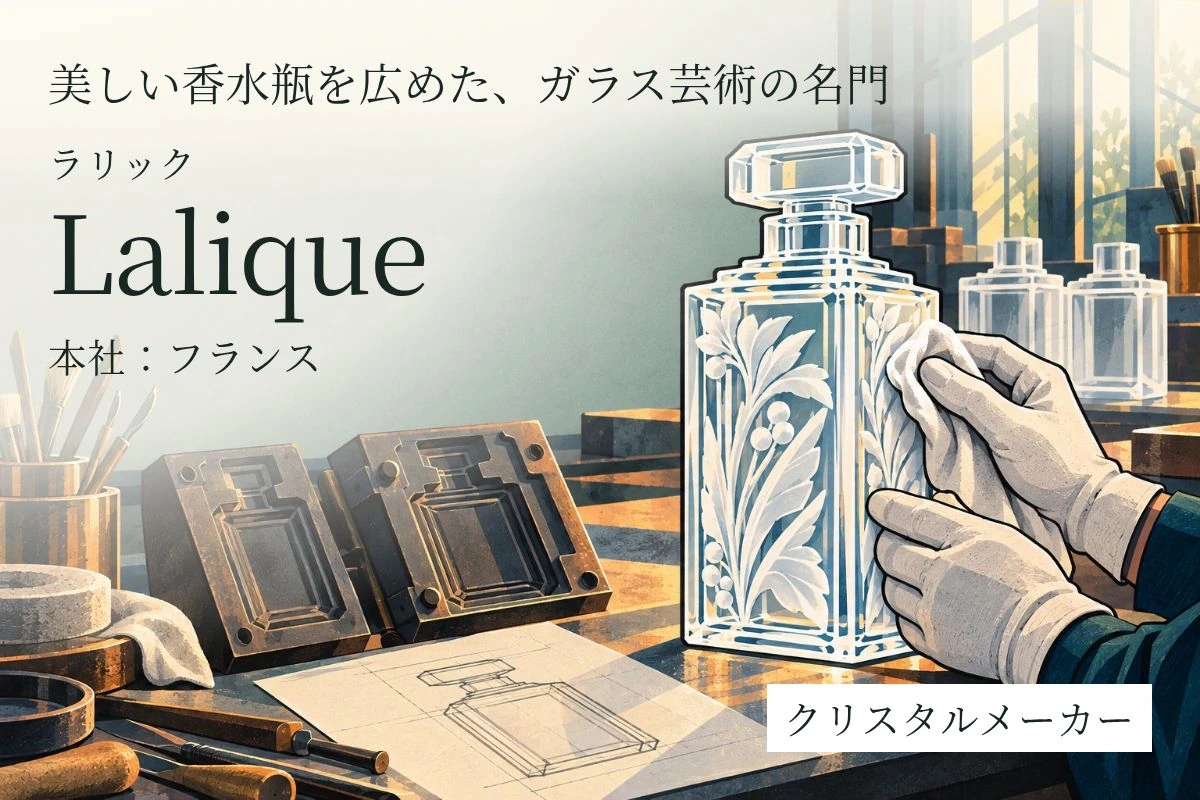
The perfumer François Coty was among those who commissioned Baccarat to make his early bottles. In his later collaboration with René Lalique, a label for L’Effleurt was created in 1908. Initially made of paper, the label subsequently became glass and was attached to a Baccarat crystal bottle. A different bottle made by Lalique himself followed in 1912. Perfume, label, and container were not always created by one person at the same time. Even the history of a single perfume brings together different makers and periods.
Looking at this period alongside Lalique’s work on perfume bottles shows how perfume’s visual form developed through exchanges between perfume houses and several glassmakers.
Bottle Shapes and Shared Authorship in the Guerlain Collaborations
The Bee Bottle of 1853 and the Heart-Shaped Stopper of 1912
Treating Guerlain’s bottles collectively as Baccarat products would misrepresent their history. The bee bottle for Eau de Cologne Impériale, dedicated by Pierre-François-Pascal Guerlain to Empress Eugénie in 1853, was entrusted to Pochet du Courval for manufacture. Guerlain’s own official history states this explicitly.
L’Heure Bleue in 1912, by contrast, introduced a bottle suggesting an inverted heart, with a heart-shaped stopper. Guerlain identifies the stopper as a technical achievement of Baccarat’s crystal workshops. A bottle covered with bees differs from one whose outline and stopper create the impression. That distinction reflects not only different decorative subjects but also different ways of making a form.
What is being traced here is the creation of historical bottles. The fact that perfumes bearing the same names are still sold today does not mean that every current container uses the same material or manufacturer.
Shalimar’s Pedestal and Sapphire-Blue Stopper
For Shalimar in 1925, the image of a garden was incorporated into the vessel surrounding the perfume. Entrusted by Jacques Guerlain with designing the bottle, Raymond Guerlain took inspiration from the pools of the Shalimar Gardens and conceived a vessel resting on a pedestal. Its sapphire-blue crystal stopper was Baccarat’s work.
Rather than simply attaching a picture of the perfume’s subject, this bottle translates that subject into the vessel’s outline and colour. Raymond developed the design, and Baccarat realised it in crystal. Considering the authorship of a perfume bottle requires distinguishing the roles of inspiration, drawing, and manufacture.
Recreating the 1914 Tortoise Bottle in Red in 2024
The tortoise-shaped Flacon Tortue was created when Guerlain opened its Champs-Élysées boutique in 1914. The red edition made in 2024, 110 years later, is an example of a historical form recreated through a later expression of its material.
This version uses Baccarat’s red, produced from clear crystal and 24-carat gold powder. Craftspeople shape the molten material by hand, work its 88 facets, and polish it to reveal the brilliance of the red crystal. The sequence of surfaces suggesting a shell describes the form while also designing how its surface receives light.
Guerlain’s Dames de Table take over next. They add barbichage, combing the silk threads one by one, and a wax seal around the neck. Completion of the crystal bottle does not end the work of enclosing the perfume. The object passes from craftspeople working with the material to those working with threads and sealing.
Learning about the work of Guerlain’s Dames de Table makes the relationship between the container and its finishing easier to understand.
Turning a Drawing into a Form That Can Be Made in Crystal
A Draughtsman Connecting Designer and Manufactory
The transparency of finished crystal gives little hint of the paper, clay, plaster, and wax used during its creation. Yet in Baccarat’s workshops, work with those materials precedes the shaping of the crystal. From here, we look at the wider work of the manufactory as described by its craftspeople, rather than a process exclusive to any particular perfume bottle.
The visual artist and draughtsman Nicolas Ledoux worked as a glassmaker for around fifteen years. His role involves more than copying a requested form onto paper.
“In a way, I am the interface between the designer’s wishes and feasibility requirements”
Nicolas Ledoux, artist and draughtsman at Baccarat
Using pencil sketches, watercolours, and models, Ledoux explores how decoration will follow a shape. The designs are then transferred into engraving, cutting, gilding, or enamelling. The angles of surfaces and their curves determine not only the visible outline, but also how light reaches them. Experience in manufacturing provides the knowledge needed to transfer a design to the material without forcing it.
Designing a Mould That Can Open and Release Its Contents
Nathalie Blaise, who works on models and prototypes, usually handles clay, plaster, wax, and resin rather than crystal. She develops the moulds in which molten crystal will acquire its shape. In addition to a beautiful form, a structure is needed that allows the object to be removed from its mould without breaking it.
The difficult judgement is deciding where to place the mould’s parting surfaces. Studying the model, she reconciles the intended form with physical constraints. Some work involves making a mould from a wax original and casting crystal into it. Blowing is not Baccarat’s only method of forming an object.
When looking at a perfume bottle, we tend to focus on its outline and stopper. The manufactory’s design work considers that outline together with the mould that receives the material, the divisions needed to release it, and the processing that follows.
Craftsmanship Connecting Forming, Cutting, and Polishing
Reading Temperature and Shaping with Breath and Rotation
In hot working, molten crystal is gathered on the end of a rod and rotated to maintain the balance between its quantity and shape. It can be blown freely or inside a mould. A production account published by Baccarat Hotels in 2018 also describes the gradual cooling that follows forming, preventing excessive stress from remaining within the material.
Work at the furnace is not separate from forming. Melting technician Frédéric Cuny deals with weighing the batch and adjusting the furnace, as well as annealing before the piece passes to cold working. Annealing means cooling slowly under controlled temperatures. Work with heat extends to bringing the piece into a condition in which it can be cut.
“everything depends on a few degrees”
John Cremel, glassmaker at Baccarat
Cremel explains that if the material becomes too cold, it breaks, while if it is too hot, it cannot be worked. What is needed is not simply learning a fixed shape but reading the material’s continually changing condition. Including the experience of coordinating movements with colleagues, forming is not a process completed by one person’s dexterity alone.
Deciding Where and How Deeply to Cut, Then Polishing the Surface
Cooled crystal undergoes processes such as cutting, engraving, and polishing. Baccarat’s account of cold working describes, for example, a progression from a rotating iron wheel using water and sand to finishing with wooden, cork, and wool wheels. Decorative methods, including wheel engraving, acid treatment, and gilding, are chosen according to the piece.
Crystal cutter Anne-Sophie Rust uses diamond tools to carve geometric patterns according to drawings. Straight bevels and fan-shaped plant motifs known as palmettes are created from plans specified to the millimetre. She takes a rough piece in hand and refines its form as the work proceeds.
The engraver Bourgougnon, meanwhile, seeks a sense of three dimensions created by lines, surfaces, and the depth of the engraving. Rendering people, plants, or folds of cloth with a rotating grinding wheel requires knowledge of the structure of the subject. Even while remaining faithful to a drawing, the engraving retains the individual touch of each craftsperson.
The opening observation about the need to “think ahead” connects with this work. Material cannot be put back into cold crystal once it has been removed. Although the work may look like decoration added to an already completed transparent surface, the depth of the cut and the areas to be retained must be judged before cutting begins.
Quality Inspection Also Draws on the Experience of Eyes and Hands
Quality controller Murielle Couqueberg developed her sensitivity in the sandblasting department after joining the company. Inspection is not limited to finished objects; it also covers raw pieces immediately after forming.
“It is a role that requires seeing with your fingertips.”
Murielle Couqueberg, quality controller at Baccarat
She checks for cracks, impurities, bubbles, and small chips against aesthetic and technical standards. For some products, she also measures thickness with calipers and other tools. The finished result depends on more than those who cut and polish. Those who decide whether a piece is ready for the next stage or acceptable as a finished product also take part in its creation.
Keeping Historical Designs Alive Through Present-Day Collaborations
The limited-edition crystal bottle for Rouge 540, created for Baccarat’s 250th anniversary in 2014, also connects an earlier drawing with new production. It used a design drawn by Georges Chevalier in the 1940s. The 250 bottles made in 2014 should not be confused with perfume bottles manufactured in the 1940s themselves.
The bottle has 96 facets on the body and 64 on the stopper, 160 in total, and brought together glassmakers, cutters, and gilders. What matters here is less the fame of the perfume than the way different processes converge in one vessel. Preserving designs and realising them in material at a later date is one way the manufactory sustains its work over time.
A more recent example is L’Abeille Noire, presented by Guerlain, Baccarat, and jeweller Lorenz Bäumer in 2022. Limited to 22 pieces, it combines a black crystal body with clear wings faceted like diamonds. Distinct from the bee-patterned bottle of 1853, this collaboration gives the bee itself a three-dimensional form.
Baccarat continues to make special vessels with perfume houses, couture houses, spirits producers, and other clients. Both recreations of historical forms and designs made for new commissions depend on the people who transfer a drawing into material.
When looking at a perfume bottle’s surfaces and stopper, it is worth considering not only what its shape represents, but also where it was moulded, where it was cut, and where it was polished. Not every stage can be read from the outside, but the transparent vessel contains a history of making that is separate from the fragrance itself.
References
- Jean-Luc Bourgougnon. Baccarat’s official craftsperson portrait: engraving and decisions about removing material.
- The History. Baccarat’s founding, the introduction of crystal in 1816, and its present activities.
- Creation of custom-made art pieces. Bespoke containers and L’Abeille Noire, 2022.
- Baccarat, Rouge 540: A Legendary Perfume and Bottle. The 2014 press material: perfume-bottle production and an archival design.
- L’Effleurt perfume bottle. Musée Lalique: Coty and Baccarat, and the chronology of the label and bottle.
- La Maison Guerlain: History. The 1853 bee bottle, L’Heure Bleue in 1912, and the design of Shalimar.
- Shalimar, Guerlain’s iconic perfume, celebrates 100th anniversary. LVMH, 13 October 2025: Raymond Guerlain and Baccarat’s stopper.
- Le Flacon Tortue Red Edition by Baccarat. Guerlain’s official account: the 1914 original, the 110th-anniversary edition, and the working and polishing of 88 facets.
- Nicolas Ledoux. Baccarat’s official craftsperson portrait: reconciling a design with what can be made.
- Nathalie Blaise. Baccarat’s official craftsperson portrait: models, prototypes, and mould design.
- How Baccarat Glassware is Made, Part One. Baccarat Hotels, 15 November 2018: hot working.
- Frédéric Cuny. Baccarat’s official craftsperson portrait: melting, furnaces, and annealing.
- John Cremel. Baccarat’s official craftsperson portrait: temperature and teamwork.
- How Baccarat Glassware is Made, Part Two. Baccarat Hotels, 15 November 2018: cold working and polishing.
- Anne-Sophie Rust. Baccarat’s official craftsperson portrait: tools and the cutting of geometric patterns.
- Murielle Couqueberg. Baccarat’s official craftsperson portrait: quality inspection.