“Innovation drives our development.”
Hélène Marchand (General Manager France, Verescence, 2017)
The weight of a perfume bottle shapes the impression it makes in the hand. A thick glass base, corners reflecting light, liquid that seems to float inside: even small changes to these elements alter the appearance of a container of the same capacity. What, then, needs to change to make a bottle lighter while preserving the character of its perfume?
Verescence is a glassmaker approaching this question from both design and manufacturing. Proenza Schouler’s Arizona, with its asymmetrical interior; Narciso Rodriguez bottles coloured on the inside; Dior‘s lighter J’adore bottle. Following these different projects reveals that a perfume bottle depends not just on its outer shape, but on the distribution of glass, the placement of colour, and quality requirements that extend beyond filling.
Key Information
- Name: Verescence
- Origins of the business: Henri Desjonquères’s acquisition of the Verrerie du Tréport in 1896
- Adoption of the present name: 2016, continuing SGD’s perfume and cosmetics business
- Historic manufacturing base: Mers-les-Bains, France
- Main activities today: Development, forming and decoration of glass bottles and jars for perfume and cosmetics; glass insulators are a separate business
- Official website: Verescence
From a Glassworks in 1896 to a New Name in 2016
The Tréport Acquisition and a New Factory in Mers-les-Bains
The business began with Henri Desjonquères. In 1896, he acquired the Verrerie du Tréport in the Bresle Valley, at a time when glass was still mouth-blown. He built a new factory in Mers-les-Bains in 1924, and the first automatic machines were introduced in 1939. Acquiring the glassworks, building the new factory and automating production were distinct turning points.
The business eventually expanded from forming bottles to finishing their surfaces. A decoration site in Écouché-les-Vallées was acquired in 1968, followed by another in Abbeville in 1989. These two towns still connect glass production and finishing in France.
Saint-Gobain Desjonquères, SGD and Verescence
When tracing earlier names, we need to consider not only corporate identities but also the businesses they included at the time. In March 2007, Saint-Gobain announced an agreement to sell Saint-Gobain Desjonquères and its subsidiaries to a consortium of the investment funds Sagard and Cognetas, with Saint-Gobain itself reinvesting for a 20% stake. At that point, the specialty-bottle business included manufacturing for pharmaceuticals as well as perfume and cosmetics.
It was SGD’s perfume and cosmetics business that became Verescence in 2016. The new name followed the separation from the pharmaceutical business; a company with the same name had not existed continuously since 1896. Combining the French word verre, meaning glass, with a suffix expressing transformation, the name evokes changes both in the material and in the company.
South Korea’s Pacificglas joined in 2021. Current official information lists seven factories in four countries: France, Spain, the United States and South Korea. There are four glass-manufacturing sites and five decoration sites, with some factories performing both functions. Adding four and five to arrive at nine factories would misrepresent this structure.
Turning a Design into a Form That Can Leave the Mould
The Shoulder and Neck Finish: Conditions for Mass Production
A glass bottle’s drawing brings together the desired appearance and the form needed for production. The shoulder slope, for example, must allow the formed bottle to be released from the mould. The neck finish receives the pump or stopper and is already formed when the first rough shape is made. A freely drawn side profile is not necessarily a shape that can be released consistently from a machine.
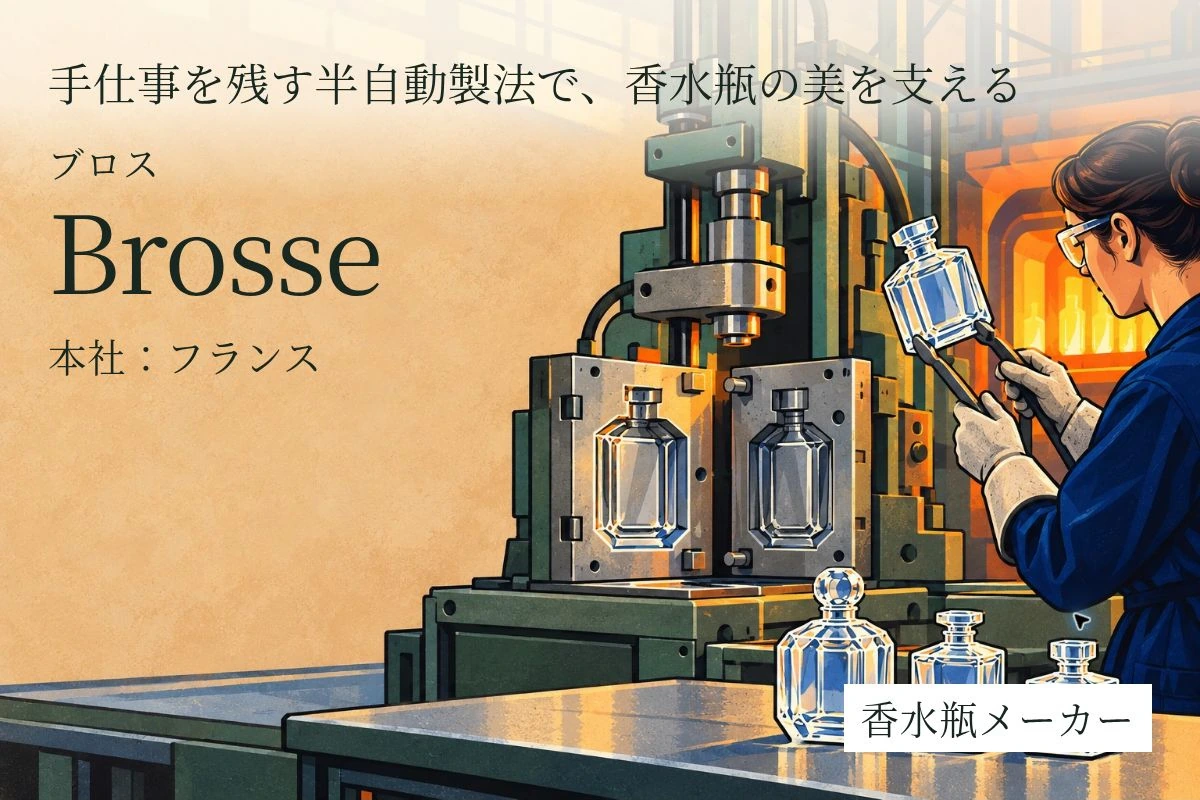
Molten glass travels through a channel called a feeder and is cut into portions corresponding to the bottle’s weight. Each portion is a gob. A blank mould creates an intermediate shape, which then takes its final form in the finishing mould. Some methods use blowing to form the glass; others press it in the blank mould before blowing it in the finishing mould. The design decision about where to retain thickness cannot be separated from these forming conditions.
The company also uses laser-engraved moulds to transfer fine patterns to the glass. Unlike drawing lines on a finished bottle, this creates surface relief during forming. Fire polishing, which reheats and smooths the surface, and subsequent annealing are also important. Annealing relieves the internal stresses caused by temperature differences after forming, preparing the bottle for decoration.
SCULPT’in and Arizona’s Asymmetrical Interior
This freedom in forming can be seen in a specific perfume bottle: Arizona, Proenza Schouler’s first fragrance, launched in 2018. Created in partnership with L’Oréal, its bottle drew inspiration from the ravines and ridges of the Sonoran Desert. Minerals brought back from their travels by designers Jack McCollough and Lazaro Hernandez also informed its conception.
Verescence used its proprietary SCULPT’in forming technology. By distributing glass asymmetrically, it created a structure in which the outer facets and the interior space do not uniformly follow one another. Samuel Joachim, who led development, described what the technology made possible:
“…create singular glass distributions inside bottles blown through a standard neck finish.”
Samuel Joachim (Director of Innovation and New Product Development, 2018)
The transparent layer surrounding the liquid is itself shaped, rather than simply making the exterior more complex. A coral-coloured gradient was then added by pad printing to emphasise the angles of the facets. The bottle was manufactured in Mers-les-Bains, with decoration expertise supplied by Abbeville. Forming and colour support the same idea while drawing on different specialisms.
Pad printing transfers ink through a silicone pad and can reach areas that are difficult to handle with screen printing. For Arizona, technology served not only to create a distinctive interior but also to determine how that form would be seen. SCULPT’in is not a shape shared by every product, but an option that makes such interior designs possible.
Where to Place Colour in the Glass
Colouring the Inside of Narciso Poudrée
A perfume bottle can be coloured within the glass itself or by applying colour to its surface after forming. Alongside a technique that adds colourants to the channel carrying molten glass to the forming machine, Verescence offers finishes including lacquering, printing and foil stamping. Nor is the exterior the only surface on which colour can be placed.
Narciso Rodriguez’s Narciso Poudrée uses COLOR’in to apply a pale pink to the inside of transparent glass. The coloured layer and the clear outer glass overlap, giving light a different appearance from that of a bottle coated entirely on the outside. Black screen printing sharpens the simple planes of the cube.
With the same approach to interior colouring, Tom Ford‘s Lost Cherry places a deep red inside, while Givenchy‘s L’Interdit Absolu uses opaque black. The latter also combines a recessed area in the glass with silver printing. Even when the underlying technology is shared, the balance between retaining transparent layers, concealing colour and reflecting light at the surface varies. Decoration involves designing which surfaces will be seen, not merely adding a final touch of colour to a finished shape.
How Lightweighting Changes Design and Quality Checks
Two 100 ml Versions of the Standard VERSO Bottle
Alongside bespoke design development, Verescence offers a catalogue of standard bottles. One, VERSO, is a rectangular container with horizontal shoulders and clearly defined edges. The current catalogue lists both a 180 g model and a lightweight 130 g model with a 100 ml capacity and an FEA 15 neck finish.
Although the capacity and neck finish are the same, the lightweight model has different height and depth dimensions. It would therefore be inaccurate to say that 50 g of glass has simply been removed from the same bottle. Capacity, external form and glass weight are reconfigured to select dimensions that work as a product. This comparison of standard products shows that lightweighting is a matter of designing the whole container, not a single operation that makes a heavy bottle thinner.
The company’s Glass Score is a proprietary indicator of a bottle’s degree of lightweighting in relation to weight and capacity, with ratings from A+ to F. In the 2023–2024 report, marketing specialist Bérangère Raguenet describes it as a tool to make it easier to prioritise a product portfolio by weight. Its role differs from life-cycle assessment, which examines several environmental criteria; a single letter does not certify the overall environmental performance of a container.
Raguenet also explains that not every design is suited to extreme weight reduction. If forming becomes more difficult and rejection rates rise, the result can be counterproductive for the overall environmental impact of manufacturing. The aim is not simply to pursue the lightness of one finished bottle, but to consider whether it can be produced consistently. In this respect, lightweight design and quality control address the same problem.
Testing J’adore’s Lighter Bottle through Filling and Transport
The official 2025–2026 report features Philippe Renault, who heads packaging development at Parfums Christian Dior. For J’adore Intense, the development brief required a reduction in weight while retaining the bottle’s iconic appearance and incorporating 20% post-consumer recycled glass.
“We spent over a year working with the teams at Verescence, […] to develop this bottle.”
Philippe Renault (Parfums Christian Dior, 2025–2026 report)
The 100 ml bottle weighs 110 g. According to the companies’ account, its glass weight is 46% lower than that of the previous 100 ml J’adore Eau de Parfum bottle. This does not mean that every size of J’adore, or the complete packaging, became 46% lighter.
New qualification and industrialisation procedures were also jointly developed to verify the integrity of the thinner bottle. They covered its journey from the manufacturing plant to the filling plant, filling with perfume, crimping the pump, attaching the neck component, and distribution to markets around the world. A sound appearance at the factory gate is not enough. Lightweighting also means ensuring that the container remains usable through the processes that follow.
Measuring Recycled Glass and Furnace Upgrades Separately
The Share of Bottles Containing Recycled Material Is Not the Recycled-Content Percentage
“However, we don’t believe in single solutions.”
Thomas Riou (CEO, 2019)
Riou followed these words by explaining the idea of combining lightweighting with recycled glass. Returning glass offcuts generated inside a factory to the furnace is different from collecting containers after consumers have finished using them and turning them into raw material. The latter is PCR, or post-consumer recycled material.
The company’s current Infinite Glass 20 and 40 product families contain 20% and 40% PCR glass respectively. Meanwhile, an official announcement in September 2026 stated that bottles containing PCR represented 92% of production in 2025. That does not mean that 92% of each bottle was recycled material. Separating the work of increasing recycled content from the work of expanding production that uses it makes the change represented by these figures clearer.
The 2026 Hybrid-Furnace Plan and the Scope of Measurement
Another challenge is how to obtain the heat needed to melt glass. In July 2025, Riou discussed a plan to replace furnace 6 in Mers-les-Bains with a hybrid system combining electricity and oxy-fuel combustion. The official September 2026 announcement also listed a furnace capable of operating on up to 80% electricity and 20% biogas, scheduled for commissioning that year. Specifications presented as a plan cannot simply be treated as a full year’s operating performance.
The same announcement reported a 35% reduction in the group’s Scope 1 and 2 CO₂ emissions in 2025 compared with 2019. Scope 1 covers direct emissions from the company’s own activities; Scope 2 covers emissions associated with purchased energy. This does not mean that Scope 3, which includes activities such as raw-material procurement and product transport, fell by the same proportion. These figures describe performance within the boundaries reported by the company.
Making the bottle lighter, incorporating recycled material and changing melting equipment are separate kinds of work. If refilling is also considered, neck finishes, pumps and the durability of decoration come into play. In 2025, Riou again advocated combining several solutions. Verescence’s examples reveal the work of designing both the technology that realises a form and the conditions that allow that form to remain in use.
References
- “Innovation drives our development”, Hélène Marchand, Verescence | Premium Beauty News, 3 October 2017. Original interview; business separation and technical development
- Our group | Verescence. History and current manufacturing sites
- Sale of Saint-Gobain Desjonquères | Saint-Gobain, 29 March 2007. Announcement of the sale agreement
- Glass: SGD changes name to Verescence | Premium Beauty News, 13 September 2016
- Glassmaking Glossary | Verescence. Moulds, neck finishes, forming, annealing and pad printing
- Our expertise | Verescence. Forming, fine engraving, decoration and recycled glass
- L’Oréal and Proenza Schouler launch Arizona | L’Oréal. Bottle inspiration and collaboration
- Proenza Schouler Just Launched Its First Fragrance—Here’s What You Need to Know | Vogue, 19 January 2018. Original interview with the designers
- Verescence creates an exceptional glass bottle with its SCULPT’in technology | Company announcement hosted by glasstec. Arizona’s forming and decoration, and Samuel Joachim’s comments
- Our perfume creations | Verescence. Narciso Poudrée, Lost Cherry and L’Interdit Absolu examples
- VERSO | Verescence. Dimensions and weights of the standard and lightweight versions
- Sustainability Report 2023–2024 | Verescence. Bérangère Raguenet’s explanation of Glass Score
- Sustainability Report 2025–2026, pp. 50–51 | Verescence. Interview with Dior’s Philippe Renault on lightweighting J’adore Intense
- “Consumers are looking for transparency”, Thomas Riou, CEO, Verescence | Premium Beauty News, 8 October 2019. Original interview
- 2025–2026 Sustainability Report | Verescence, 14 September 2026. Published information on recycled glass, emissions boundaries and the hybrid furnace
- “Verescence has very high expectations for the years to come”, Thomas Riou | Premium Beauty News, 14 July 2025. Original interview; furnace renewal and combined design approaches