Louis Vuitton is the first brand to have used clean technology to extract flowers, including jasmine and rose. We are releasing fewer dioxins than before in order to capture smells and use them in perfumes! This technology was first invented in the food and beverage industry, for uses such as producing caffeine-free coffee (decaf). I discovered the technology 20 years ago (around 1999) and asked my suppliers whether we could use it for perfumes to develop a collection of fragrance ingredients produced exclusively through carbon dioxide extraction.
In fact, I was the first perfumer in the perfume industry to use ingredients extracted by this method. That was 25 years ago: dried materials such as incense and cardamom were extracted using carbon dioxide and used in an Yves Saint Laurent perfume (note: probably Opium Pour Homme).
Jacques Cavallier
History and Method
This method has been gaining popularity since the 1980s and, as its name suggests, uses carbon dioxide (CO2) that has reached a supercritical state for extraction. In English it is called CO2 extraction. Because substances other than carbon dioxide may also be used, it is also called Supercritical Extraction or Supercritical Fluid (SCF).
Depending on temperature and pressure, substances take three states: solid, liquid and gas. Water (a liquid), for example, can become ice (a solid) or water vapor (a gas). Because these states depend on temperature and pressure, even at the same temperature a substance’s state changes if the pressure differs.
A graph of the temperatures and pressures at which liquid and gas coexist is called the vapor-pressure curve, and its upper limit is called the critical point. When the temperature and pressure are raised above this critical point, a single phase forms that cannot be distinguished as either liquid or gas. A substance in this supercritical state is called a “supercritical fluid.” Supercritical fluids have properties different from both liquids and gases, and small pressure changes produce large changes in density. Because a substance’s solubility (how much can dissolve) depends strongly on density, supercritical fluids, whose density can be controlled through fine changes in pressure, have come to be widely used for dissolution.
The critical point was discovered in 1822. In 1978, the technology for removing caffeine from coffee beans (decaffeination) was industrialized, and hop-extract production followed in 1982.
The critical point varies from substance to substance. For example, while water has a critical temperature of 374.2°C and a critical pressure of 22.12 MPa, carbon dioxide becomes a supercritical fluid at 31.1°C and 7.38 MPa, at room temperature and low pressure by comparison. This is why carbon dioxide tends to be used so widely. The low temperature and pressure also make it possible to extract essential oils without altering or degrading delicate raw materials. Extracts obtained in this way are called SFE (Supercritical Fluid Extract).
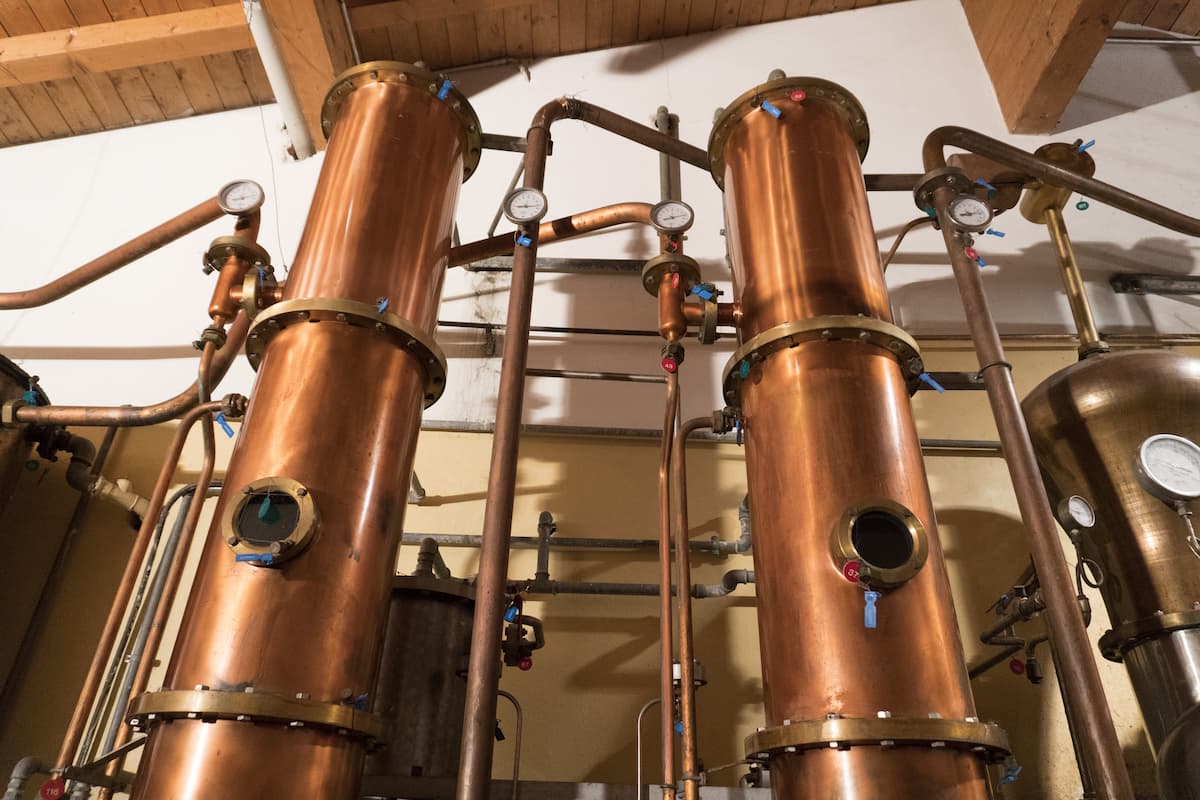
The extraction process is simple: the raw material is placed in a cylindrical extraction vessel, the temperature and pressure of the CO2 are changed, and the aromatic constituents are dissolved in the CO2.
The advantages and disadvantages of supercritical carbon dioxide extraction are as follows.
Advantages
・The low temperature makes heat-induced changes to aromatic constituents less likely.
・Extraction with carbon dioxide makes oxidation and alteration of aromatic constituents less likely, allowing a scent close to that of the raw material to be extracted.
・The process is simple and straightforward, and processing can be completed in a short time.
・Because carbon dioxide is nontoxic, residual solvent is not a safety concern.
・Because carbon dioxide is used, there is no risk of explosion; it is also environmentally friendly, odorless and leaves no lingering smell.
Disadvantages
・Solubility is lower than with organic solvents, so the amount extracted is smaller.
・Raw materials with a high water content, such as jasmine or lavender, involve additional costs; dried materials are therefore well suited to the method.
・The machinery is extraordinarily expensive, which also raises the cost of the essential oils.