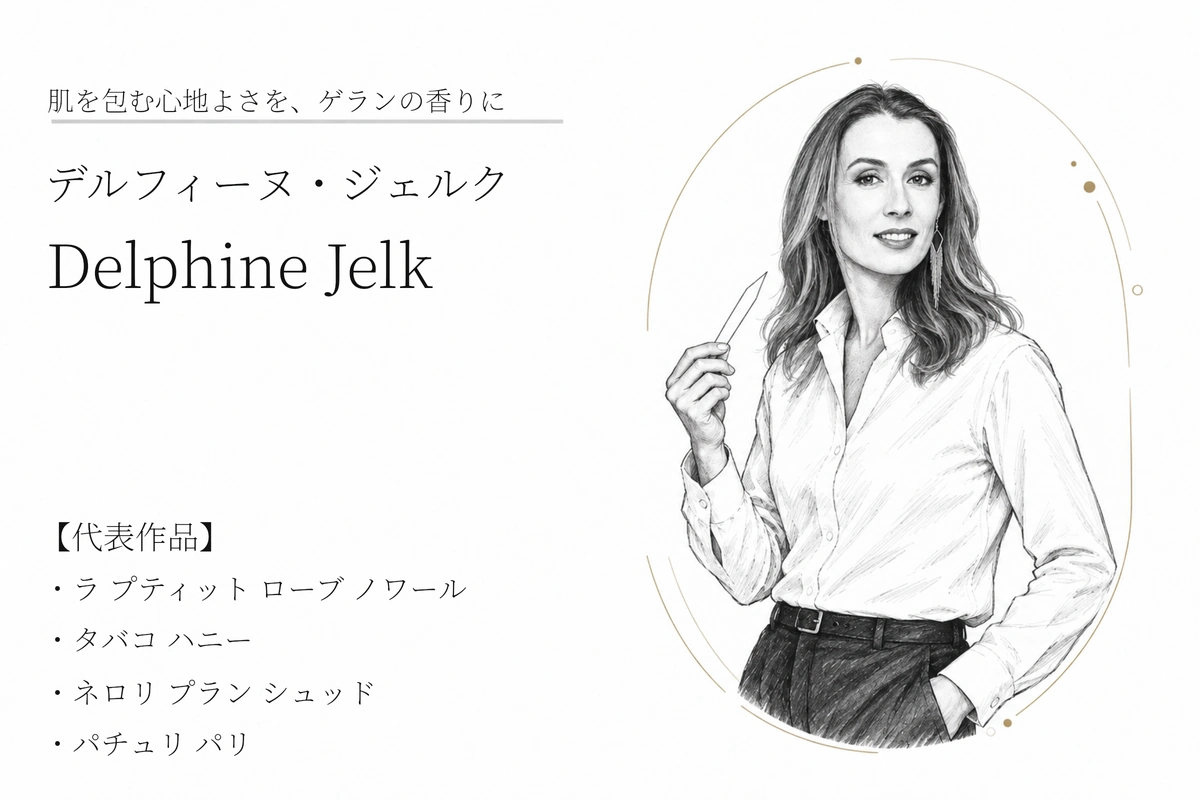
“I think of Cartier’s perfumes as invisible jewelry.”
Mathilde Laurent, from an interview with FACES magazine
Reportedly born on April 18, 1970, in Neuilly-sur-Seine, near Paris.
With one large diamond, there is no need to add a multitude of other gems around it. Mathilde Laurent invokes this idea from jewelry when explaining Cartier’s perfumes. She gives a leading ingredient clear prominence and moves people through the power of its scent. After learning tradition at Guerlain, she developed her own aesthetic at Cartier, eventually extending her work beyond the perfume bottle.
A Life in Perfumery
Between Photography and Fragrance
Laurent grew up with artist parents in Montparnasse, Paris. The neighborhood’s studios and railways, and Corsica, where she spent summer holidays, shaped her childhood memories.
While some records give Neuilly-sur-Seine as her birthplace, other publications describe her as being from Corsica. What she repeatedly discusses is the strong olfactory impression left by time on the island. She recalls being surrounded by the smell of the maquis, the Mediterranean scrubland, the moment an airplane’s door opened, describing it as a sensation like a slap on the cheek.
She loved taking photographs from her teens and originally considered becoming a photographer. Friends, meanwhile, suggested that since she smelled everything, she might become a perfumer. She did not immediately leap into the profession, but eventually had to choose where to direct her interests.
After studying chemistry and physics, she entered the ISIPCA perfumery school in 1992. Capturing the visible through photography and expressing the invisible through scent: these two interests remained connected even after she chose perfumery.
Eleven Years with Jean-Paul Guerlain
As a student, she approached Jean-Paul Guerlain herself and secured an internship. It was a bold move, reportedly made by directly expressing her hopes when they met at school. That short internship led to a long period of work.
She spent about eleven years at Guerlain, from 1994 to 2005. It was a time of working with high-quality materials and learning on the job how traditional perfumes were constructed. Among the lessons from her mentor, she cites an uncompromising attitude toward quality.
In 1999, she worked on Aqua Allegoria Pamplelune and Herba Fresca. These are clear-cut fragrances taking citrus bitterness or the green sensations of grass and mint as their themes. That year also saw the introduction of Guet-Apens, later known as Attrape-Coeur.
In Shalimar Eau Légère (2003), she reinterpreted one of Guerlain’s defining scents with a lighter expression. She was changing the way fragrance could be presented while working within a tradition.
Getting to Know Cartier from Within
In 2005, Laurent moved to Cartier. As its in-house perfumer, she initially created bespoke perfumes for clients at 13 rue de la Paix in Paris.
Cartier already had perfumes such as Must de Cartier (1981). Laurent’s arrival did not mark the beginning of a fragrance business from scratch. Rather, it was a turning point: bringing a perfumer inside the company established a way to build the brand’s expression into scent from within, as with its jewelry and watches.
At first, she needed to absorb Cartier’s atmosphere, which differed from what she had cultivated at Guerlain. In an office surrounded by gemstone, accessories, and jewelry departments, she encountered their choices of materials, forms, and working methods.
In La Réserve Magazine, she describes the beginning of creation as follows.
“First, I find a theme together with the team. At this stage, scent is not yet involved. When I start making the perfume, I know the result I want and how to get there. Then alchemy goes to work and casts its magic.”
Mathilde Laurent, from an interview with La Réserve Magazine
The sequence is not to begin by laying out materials, but to consider what the work will express, then translate that into the form of a fragrance.
From Roadster to Fragrances Exploring Time
Roadster appeared in 2008. From 2009, she developed Les Heures de Parfum, a series exploring time and sensation.
One of its fragrances, La Treizième Heure, or “The Thirteenth Hour,” won both the experts’ and perfumers’ prizes at the 2010 French perfume Grand Prix. Déclaration d’un Soir (2012) also won the men’s fragrance category at Olfactorama 2012, whose results were announced the following year.
Baiser Volé appeared in 2011, La Panthère in 2014, and L’Envol in 2016. Through both widely accessible perfumes and more experimental high-perfumery creations, she expanded Cartier’s olfactory world.
Creative Philosophy: Surprising with Familiar Materials
Laurent describes what she seeks as an aesthetic shock. In a 2026 interview with Forbes, she carefully distinguishes it from novelty for novelty’s sake.
“By ‘shock,’ I do not mean making something bizarre or strange simply to surprise people. It is a positive shock, one that moves you and feels somehow familiar.”
Mathilde Laurent, from an interview with Forbes
She uses familiar ingredients. By changing their combinations, quantities, and presentation, she creates a sensation that feels nostalgic even on first encounter. She likens it to redealing cards that everyone knows.
That thinking also appears in how she selects materials.
“I use the important ingredients to a point that could be called excessive, and place as little that is superfluous around them as possible. Simplicity creates emotion. I like a composition that resembles a soloist surrounded by a choir.”
Mathilde Laurent, from an interview with FACES magazine
Rather than complete silence around the protagonist, there is accompaniment that makes the leading voice easier to hear. The jewelry and music analogies share the idea of how to reveal a central beauty.
She is also cautious about using only favorite materials. Bringing personal preferences into a formula might lead to making the same perfume for different briefs. What matters, in her view, is not a favorite ingredient but the ingredient that the particular creation needs.
While interested in wildflowers and peonies, she has also said that when working with flowers already expressed in many perfumes, such as rose and jasmine, she wants to transform them into something different. Rather than judging the worth of the flowers themselves, this reflects a reluctance to repeat familiar expressions in her work.
She explains the distinction between high perfumery and fragrances intended for a broad audience by saying that the former emphasizes exploration of materials and combinations, while the latter needs a recognizable, timeless signature that tells the brand’s story. In either case, the wearer’s feelings cannot be predetermined. Different memories and experiences produce different responses to the same smell.
Signature Fragrances and Their Backgrounds
Guet-Apens / Attrape-Coeur: A Long-Remembered Creation for Guerlain
Guet-Apens (1999) was introduced as a limited edition and returned in 2005 as Attrape-Coeur. Rose, violet, iris, vanilla, woods, and amber come together in a rich, enveloping fragrance.
Earlier accounts sometimes attached Jean-Paul Guerlain’s name to it, but specialist publications have revisited it as Laurent’s creation. In a 2012 interview with Persolaise, she herself recalled it as a work of personal importance.
With the richness of traditional Guerlain but a softly expansive feel, it offers a perspective on Laurent’s sensibility different from her later Cartier fragrances.
Baiser Volé: Depicting a Whole Lily
Baiser Volé (2011) takes the lily as its theme. Yet it does not isolate only the sweet smell of the petals. It constructs an entire plant, from the greenness of stem and leaves to the powderiness of pollen and the flower’s abundant presence.
Rather than multiplying showy flowers into a lavish bouquet, it enters deeply into a single bloom. It recalls the soloist analogy of bringing the main ingredient into prominence. At the same time, it was Laurent’s own way of questioning why women’s perfumes should always repeat the same sweetness or bouquets.
La Panthère: The Myth of a Fragrant Panther
La Panthère (2014) was inspired by Cartier’s emblematic panther. This is not a description of the body odor of an actual panther, but an ancient legend of a panther that attracts other animals through its sweet scent.
It combines gardenia’s floral richness, animalic musk, and a chypre framework. Bringing together the seemingly distant sensations of flowers and wildness expresses Laurent’s taste for contrast.
The perfumer approaches from an olfactory perspective an animal Cartier knows well as a sculptural form. This theme later developed into a spatial installation.
Carat: From Seven Flowers to a Single Light
Carat (2018) sought to express the qualities of a diamond’s light through floral scents. Violet, iris, hyacinth, ylang-ylang, narcissus, honeysuckle, and tulip: images of seven flowers overlap to depict an abstract flower that does not exist in nature.
As though returning the rainbow’s colors to a single light, it creates a new flower from a bouquet. Laurent likens this to an olfactory decomposition and reconstruction of light. For someone who loves photography and perceives smells as images, it is a characteristic construction of scent from a visual idea.
L’Envol: Entering a Fragrance
L’Envol (2016) has a name meaning “flight.” Through a honey-like softness and transparent expansiveness, it portrays a sensation of floating into the sky.
The following year, the fragrance led to a cloud suspended inside a glass cube. Instead of spraying perfume onto the wrist, people walk into a scented space. It is an experiment in changing the very way fragrance is worn.
OSNI: Creations Beyond the Perfume Bottle
OSNI, or Objet Sentant Non Identifié, means something like “unidentified scented object.” It is Cartier’s series of olfactory expressions. The first, Le Nuage Parfumé, or “The Scented Cloud,” was unveiled in front of the Palais de Tokyo in Paris in 2017.
Working with climate-engineering firm Transsolar, Laurent suspended a cloud inside a glass space. Visitors climbed a spiral staircase and, on passing through the cloud, experienced the air’s temperature and the scent of L’Envol.
Laurent explained the intention behind the work to Artnet.
“This is not a product launch. It is intended to open a door to contemporary olfactory art. I wanted to show that perfume inspired by poetry can move emotions just as music or film can.”
Mathilde Laurent, speaking to Artnet
The scented-cloud experience was also presented at the Louvre Abu Dhabi in 2019. In 2022, the second work, Le Mythe Parfumé, or “The Scented Myth,” was presented at Les Invalides in Paris. Created with the Bureau of Extraordinary Affairs, it layers light and scent to express the panther’s mythical presence.
Both are works to experience physically before putting impressions of perfume into words. They can be understood as an extension of what Laurent calls aesthetic shock into scent, light, and space.
An Aside…
Laurent does not wear perfume to work, nor does she wear it every day. If her nose becomes accustomed to her own perfume, it makes it harder to assess a fragrance in development objectively. This does not mean she never uses it: in a 2024 interview, she said she wears a perfume that has particularly moved her about once a month.
Tea is something to which she is especially attached. She is said to enjoy Korean Jukro and is drawn to the act of appreciating fragrance through a drink.
“To me, tea is perfume you drink.”
Mathilde Laurent, from an interview with La Réserve Magazine
Her interest in photography continues. Interviews also describe her white-streaked hairstyle and extensive collection of Converse sneakers, but as memorable as her visual individuality is her continued effort to think about smell in her own words.
In La Réserve Magazine, she also says that thinking in a quiet room with white walls suits her better than finding inspiration by chance on her travels. Alongside her strong memories of Corsica, the actual creative work advances through time spent reconstructing memories in her mind.
Perfume Creations
Major works are listed chronologically. Ranges are given where announcement dates differ from release dates in individual markets.
| Year | Brand | Fragrance | Co-perfumers and Notes |
|---|---|---|---|
| 1999 | Guerlain | Aqua Allegoria Pamplelune | Jean-Paul Guerlain |
| 1999 | Guerlain | Aqua Allegoria Herba Fresca | Also described as a collaboration with Jean-Paul Guerlain |
| 1999 | Guerlain | Guet-Apens | Returned as Attrape-Coeur in 2005 |
| 2002 | Guerlain | No. 68 / Cologne du 68 | The 2002 version, distinct from Sophie Labbé’s 2006 version |
| 2003–2004 | Guerlain | Shalimar Eau Légère / Shalimar Light | Names and years differ by market and version |
| 2008 | Cartier | Roadster | — |
| 2009 | Cartier | L’Heure Promise, L’Heure Brillante, L’Heure Folle, L’Heure Mystérieuse | — |
| 2009–2010 | Cartier | La Treizième Heure | Introduced in 2009; awarded in 2010 |
| 2010 | Cartier | L’Heure Fougueuse, L’Heure Défendue | — |
| 2010–2011 | Cartier | L’Heure Diaphane | Sources differ on the year |
| 2011 | Cartier | Baiser Volé, Cartier de Lune, L’Heure Convoitée | — |
| 2012 | Cartier | Déclaration d’un Soir | — |
| 2012–2013 | Cartier | Eau de Cartier Goutte de Rose | Some sources give a 2012 announcement and 2013 release |
| 2014 | Cartier | La Panthère, Baiser Volé Lys Rose | — |
| 2014 | Cartier | Oud & Musc, Oud & Oud, Oud & Rose | — |
| 2015 | Cartier | Must de Cartier Gold, L’Heure Perdue, Oud Radieux | — |
| 2016 | Cartier | L’Envol, Oud & Santal, Oud Absolu | — |
| 2016 | Cartier | La Panthère Édition Soir, La Panthère Noir Absolu | — |
| 2018 | Cartier | Carat, Déclaration Parfum | — |
| 2020 | Cartier | Pasha de Cartier Parfum | — |
References
- Wikipedia — Mathilde Laurent (French edition)
- Wikipedia — Mathilde Laurent (English edition)
- FACES — Interview: Mathilde Laurent (2024)
- La Réserve Magazine — Mathilde Laurent: She exudes happiness
- Forbes — Mathilde Laurent On Cartier’s Art Of Olfactory Shock (2026)
- The Perfume Society — Exclusive interview with Cartier’s in-house perfumer, Mathilde Laurent
- The Week — Mathilde Laurent: translating Cartier’s stones into scent
- The Cut — Cartier’s Perfume Guru Really Loves Converse Sneakers
- Lampoon — Carat, Cartier: The jewel of a scent, according to Mathilde Laurent (article cited by the source draft)
- Olfastory — Mathilde Laurent
- Persolaise — You’ll Always Have The Truth: An Interview With Mathilde Laurent (2012)
- The Candy Perfume Boy — The Soul of the Panther (2015)
- Artnet News — With a Scented Cloud Floating in Paris, Cartier Transformed Perfume Into a Work of Art (2017)
- Wallpaper — Cloud bursting: Cartier and Transsolar imagine the scent of the sky
- Transsolar — Unidentified Scented Object in Times of Climate Change
- ELLE UK — Cartier Are Evolving Perfume Into A Multi-Sensory Experience (2022)
- A Shaded View on Fashion — OSNI 2 The Scented Myth by Cartier (2022)
- Now Smell This — Mathilde Laurent
- Now Smell This — Must de Cartier Gold (2015)
- Now Smell This — Guerlain 68 (2006; also discusses the 2002 version)
- Fragrantica — Mathilde Laurent
- Olfactoria’s Travels — Guerlain Guet-Apens / Attrape Coeur