Ingredient Guide
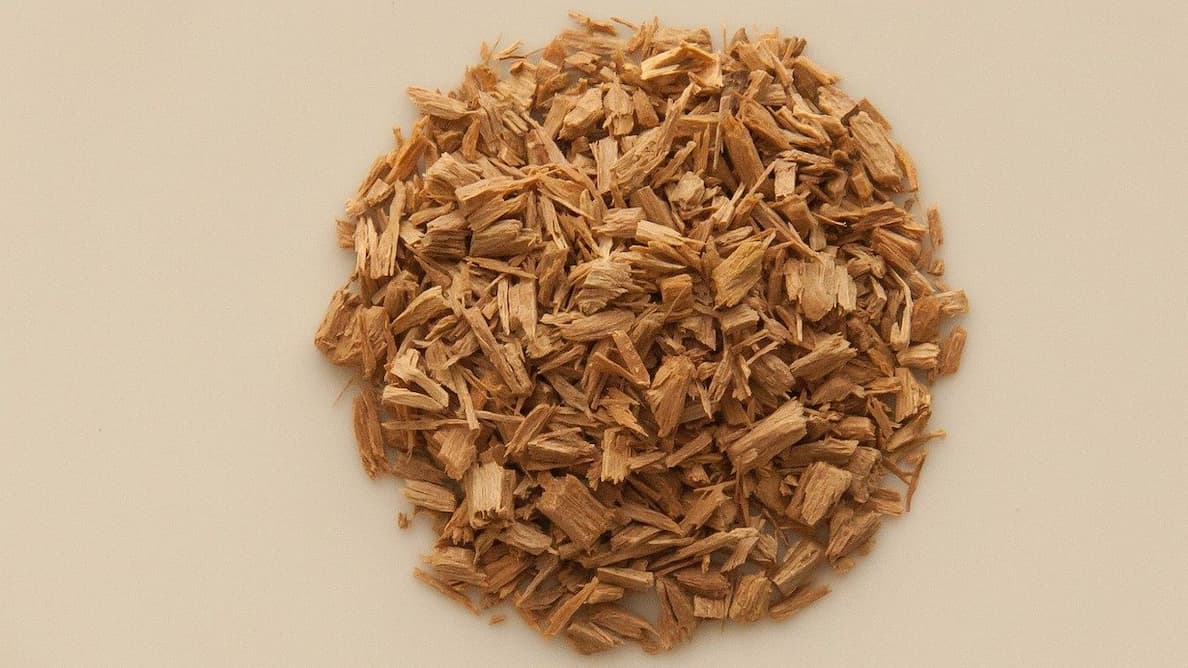
Agarwood is a fragrant wood from the Thymelaeaceae family, also known by the Arabic names oudh and oud. It has many regional names, including wood of the gods, water-sinking wood, eaglewood, calambac, and gaharu.
When a tree is injured and fungi enter it, it secretes an aromatic resin to protect itself. This gradually hardens and changes from deep brown to black. Interestingly, the original wood and leaves have no scent. The resin makes the parts of the wood where it accumulates heavier than normal, so they sink in water. This is why it is also called jinsui kōboku, or jinkō, meaning “sinking fragrant wood”.
Drying and heating this resin releases its distinctive aroma, which varies somewhat from tree to tree. Only 12 ml of oil can be obtained from 20 kg of material, making it one of the most expensive fragrance ingredients. Even ordinary grades cost around ¥800,000, while the highest grades cost at least ¥3 million. It is available not only as an oil but also as a powder.
Today, it is cultivated on plantations in South and Southeast Asia, including Bangladesh, Bhutan, India, and Laos.


Kyara, History, and Perfume
For a long time, perfumers paid no attention to oud. Now, however, it has become part of our palette. This is because its scent has the sensuality that we have become accustomed to using in animalic notes over the past twenty years. To protect animals, we can no longer use animal-derived fragrance ingredients. Oud was a good alternative. Another reason is that it is a powerful material with a very long-lasting scent.
Francis Kurkdjian
The tree that produces agarwood, scientifically named Aquilaria agallocha, is said to take about twenty years to mature, fifty years to produce agarwood, and one hundred to one hundred and fifty years to yield high-quality material. As with wine, older trees are considered to contain a higher concentration of resin, and older resin is considered better in quality.
The very highest grade is called “kyara” and has characteristics quite unlike ordinary agarwood: its resin is sticky, fragrant even at room temperature, and moist to the touch.
Oud is thought to have reached Japan around the sixth century. The Nihon Shoki records that a huge piece of fragrant wood that washed ashore on Awaji Island was presented to Empress Suiko.
A large piece of sinking fragrant wood, big enough to fill one’s arms, washed ashore on Awaji Island. Unaware of what it was, the islanders put it in a stove and burned it with their firewood. Its smoke carried a fragrance far into the distance, and, finding this remarkable, they presented the wood to the imperial court.
Nihon Shoki
The perfume believed to have first brought oud from the Middle East into Western perfumery is Yves Saint Laurent’s M7 (pronounced “em set,” 2002, Alberto Morillas and Jacques Cavallier). Incidentally, its creative director at the time was Tom Ford!
From there, French-style oud perfumes appealing to the Middle Eastern market gradually increased, in a kind of reverse import.
In the mainstream, examples include:
• Oud Wood (Tom Ford, 2007, Richard Herpin)
• Versace Pour Homme (2008, Alberto Morillas)
In niche perfumery:
• Kilian’s Arabian Nights Collection (from 2009)
• Oud 27 (Le Labo, 2009, Vincent Schaller).
The unprecedented oud boom that began around 2010 has continued to the present, and many oud perfumes are now on the market.

Scent
The scent of (1) agarwood burned in kōdō, the Japanese incense tradition, is completely different from (2) the Western-market fragrances called “oud perfumes.” And (3) the natural fragrance material agarwood oil also differs from the scent of incense.
For (1), I perceive the agarwood rising from the incense burner as a sweet, warm, dry, spicy woody note: a pure fragrance that calms the mind.
By contrast, (2), “oud perfumes,” have an animalic, rich, lustrous, sensual scent that stirs the emotions.
As for (3), the natural fragrance material extracted from agarwood is very powerful, with a cresolic odor and animalic, leathery facets. It gradually becomes smoky, tobacco-like, woody, and balsamic.
It has some resemblance to animal-derived castoreum, although castoreum is actually milder.
Satori Osawa
There are three main methods of extracting agarwood oil: hydrodistillation, steam distillation, and supercritical carbon dioxide extraction.
The essential oil is described as having an intensely animalic character and a bittersweet quality, with a scent that seems to transport you to heaven. Because it is exceptionally expensive even among fragrance ingredients, the natural material is rarely used, and when it is, the amount is often very small. Oud is also frequently represented with synthetic fragrance materials or other ingredients, such as patchouli, amyris, and incense. Even Kilian has acknowledged that the oud used in his own brand is synthetic.
Generally, you can tell from the price whether real oud is used and in what quantity. Some people claim that no oud perfume uses real oud at all, but given how minute the amounts are, that may not be much of an exaggeration.
Furthermore, oud made with synthetic ingredients has only a straightforward woody and leathery scent, lacking the warm, balsamic sweetness.
For comparison, Frédéric Malle spends its money on the finest fragrance materials rather than advertising and marketing, with prices varying according to the ingredients. Its The Night, by Dominique Ropion, contains oud at a concentration of 21% and costs $1,600 for 100 ml, or about ¥170,000. This can be considered one point of reference.

Perfumers and Industry Figures on Oud
Oud perfumes are a little like the oriental perfumes of an earlier era. Everyone wants oud, and perfumes named oud are released, but it is an illusion. Just as oriental perfumes have nothing at all to do with the actual Orient, real oud has nothing to do with oud perfumes.
Frédéric Malle
Oud is one of my favorite fragrance ingredients. I always want to put it in perfumes, but real oud is very precious and difficult to find. The first time I used it in a perfume was in Eau de Cartier.
Mathilde Laurent
Perfume reflects the personalities of those who have power and money. That is why oud-based perfumes, much as gourmand perfumes became popular, are developing into a true fragrance family of their own.
Francis Kurkdjian
What Does It Smell Like in Perfume?
In perfume, agarwood, or oud, has a deep scent that layers dense woodiness with smoke, leather, resin, and animalic warmth. The aromatic constituents of natural oil vary with the Aquilaria species and its origin, giving the scent a broad range of expressions. Alongside natural oil, perfumery uses oud-reconstruction materials that combine several natural and synthetic ingredients. OUD LAOS FIRBEST and OUD SAMRAT, for example, are reconstitutions that build woody, animalic, and balsamic facets; they differ in their makeup from natural oud oil.
For Those Who Love Oud
If you enjoy oud fragrances, this is a blog I warmly recommend reading.

Written by an oud lover who buys many perfumes containing oud and reviews them, it has so many reviews that I wonder whether anyone else in the world has reviewed this many oud perfumes.
I recommend it to anyone looking for an oud perfume or wanting to broaden their horizons!
How to Choose Oud Fragrances
If you enjoy the strength of wood and smoke, look for oud with spices or other woods. Rose and violet bring a more floral character. For a less sweet fragrance, the prominence of vanilla, tonka and amber matters as much as the intensity of the oud itself.
Comparing Oud Fragrances
Oud Wood Eau de Parfum (Tom Ford)
An oud focused on woods and spice rather than flowers. Rosewood and cardamom lead into sandalwood and vetiver, then tonka and amber.
OUD satin mood Eau de Parfum (Maison Francis Kurkdjian)
Damascena rose and a violet accord accompany the oud, with the sweetness of vanilla and amber. Floral richness surrounds the strength of the wood.
Find Your Next Fragrance
To explore more perfumes, open our Fragrance Finder. Choose “Favorite fragrances & notes” on the home screen, then search in the “Favorite notes” field. Select a note you like from the results and press “Next” to continue. You can start with notes even if you do not yet have a favorite perfume.