“Above all else, a perfume must smell good.”
As Guy Robert’s guiding principle, in Perfume Shrine’s tribute, 2012
Born January 29, 1926; died May 28, 2012.
Madame Rochas, Calèche, Dioressence, and Amouage’s Gold. Set Guy Robert’s major creations side by side, and a line runs through the glamorous history of perfume.
What sustained that line was the skill to make complex scents feel pleasing without stripping away their complexity. Flowers and woods, brightness and shadow, cleanliness and animal warmth: contrasting elements were layered together, yet ultimately felt like a single perfume.
Robert also put his techniques into words for posterity. In lectures, he laughed at perfumers’ arrogance; in his book, he explored the work of his predecessors; and he took part in efforts to preserve perfumes. Creating fragrances and passing on their world were inseparably connected.
- Perfumery History
- From a Grasse Family to a New York Laboratory
- Long Practical Experience with Materials and Bases
- Madame Rochas: Human Warmth Behind the Flowers
- Calèche and Équipage: Giving Hermès Its Outline
- Dioressence: Animal Depth Discovered by Chance
- Gold: French Composition Meets the Scents of Oman
- Thinking about Perfumery through Cooking, Music, and Painting
- Preserving Memories and Leaving Words Behind
- Incidentally… Becoming Humble after 52 Years
- Fragrance Creations
- References
Perfumery History
From a Grasse Family to a New York Laboratory
Robert was born in Grasse, France, in 1926. His grandfather Joseph Robert was one of the people who developed solvent extraction of floral scents at the fragrance company Chiris. His father, Victor Robert, was also a perfumer.
His uncle Henri Robert later created Pour Monsieur and N°19 at CHANEL. Perfumers such as Ernest Beaux and Henri Alméras are also said to have been close to the family.
Guy knew the world inhabited by perfumers before he knew perfumery as a profession. That environment was an important asset. From a young age, he encountered distillation and raw-material work in Grasse, and after the Second World War he went to New York. There, he worked under his uncle Henri and received thorough training.
It was a time to learn not only how to remember scents, but also how to organize and read formulas. His later book explains that rewriting someone else’s formula in the order he had used for years enabled him to understand its scent in his mind. It was the skill of reading a fragrance’s structure as a musician reads a score.
Long Practical Experience with Materials and Bases
From 1949 onward, Robert worked for several fragrance companies. Besides creating perfumes, he came to lead teams of perfumers, work with clients abroad, and teach younger perfumers.
His experience at De Laire, known for its compounded perfume bases, is important to understanding his technique. In a later paper, Robert wrote that in 1952 he had one of the company’s chemists make hexyl cinnamic aldehyde for him, enabling him to create the Mayciane series of bases.
Simply recognizing a new molecule does not make a perfume. A perfumer must see what floral impression it supports and how it works with other materials. From extraction techniques in his grandfather’s time to the design of bases using synthetic materials, Robert’s work rested on accumulated knowledge of both.
Later, he also worked and consulted for companies including Takasago, and spent a period at Quintessence in Paris. Besides perfume, he handled fragrances for soap, talc, deodorants, and cosmetics. Work that left his name attached to bottles of masterpieces was not the whole of a perfumer’s daily life.
Madame Rochas: Human Warmth Behind the Flowers
Madame Rochas, released in 1960, made Robert’s name widely known. The woman who commissioned it, Hélène Rochas, had lost her husband Marcel Rochas in 1955 and taken over the business at the age of 34.
The request was for a floral fragrance that was elegant and new, yet also easy for many people to love. One of the perfumes Robert had in mind was Lanvin’s Arpège. But rather than simply producing a similar scent, he sought to add a little more warmth to its background.
In the recollections of its creation presented by Michael Edwards, Robert recalled Caron’s Nuit de Noël: the effect of sandalwood close to the skin, as used by Ernest Daltroff.
Transferring that weight directly, however, would have covered Madame Rochas’s delicate flowers. He is said to have approached the desired warmth by combining a sandalwood-type material that provided lasting power with a material that helped the opening rise.
Aldehydes brightly illuminate flowers such as rose, jasmine, lily of the valley, and iris. Behind them is the soft support of woods and musk. Within a brief that called for approachability, Robert was perhaps seeking a way to make a fragrance suggest the warmth of a human body.
Calèche and Équipage: Giving Hermès Its Outline
The following year, 1961, brought Hermès’s Calèche. The official history positions it as the house’s first fragrance for women. Its name comes from the light carriage that symbolizes Hermès.
Calèche, too, has the richness of flowers and the brightness of aldehydes. Compared with Madame Rochas, however, attention turns more to the dry outlines of iris, vetiver, and chypre. Even in work by the same perfumer at a similar time, changing the roles of the materials changes the shape of the fragrance.
In the recollections Edwards relayed, Robert named Florel’s Fleurs Vertes as one source of inspiration. He enriched the floral and woody portions while retaining a light green-chypre impression. The role of each part was considered, from a lily-of-the-valley accent supporting jasmine to mandarin enlivening the citrus.
“An exceptionally feminine combination of delicate aldehydes, generously unfolding jasmine, and light rose.”
Hermès, official description of Calèche Eau de Toilette
In 1970, he created Équipage, Hermès’s first fragrance for men. Its name, drawn from the equestrian world, also evokes companionship and team spirit. The liveliness of herbs, the strength of spices, and the soft feel of woods: their balance is the fragrance’s appeal.
His work with Hermès also dates back to Doblis in 1955. Given predecessors such as Doblis, Calèche’s designation as the “first” is best read as its position within the house’s official history of fragrances for women.
Dioressence: Animal Depth Discovered by Chance
Dioressence, released in 1969, shows a different face from Robert’s bright florals. Dior wanted a fragrance with a strong animal character to accompany its fur collection.
A striking anecdote survives about the spark for its creation. After handling ambergris, Robert washed his hands with an inexpensive soap imitating the scent of Miss Dior; the two smells combined to suggest a new direction. Luca Turin related this story, which was also presented by Bois de Jasmin.
An expensive raw material and a cheap imitation: even when two things of different value meet, what reaches the nose is not their price but the result of their combination. Robert did not miss that unexpected overlap.
The original is described as a chypre layering the animal presence of ambergris with the warmth of patchouli and moss, rose, and jasmine. Max Gavarry reworked it in 1979, and the formula continued to change in later years. The current product, or later vintage examples, cannot simply be taken as Robert’s 1969 original.
Gold: French Composition Meets the Scents of Oman
In 1983, Amouage was founded as a house that would convey Oman’s fragrance traditions internationally. Robert was entrusted with its first perfume.
Frankincense from Dhofar and roses from Jebel Akhdar: the account of its creation presented by the World Intellectual Property Organization (WIPO) places materials from these two regions at the center. Many other materials were layered in, including myrrh, jasmine, lily of the valley, sandalwood, ambergris, civet, and musk.
“My ultimate symphony.”
As Guy Robert’s description of Gold, WIPO, “Designs, Fragrances, and Sustaining Traditions”
That metaphor probably means more than simply a large number of materials. Flowers, resins, woods, and animal warmth form one expansive fragrance rather than each asserting itself separately. In this work, the compositional skill Robert had refined over many years met the materials of Oman.
Gold Woman and Gold Man both remain among Robert’s major creations. Many fragrance references date both to 1983, although some accounts place the men’s version later. Descriptions of Gold as his “last work” also require caution, since Robert subsequently worked for La Prairie and The Pink Room.
Thinking about Perfumery through Cooking, Music, and Painting
Robert’s lectures have the candor of someone with extensive experience. At a British Society of Perfumers symposium in 1998, he questioned why the methods of perfumery had not been adequately put into words.
“Our art is so mysterious that many perfumers cannot explain the procedures they use when constructing their creations. Our methods resemble the art of cooking, a kind of empiricism. I think this means we are not taking our profession seriously enough.”
Guy Robert, lecture delivered in 1998. “Biogenesis of a Perfume,” published in Perfumer & Flavorist, 1999
He was not rejecting experience. Within it, he sought something corresponding to harmony and counterpoint in music.
Even materials suggesting the same impression of rose differ in strength and character: damascone, rose oxide, rose essential oil, geranium, rose absolute, geraniol, and phenyl ethyl alcohol, for example. Robert thought of them as levels resembling musical octaves.
He also understood the relationships between materials as akin to colors in painting. Just as adding more colors does not necessarily make a richer painting, piling up too many fragrance materials can lead to a gray confusion. What was needed to avoid this was the perfumer’s own palette.
“We are like painters. Some use simple colors; others prefer sophisticated ones. What matters is the result.”
Guy Robert, Les Sens du Parfum. Quoted in Now Smell This’s book review, 2007
Robert did not favor a simple formula-based answer to making a scent last, either.
“We hear many tunes every day and quickly forget them. But sometimes a tune will not leave our heads, and we whistle it all day. Its composer did not use a fixative to achieve that.”
Guy Robert, “Biogenesis of a Perfume,” Perfumer & Flavorist, 1999
This is not proof denying the physical properties of volatility or persistence in fragrance materials, but a metaphor conveying his aesthetics. To create a memorable perfume, simply adding long-lasting materials is not enough. He was raising the need to consider the appeal of the accord itself.
In his 1976–1977 paper “Base Notes of Perfumery,” too, he emphasized how a fragrance changes over time, rather than simply extending its lingering scent. A rich base is not made solely by the quantity of heavy materials.
Preserving Memories and Leaving Words Behind
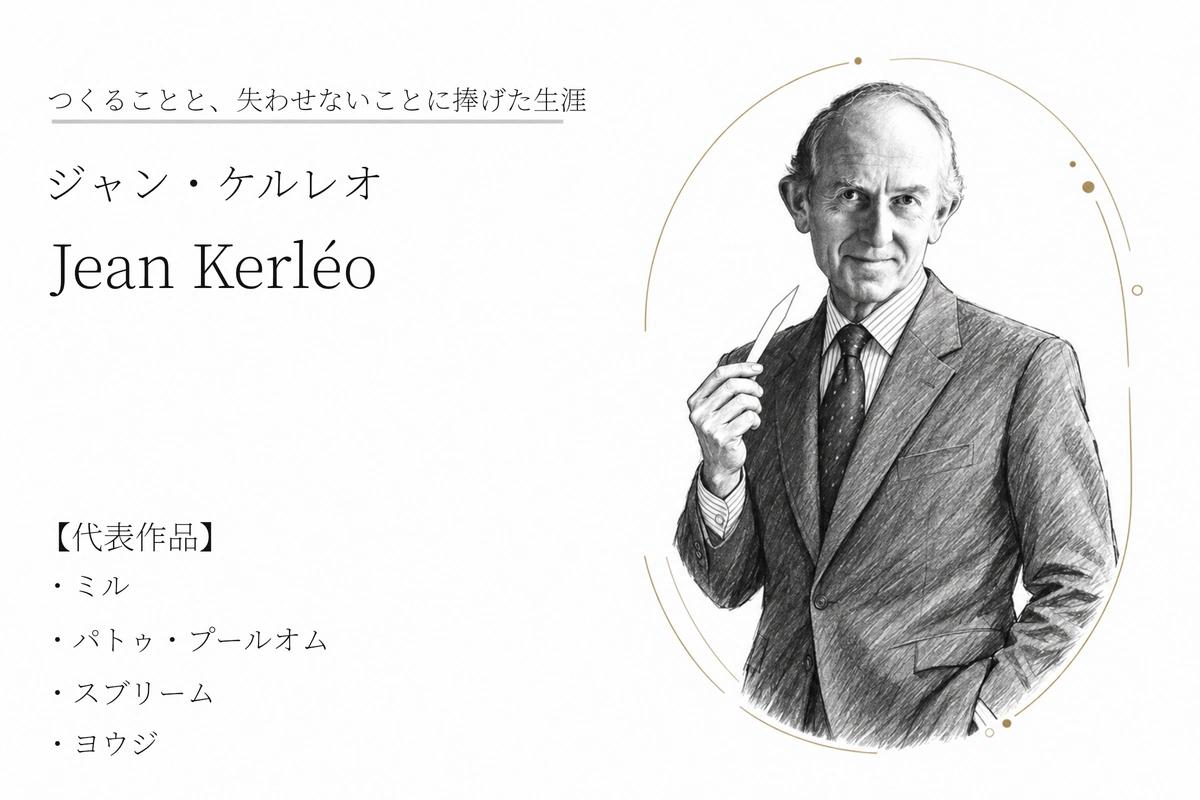
Robert served as president of the French Society of Perfumers and helped train the next generation. At the Osmothèque, the perfume conservation institution that opened in 1990, he participated as a member of the advisory committee in the founding plans led by Jean Kerléo.
The perfumes one has smelled do not necessarily continue to exist in the same form forever. Preserving fragrances that are disappearing through discontinuation or reformulation, together with their original formulas, was a role well suited to Robert, who valued knowledge of his predecessors’ work.
In 1983, he received the Hackforth-Jones Award in recognition of his achievements in creative perfumery. In 2000, he published Les Sens du Parfum.
The 224-page book covers olfaction, materials, perfume history, and methods of creation. Rather than simply a collection of recipes, it considers how earlier perfumers selected materials and developed their styles. The work of François Coty, Jacques Guerlain, Daltroff, Alméras, and others is discussed in terms of individual palettes.
He also assisted Edwards with Perfume Legends and the classification of fragrances. As well as creating new perfumes, he was someone to consult for an understanding of perfumes of the past.
Incidentally… Becoming Humble after 52 Years
Turin recalled Robert as an excellent jazz pianist, a lover of cooking, and a writer of novels. A conversation that seemed to be about perfume could turn to olive oil or restaurants. Though a specialist, he had pleasures beyond his specialty.
His view of the industry was sharp, however, and his lectures also contained irony. Young perfumers quickly want to write a book teaching perfumery; after gaining a little experience, they think themselves geniuses and regard those who criticize their work as fools. After describing this progression, he said of himself:
“Now, after 52 years of trying to understand perfume, I have become very humble.”
Guy Robert, “Biogenesis of a Perfume,” Perfumer & Flavorist, 1999
What he sought to the end was the difference between what truly makes a perfume work and what is merely piled into it. That question runs through both the opulence of Gold and the restraint of Équipage.
Robert died on May 28, 2012, aged 86. He left many perfumes, and words with which to think about perfume. “First, it must smell good.” Behind that apparently simple statement lay more than half a century of experimentation and memory.
Fragrance Creations
Same-name relaunches and different concentrations are listed separately only where necessary. “No record” in the co-perfumer column does not mean that no one else was involved in creating the fragrance.
| Year | Brand | Fragrance | Co-perfumers / Notes |
|---|---|---|---|
| 1955 | Hermès | Doblis (original) | No record |
| 1956 | Jean Patou | Lasso | No record |
| 1959 | Grès | Chouda | A fragrance known mainly through private use |
| 1960 | Rochas | Madame Rochas | No record |
| 1961 | Hermès | Calèche | No record |
| 1969 | Dior | Dioressence (original) | The 1979 reworking was by Max Gavarry |
| 1969 | Rochas | Monsieur Rochas | No record |
| 1970 | Hermès | Équipage | No record |
| 1974 | Gucci | Gucci N°1 | No record |
| 1974 | Mary Quant | Havoc | No record |
| 1976 | Gucci | Gucci pour Homme | A different fragrance from the later creation of the same name |
| 1979 | Menard | Mérefame Parfum | No record |
| 1981 | Menard | Mérefame Eau de Toilette | No record |
| 1983 | Amouage | Gold Woman | No record |
| 1983 | Amouage | Gold Man | Some accounts date the men’s version to 1988 |
| 1988 | Amouage | Amouage Cristal & Gold | No record |
| 1990 | La Prairie | One Perfect Rose | No record |
| 2000 | The Pink Room | Parfum N°1 (Parfum No 1) | Creative collaboration with the brand’s founder |
References
- “Guy Robert, Perfumer” Perfume Projects
- “Guy Robert” Parfumo perfumer catalogue
- “Gucci Pour Homme (1976)” Fragrantica
- “Perfumer of the Day: Guy Robert” V Perfumes, 2026
- “Guy Robert: Loving Tribute to a Legendary Perfumer” Perfume Shrine, 2012
- Michael Edwards “Guy Robert: A Tribute” The Perfume Magazine, 2012
- “In Tribute to Perfumer Guy Robert” Bois de Jasmin, 2012
- Guy Robert “Biogenesis of a Perfume” Perfumer & Flavorist, 1999
- Guy Robert “Base Notes of Perfumery” Perfumer & Flavorist, 1976–1977
- “100 Years of P&F” Perfumer & Flavorist, 2006
- “Les sens du parfum by Guy Robert” Now Smell This, 2007
- “Calèche Eau de toilette” Hermès
- “Équipage Eau de toilette” Hermès
- “Christian Dior Dioressence: Perfume Review” Bois de Jasmin, 2012
- “Designs, Fragrances, and Sustaining Traditions” WIPO
- “Hélène Rochas” French Wikipedia
- “Osmothèque” English Wikipedia