Early Life and Formative Encounters
Dominique was born in Paris, France, in 1955. Dominique’s father and grandfather worked at Roure in Argenteuil, northwest of Paris: the father was a chemist and the grandfather headed the accounting department. Through their influence, Dominique learned from an early age to see the world through scent, but had not yet imagined working in the industry. The earliest memory of perfume was Calandre (Paco Rabanne, 1969, Michel Hy), worn by Dominique’s mother.
I liked mathematics and science. But I liked the aesthetic side of the world even more.
Dominique Ropion
After passing the baccalaureate, Dominique initially studied physics and intended to become an engineer. The turning point came in the summer of 1971, at the age of 16, with an opportunity to intern at Roure as a laboratory assistant. After training in the chromatography department, Dominique was invited by the company’s then-president, Jean Amic, to try its perfumery school. There, Dominique met a young Pierre Bourdon, who joined in 1971, and the then-head perfumer, Jean-Louis Sieuzac, creator of YSL’s Opium in 1977. They taught Dominique that “perfumery is a profession of patience and learning.” Feeling that it was a good fit and fascinated by the process of composition, Dominique abandoned the plan to become an engineer and set out to become a perfumer.
At the time, Chanel’s third in-house perfumer, Jacques Polge, was also there. While Polge was composing YSL’s Rive Gauche, Dominique weighed out the formula for Polge.
Apprenticeship and the Blossoming of Talent
After three years of training in Grasse, Dominique began working as a junior perfumer at Roure in 1976. By then, Jean-Louis Sieuzac, the future mentor whose influence had prompted Dominique to become a perfumer, was no longer at Roure but held a senior position at Florasynth, later Symrise. Back in Paris, Dominique demonstrated talent through home fragrances, hairsprays and shampoos.
There were hardly any difficult techniques, and we did not use many ingredients. Composing fragrances for toiletries was very interesting and taught me a great deal. I even made toilet cleaners based on famous women’s fragrances.
Dominique Ropion
In 1984, Dominique entered a Givenchy competition with a perfume that had taken 18 months to develop, and it was selected. This was Ysatis, which would establish itself as one of the brand’s great fragrances. From this point, Dominique Ropion’s name began to become well known within the industry.
I like the idea of creating perfume like a sculptor or an architect. When I study scientifically how to construct with natural ingredients and move toward the heart of it, I am suddenly seduced by its beauty, and it is deeply satisfying.
Dominique Ropion
Dominique worked at Roure for about 12 years, from 1976 to 1989. Frédéric Malle joined Roure in 1988, meeting Dominique, a future collaborator, at that time. By then, Dominique’s abilities were already such that the perfumers in the fine fragrance division regarded Dominique as a future star.
In 1989, wanting to work with Jean-Louis Sieuzac, Dominique moved to Florasynth. Jean was then head perfumer at the company’s laboratory and had worked with Michel Almairac to create Fahrenheit (Dior, 1988). Having developed as a perfumer, Dominique teamed up with the mentor Jean to create a succession of wonderful scents, including Dune (Dior, 1991) and Amarige (Givenchy, 1991). Absorbing knowledge from the gifted Jean and independently studying techniques in great perfumes such as No. 5 and Shalimar, Dominique was steadily progressing toward becoming one of the world’s finest perfumers.
A perfumer must be a craftsperson. We constantly encounter so many different fragrance materials. Where do I find inspiration? I often find it in a central theme surrounding a single ingredient. Then I sketch its contours, volume and contrasts. People often say that the vocabularies of music and perfume are very similar, but I think the perfumer’s profession is something more tangible.
Dominique Ropion
Leaving a Mentor to Follow an Independent Path
After beginning work at Dragoco in 1998, Dominique rekindled the friendship with Malle from the Roure years and began composing the first perfume for Frédéric Malle, Une Fleur de Cassie. Dragoco was not a particularly happy place for Dominique, who recalls that the time spent creating a perfume for Malle recharged Dominique’s batteries.
Dominique joined IFF’s Paris branch in 2000. At IFF, Dominique also worked with Olivier Polge, who was at the company from 1998 to 2014. Olivier is the son of Jacques Polge, for whom Dominique had helped weigh formulas as a student.
In 2008, Dominique received the Prix François Coty.
In 2018, following Carlos Benaïm, Dominique became IFF’s second master perfumer. Incidentally, the Prix François Coty, revived that year after a ten-year hiatus, was awarded to Émilie Coppermann, whom Dominique had mentored.
He is probably the most skilled perfumer working today. And Dominique is always open to new ideas. Other top perfumers are not always flexible in their thinking.
Frédéric Malle
Incidentally…
To a perfumer, the scent of flowers is as valuable as gemstones are to a jeweler.
Dominique Ropion
• In the perfumery world, Dominique is known as the “Master of Flowers.”
• Asked about favorite ingredients, Dominique names flowers and cashmeran.
• At the perfumery school ISIPCA, Dominique mentored Fanny Bal and formally took Bal on as an apprentice at IFF after graduation. Dominique later introduced Bal to Malle, and in 2017 Bal composed Sale Gosse, Frédéric Malle’s first perfume for children, at just 29 years old.
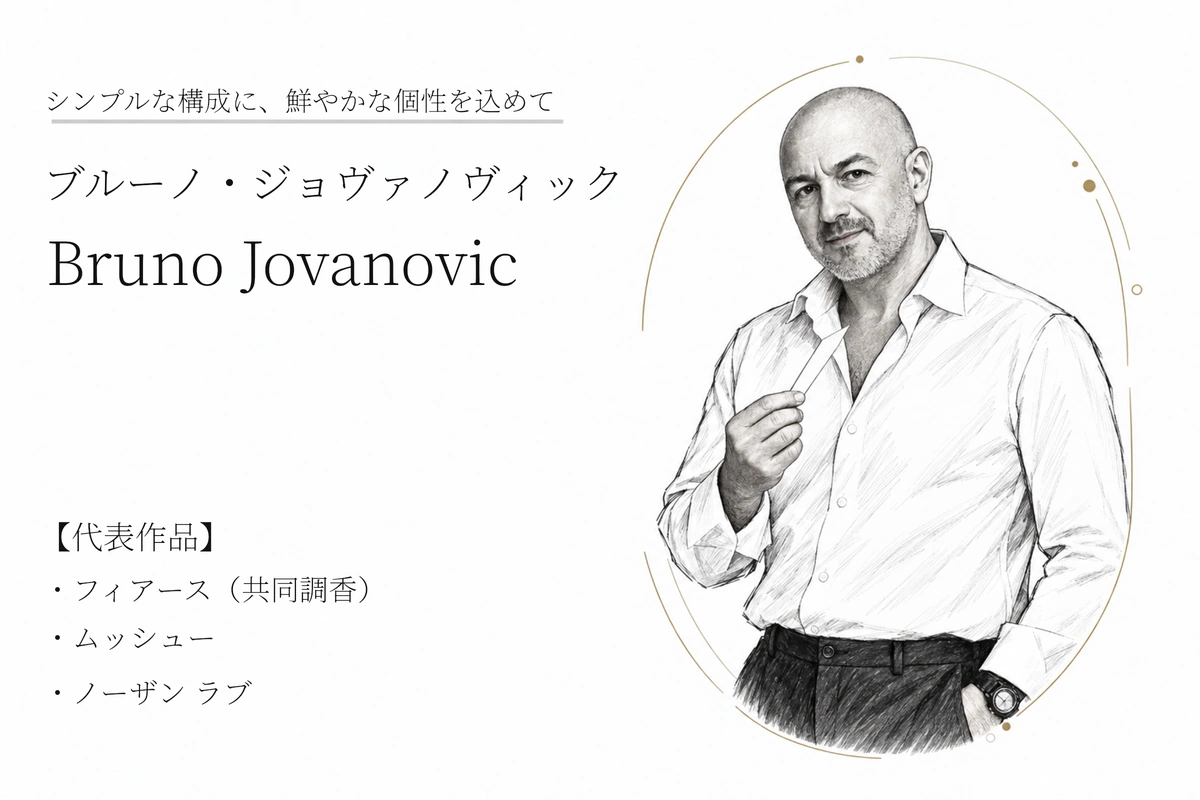
Dominique also taught Bruno Jovanovic at ISIPCA.
• Bertrand Duchaufour, creator of many works for L’Artisan Parfumeur, names Jean-Louis Sieuzac, Dominique Ropion and Michel Almairac as major mentors.
Perfume has an endless connection with the power to evoke diverse sensations, because the dreams of the person wearing it are always expressed within it.
Dominique Ropion
• In 2018, Dominique wrote Aphorismes d’un Parfumeur (Aphorisms of a Perfumer), a book of perfumer’s aphorisms with no Japanese translation. It publishes the thoughts Dominique had recorded in notebooks over a long career. The foreword was written by Frédéric Malle.
• Dominique always carries a book of poetry and sees a parallel with perfumery in writing something wonderful while imposing constraints. A particular favorite is Georges Perec.
Perfume is a kind of message about beauty. You can be moved very deeply and emotionally by perfume, and you can express yourself through the perfume you wear. It can become part of your identity and personality. If you decide to wear a perfume, it becomes part of you, and when you wear it, it is trying to say something to other people.
Dominique Ropion