A perfume does not reach the shop simply because a perfumer has completed its formula. It needs somewhere to make the liquid, somewhere to shape the bottle, somewhere to finish its surface, and somewhere to print and assemble the box. In the early twentieth century, Coty’s Cité des parfums in Suresnes, west of Paris, was a production centre that gave this sequence of work a place in the urban landscape.
This time, I want to step back a little from the story of the founder who created celebrated perfumes and look instead at places and work: the factories beside the Seine, specialist workshops in neighbouring towns, workers lined up at benches, and the buildings that survive today. Together, they reveal an industry bringing fragrance, containers and packaging into a single product.
- Key Information
- A Factory Complex beside the Seine
- Bottles and Boxes Connected to Specialist Workshops in Nearby Towns
- Production Seen through Workbenches, Glass Bottles and Delivery Vehicles
- What Did the New Factory of Around 1936 Bring Together?
- Architecture and Decoration after the Factory Closed
- A Note on Dates
- References
Key Information
Name: Coty’s Suresnes factory / Cité des parfums
Location: Suresnes, France, around the former grounds of the Château de la Source, close to the Seine and the old Suresnes bridge
Established: The site took shape in the 1900s and was enlarged in stages. An important part of what survives is the building designed by architect Jean Barot around 1936
Today: Perfume manufacturing has ceased. Part of the former factory, renovated and extended, serves as the headquarters of Bel
History and collections: MUS, the Museum of Urban and Social History of Suresnes
A Factory Complex beside the Seine
From a Country-House Estate to a Production Centre
The site began on land associated with the Château de la Source in Suresnes. Close to the Seine and the bridge, the factory brought together perfume and cosmetics production and commercial departments through successive extensions. Its name, “city of perfumes,” is easier to understand if we imagine a cluster of facilities with different functions rather than a single large building.
An aerial photograph dated by MUS to 1927 shows a long building facing the river, parallel rows of roofs, and courtyards and open spaces between them. A house and tree-filled grounds are visible alongside. It shows how factories accumulated across the site in a way that the orderly brick façade of later years cannot convey on its own. The visible details do not establish the processes carried out in each building, but they do show a factory complex composed of several buildings and passageways.
The Area of Suresnes and the Area of All Production Sites
When assessing the scale, it matters what a figure includes. MUS’s perfume-industry chronology gives the Cité des parfums an area of 15,000 square metres after its expansion in 1915, and a combined area of 50,000 square metres for all production sites. The latter cannot simply be read as the area of Suresnes alone.
Industrialising perfume involved more than constructing enormous buildings. It also meant assigning materials with different properties, fragrance, glass, metal and paper, to the specialist skills they required. That network extended beyond the Suresnes grounds.
Bottles and Boxes Connected to Specialist Workshops in Nearby Towns
Setting out the division of work described in MUS’s factory history makes the geography behind the finished products clearer.
| Site | Principal activities recorded |
|---|---|
| Suresnes | Perfume and cosmetics production; commercial departments. The new buildings of around 1936 housed soap, face-powder and rouge production, administration, storage, technical departments and other services |
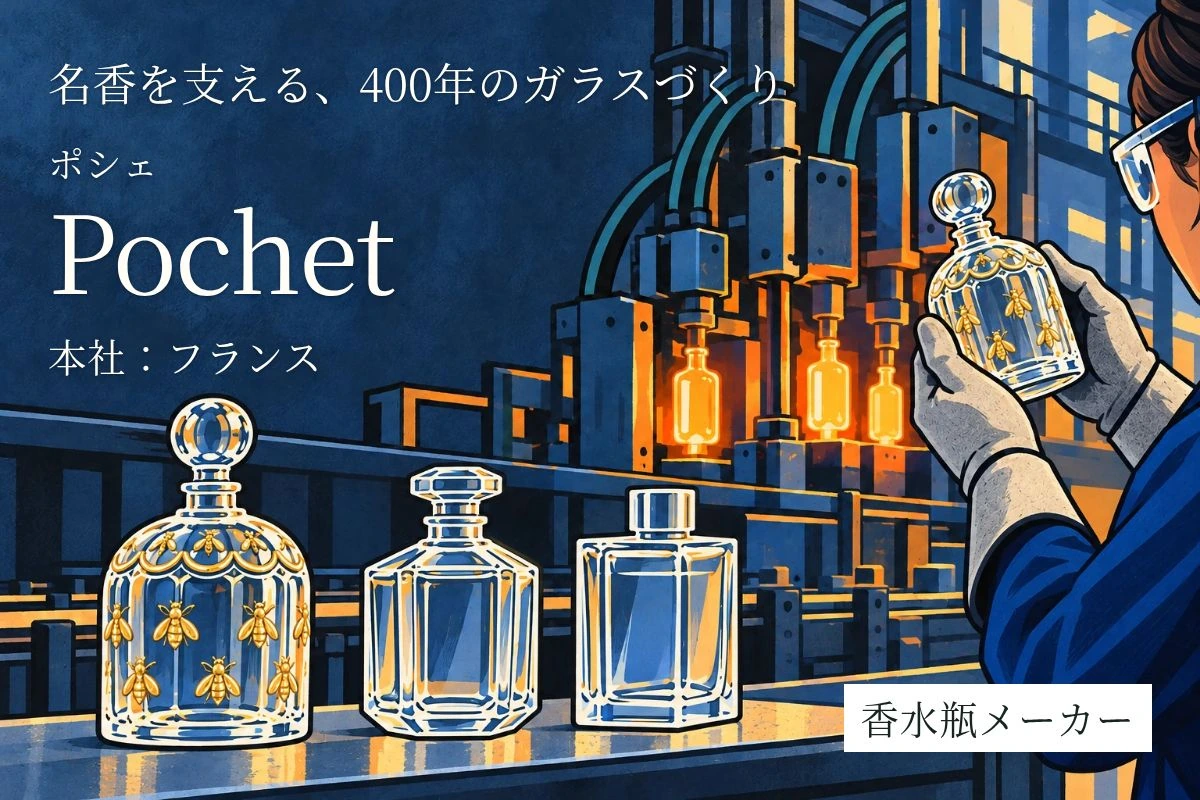
| Puteaux | Manufacture of lipstick tubes, gilding, and grinding and cutting of perfume bottles |
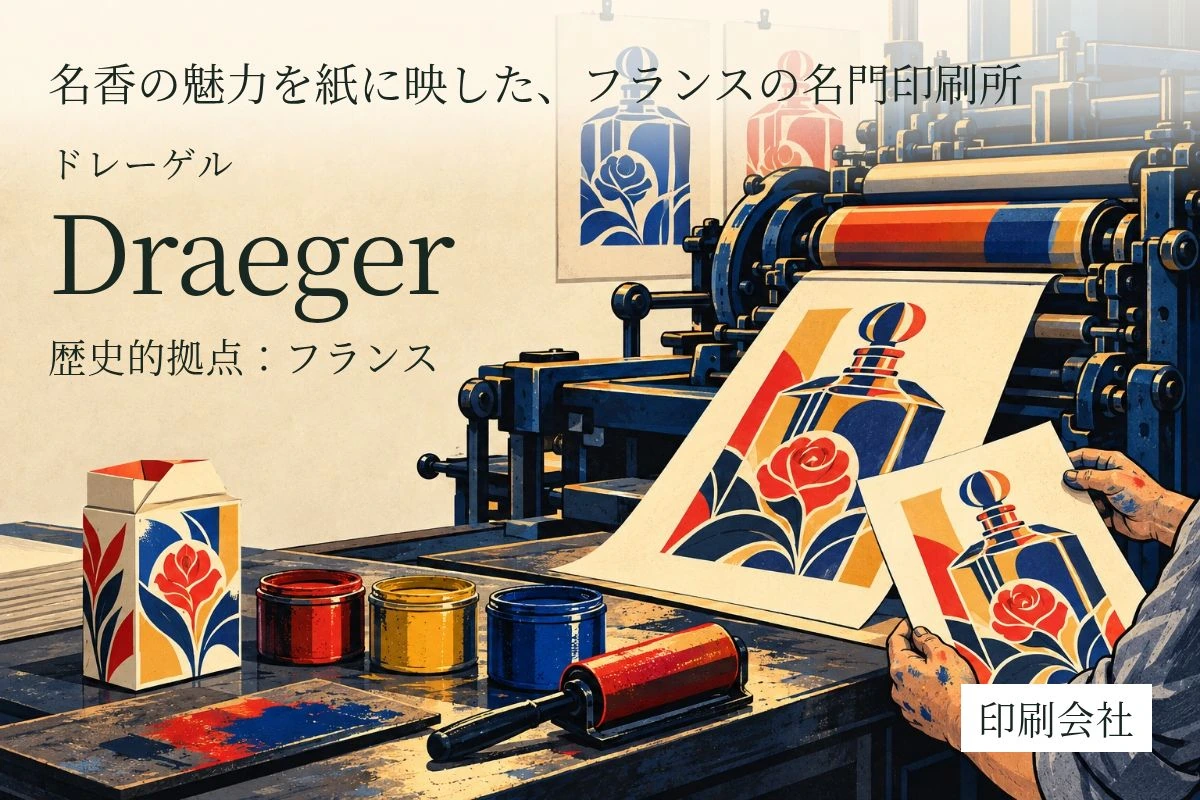
| Neuilly | Printing and assembly of boxes |
| Pantin | Crystal glass manufacture |
Making a bottle and working on the bottle once it has been made are separate jobs, too. Distinguishing glass manufacture in Pantin from bottle finishing in Puteaux reveals differences between processes concealed by the single expression “Coty bottles.” For lipstick, likewise, manufacturing the metal tubes cannot simply be grouped together with cosmetics production in Suresnes.
Boxes involve two kinds of work: printing and assembly. Applying a design to a flat sheet of paper does not, by itself, create a box that can hold a bottle. To understand perfume as a finished object, we need to consider not only the design but also the work of turning paper into a three-dimensional form. Looking at Draeger’s printing work alongside the division of manufacturing among Coty’s sites reveals the range of work supporting a perfume’s appearance.
Production Seen through Workbenches, Glass Bottles and Delivery Vehicles
Bottles Made Repeatedly, and Their Finishing
Sophie Cheam’s 2014 conservation study of Lalique bottles made for Coty in the MUS collection gives a concrete account of industrialisation on the container side. Its subjects include the perfume bottles for Styx, L’Or and L’Aimant, treated as representative examples of semi-automatic production. Glass was blown or pressed into moulds, then polished, with surface finishing applied to the stoppers. Their forms were inseparable from the techniques that allowed them to be made repeatedly.
This is evidence of Lalique’s bottle-making techniques, not proof that all the moulding equipment stood in Suresnes. Reading the history of a perfume factory also means understanding the system that turned containers and components, including those made elsewhere, into a finished product.
Workers at Their Stations and the Transport of Finished Goods
The historical section of the same study includes photographs of Coty workers reproduced from Patrice de Sarran’s 1990 book. They show people arranged along long workbenches, tables holding containers and box-like objects, and people working around machinery. These are spaces where many people handled goods, quite different from the desk of an individual perfumer.
The City of Suresnes’s 2010 industrial-heritage guide reproduces one of these scenes with the caption “The lipstick packaging workshop.” Its inclusion on a page about the factory does not, however, establish that the photograph itself was taken in Suresnes. It should be read with the knowledge that cosmetics workshops also operated at nearby sites.
The study also includes a photograph of delivery vehicles with the Coty name painted prominently on their sides. The work of making bottles and boxes was followed by the work of transporting them. A riverside location and the question of what was actually transported, and how, are separate matters. What the photograph clearly shows is road transport bearing the company’s name.
What Did the New Factory of Around 1936 Bring Together?
Old Buildings for Perfume, New Buildings for Cosmetics and Administration
François Coty died in 1934. The construction that followed is important to understanding the factory as it appears today. The new buildings designed by architect Jean Barot around 1936 accommodated soap manufacture, face-powder and rouge production, administration, employee facilities, storage and technical facilities. Perfume production, meanwhile, continued in the older buildings.
To think of the brick building often pictured today as the factory that made all the perfumes from the company’s earliest days would therefore confuse both its period and its purpose. The official architectural survey also records brick and reinforced-concrete construction, flat roofs and sawtooth roofs. Both the handsome frontage and the arrangement of production facilities offer clues when looking at the factory.
Facilities for Workers Were Part of the Factory, Too
Alongside manufacturing workshops and laboratories, the architectural survey lists an infirmary, a canteen and a trade-union room among the site’s components. MUS also records an infant-care facility, maternity leave for women workers, eight days of paid leave for employees, and contributions to a pension fund as part of the factory’s history.
These facilities and arrangements show how employees’ lives were incorporated into factory operations. They are not, on their own, enough to judge wages, workloads or workplace relationships. The family history of a donor who gave a powder compact to MUS records that both her parents and one of her grandmothers worked at the factory. Products have passed into the local museum accompanied by memories of work across several generations.
Architecture and Decoration after the Factory Closed
Coty’s manufacturing activity ended, and the buildings moved into other uses. The 1995 architectural survey records a renovation by H. Guillaume and A. Bigozzi in 1989 to accommodate an Agfa Gevaert factory for photographic and cinematographic products. Further renovation and contemporary extensions by Valode & Pistre followed in 2003.
MUS states that Bel’s headquarters have occupied the site since 2016, and Bel’s current official information also gives its headquarters as 2 Allée de Longchamp, Suresnes. What survives today is not the entire historic factory complex preserved unchanged, but a building that retains part of the architecture of the 1930s while changing its use and appearance.
In the courtyard at the front of the factory, fountains once stood on either side of the entrance, decorated with reliefs of women kneeling around an incense burner. According to MUS, the sculptor André Augustin Sallé rendered a design by René Lalique. The reliefs were removed during alterations to the building in 2001 and, after storage and restoration by the museum, moved to the Parc du Château. Even the work of cleaning stone that had remained outdoors and adding a covering to protect it from rain helps carry this site’s history forward.
Perfume bottles and boxes, aerial photographs of the factory, objects preserved by employees’ families, and relocated decorations: each is part of the same industrial heritage, yet each tells us about different work. Learning about Coty’s Suresnes factory means looking beyond the creator of famous perfumes and reconsidering the people and places that repeatedly made, finished and delivered them. Reading the article on François Coty alongside this account helps clarify the connection between the founder’s career and creations and this production centre.
A Note on Dates
Official sources differ even on the date of establishment. MUS’s perfume chronology and the Ministry of Culture’s architectural survey record the purchase of the château in 1905; MUS’s factory guide records the purchase of part of the park in 1907; and the city’s 2010 guide dates Coty’s arrival in Suresnes to 1909. These accounts cannot be merged into a single certain date for the same transaction, or treated as a verified sequence of development stages. The date of closure is also left unspecified here: the current MUS guide gives the 1960s, while the city’s 2010 guide describes activity continuing into the 1970s.
References
- MUS de Suresnes: 8 – L’usine Coty / Factory location, division of work among sites, aerial photographs and architectural records
- MUS de Suresnes: L’œuvre du jour – 23 avril / The 1927 aerial photograph, employee provisions and changes to the factory
- MUS de Suresnes: La parfumerie / Perfume-industry chronology and the areas recorded for 1915
- French Ministry of Culture, POP: Parfumerie Coty, puis usine Agfa Gevaert / 1995 survey, building uses, structure and alterations
- Sophie Cheam: Conservation study of Lalique bottles for Coty, 2014 / Forming and finishing techniques; photographs of workers and delivery vehicles on p. 46 of the historical section
- City of Suresnes: Parcours patrimoine 20e siècle, 2010 / “L’usine Coty,” p. 8
- French Ministry of Culture, POP / MUS: Powder compact, inventory no. 2016.3.2 / The donor family’s history of employment at the factory
- Groupe Bel: Mentions légales / Current headquarters address
- MUS de Suresnes: Étude des collections / Conservation and relocation of reliefs from the former Coty factory