Early Life and Training
Art moves us instinctively or intellectually, and sometimes it moves us in both ways, which is wonderful when it happens.
Edmond Roudnitska
Edmond Roudnitska was born on March 22, 1905, in Nice, France. Edmond’s father was a Russian official, and the family had fled Ukraine into exile.
In 1926, Roudnitska, who said, “I really wanted to become an opera singer,” became an apprentice in a laboratory analyzing raw materials at Roure in Grasse. At first, Roudnitska had little interest in culture or art and was passionate about sport. But after spending three months with Leon Chiris, who had patented an extraction method using volatile solvents, Roudnitska learned composition techniques and the thinking behind perfume bases, and decided to become a perfumer. Roudnitska then studied under Ernest Beaux, Chanel’s first in-house perfumer and the creator of No. 5. After a year in Grasse, Roudnitska continued studying composition in Argenteuil, near Paris, where Roure had its headquarters.
After seven years at Roure, Roudnitska was hired in 1935 by De Laire, now part of Symrise, to create perfume bases. It was an era in which synthetic fragrance materials had begun to emerge and, following Guerlain’s Jicky (1889), were being used in a variety of perfumes. However, synthetic materials were still very difficult for perfumers to handle. Companies such as De Laire therefore developed bases containing synthetic materials to make them easier to use.
Founded in 1876, De Laire was the first company to make bases with synthetic fragrance materials. In 1889, it created Ambre83, blending vetiver, patchouli and jasmine around a core of vanillin, which was used in Guerlain’s Jicky (1889). It also created bases such as Prunol, used in Diorella and Le Parfum de Thérèse; Bouvardia; and Mousse de Saxe, used in Rose & Cuir. Roudnitska frequently used these bases in later years.
The Beginning of a Legend
Roudnitska was close to François de Laire, the successor to De Laire’s founder, George de Laire, and through this friendship gradually became interested in culture, art, painting and music. During this period, Roudnitska began reading books on beauty, philosophy and thinkers, including Montaigne, Montesquieu, Henri Delacroix and Henri Bergson. This is thought to have influenced Roudnitska’s philosophical approach to perfumery.
In 1938, Roudnitska helped write a leaflet for De Laire’s products for the perfume industry. By then, Roudnitska had already mastered hundreds of bases and chemical ingredients. Roudnitska’s first article also appeared in Parfums de France, beginning what would become a large body of writing on the perfume industry, philosophy and thought.
That same year saw the launch of Roudnitska’s first perfume, It’s You for Elizabeth Arden.
In 1942, Roudnitska met Thérèse Delveaux, a chemist working at De Laire who would later become Edmond’s wife. Thérèse worked in the pharmaceutical division. Young and passionate about fashion, Thérèse began smelling a variety of perfumes, partly under Roudnitska’s influence. The couple rode a motorcycle to distant forests to gather lily of the valley, visited bookshops and went to the opera. At the time, Roudnitska was reading Kant.
From 1945, Roudnitska began developing a personal theory by bringing together critical essays on Kant’s aesthetics. It would be published 31 years later.
“To give meaning to Roudnitska’s work as a perfumer was to put forward a theory of beauty and a philosophy of life; that was Roudnitska’s purpose.”
In 1944, Roudnitska launched Femme for Rochas, then composed a series of perfumes: Mousseline (1946), Mouche (1947), Moustache (1948) and La Rose (1949).
—
★ Femme (Rochas, 1944)
When Marcel Rochas opened a first couture shop in Paris in 1925, Marcel was only 22. Originally wanting to become a lawyer, Marcel had not been interested in fashion, but the first wife Marcel fell in love with liked fine clothes, so the couple decided to work together. Incidentally, Marcel was the first designer to put pockets in skirts.
Time passed, and in 1943 Marcel met the woman who would become a second wife: Hélène Rochas, then eighteen years old. Marcel was forty!
“At the time, he was considering closing the shop because of the war. That was when he met me, and I suggested the idea of having a family. Soon we had two children, and I became his wife, his model and his inspiration. I gave him the courage to do something new and became an important mentor in his life. When I met Marcel, I was still a young girl, but afterward I became a grown woman.” (Hélène Rochas)
But without a backer like Bernard Arnault or Marcel Boussac, Marcel had no money. Still wanting a gift for Hélène, Marcel said, “I want to create a perfume for you.” Marcel had always known that fashion and fragrance were inseparable for women, and had therefore also been selling perfume in the salon since 1936.
The idea for Femme had long been in Rochas’s mind, and Albert Gosset brought it to life. Marcel was the spirit of the perfume, and Gosset was its engine.
When starting the perfume venture, they first planned to establish a fragrance line like Chanel’s, and Femme was its first scent. When Marcel and Gosset told Roudnitska what they hoped to create, Roudnitska had already created that very scent.
In November 1943, the two met Roudnitska. They wanted a scent that could become a hallmark of the rebirth of French couture, and Roudnitska handed over the only perfume Roudnitska had been working on throughout that year.
Femme possessed sensuality through the precious prune scent of methyl ionone. Roudnitska discovered that it had never before been used in perfume and incorporated it. This prune note was enveloped in an accord of oakmoss and peach.
“When I made Femme, I made it very fruity to harmonize with sweet, sugar-like notes; added woods to tone down the fruit; included aldehydic scents to give it strength and richness; and made it very floral. At first, I was making it for myself, so I did not know it would be called Femme.” (Edmond Roudnitska)
In December 1944, a limited edition of Femme was released in a Lalique bottle inspired by Mae West’s bottom. Marcel had a weakness for women with a trim waist and a round bottom! The perfume was a tremendous success, and Rochas came to be regarded as France’s largest perfume brand.
“I never imagined that my perfume would sell so well or gain so much recognition. At that moment, I felt that Femme was not a perfume. Yes, it was something very special.” (Edmond Roudnitska)
—
In 1946, the success of Rochas’s Femme gave Roudnitska the means to establish a laboratory and company called Art et Parfum in Cabris, becoming the world’s first independent perfumer. Thérèse provided support and handled production and sales management. Incidentally, there is a T-shaped swimming pool there, built in Thérèse’s honor.
In 1947, Roudnitska met Serge Heftler-Louiche and Christian Dior. They quickly became friends, and Roudnitska composed Diorama (1948) as a token of that friendship. This led to the release of numerous perfumes for Dior.
In 1948, a son, Michel, was born.
In 1949, Roudnitska moved to Cabris and began writing many articles about the perfume industry and beauty. The compositional style also grew more rigorous and pure, and the formulas became simpler.
In May 1951, Roudnitska lectured at the Sorbonne on the conditions necessary for perfume to be an art.
“Do not hesitate to recognize the sense of smell as an aesthetic sense of the highest order.”
(Edmond Roudnitska)
That same year, with the cooperation of Émile Hermès, Roudnitska launched Hermès’s first commercial perfume, Eau d’Hermès. It captured the scent of an Hermès handbag.
In 1955, Roudnitska released Eau Fraîche for Dior. Serge’s only instruction was to create a perfume inspired by Coty’s Chypre. Dior’s Eau Fraîche introduced the category of eau fraîche to perfumery, lasting longer than eau de cologne but not as long as eau de toilette.
The following year, Diorissimo was released.
—
★ Diorissimo (Dior, 1956)
After synthetic fragrance materials began to be used in perfume in the late nineteenth century, the perfume industry became modern, and many perfumers began using large quantities of synthetics. Vanilla, fruity and sugary notes were especially common. However, the more these sweet scents were used, the more perfumes ended up stimulating taste rather than smell. Unable to tolerate this state of the industry, Roudnitska took action with Femme in 1944 and Eau Fraîche for Dior in 1953.
Roudnitska’s philosophy was not simply to return to nature, but also to simplify the structure of perfume. At the time, scents were not only moving toward food; they were also becoming more complex and muddled through the use of many ingredients. This further strengthened Roudnitska’s pursuit of simplicity.
“Diorissimo was a pioneer. Every perfume I made afterward was devoted to the motto ‘simplify, simplify, simplify.’ For me, simplicity is like the artist’s distillation, whatever the field. Only at the pinnacle of talent can artists make their work simpler.” (Edmond Roudnitska)
Roudnitska first classified the new synthetic materials on the market, replacing overused materials with fresher, lighter and more transparent ones. Avoiding scents that approached flavorings, Roudnitska selected those that seemed closer to nature and capable of simplifying a formula. What emerged was an accord of lily of the valley. Lily of the valley grew in Roudnitska’s garden; each spring, Roudnitska smelled the flowers and developed the accord over several years.
At a dinner at La Colle Noire, Dior’s home in Grasse, Roudnitska presented the trial to Christian Dior. This was several years after meeting Christian Dior and Serge Heftler-Louiche in 1947.
“Diorissimo is a fragrance made from a bouquet of lily of the valley, but it does not evoke the flowers alone, because the surrounding undergrowth, dew and countryside are all present in harmony. Since neither an essence extracted from lily of the valley nor anything close to it exists in nature, the fragrance had to be built from disparate elements with no direct relationship at all to the smell of lily of the valley.” (Edmond Roudnitska)
For Dior, lily of the valley was a symbol of good fortune, a flower with special powers. Dior was superstitious and a fervent believer in fortune-telling. Yet, although Catholic, Dior disliked Sunday services and was skeptical about prophecies. In 1919, when Dior was only fourteen, there was a bazaar near home, and a fortune-teller who happened to be nearby read Dior’s palm. The prediction was: “You will suffer poverty. But women will bring you good fortune, and through them you will succeed. You will gain a great deal of money and travel around the world.” Since this came true, the fortune-teller was always a source of help to Dior, who consulted this person at every turn! When Dior died, the coffin was completely covered with lily of the valley.
On hearing of Dior’s death and seeing the coffin surrounded by lily of the valley, Roudnitska was overcome with emotion. Only then did Roudnitska truly understand how much the flower had meant to Dior.
“Looking across the whole history of perfume, Diorissimo is the only surviving monofloral perfume. Among monoflorals, violet and lavender are familiar to the public but very cheap. The more sophisticated monoflorals include gardenia and narcissus, but the famous examples have outdated structures. Diorissimo, the only successful survivor, is very familiar yet not simple: it is highly complex, with many facets to discover. This is because its readily recognizable lily-of-the-valley accord is accented with jasmine, boronia and other sophisticated-smelling accords. This is the result of Roudnitska’s genius.” (Maurice Roger)
“At first, I was studying lily-of-the-valley notes, but at the same time I was also studying hyacinth notes. Their green character brought the lily-of-the-valley scent closer to nature. I knew that Coty had released a lily-of-the-valley perfume called Muguet des Bois (1941, Henri Robert). Its lily-of-the-valley scent was as wonderful as could be, and I wondered how it had been made in the 1930s. Yet it was not successful at all, because it was not a wearable perfume. To avoid falling into the same trap, I made mine into a perfume. It became a fresh, otherworldly scent, as though spring rain had fallen on the garden.” (Edmond Roudnitska)
The initial edition of Diorissimo, limited to sixty bottles, was presented in Baccarat bottles decorated with Dior’s signature pearls and topped with a cap in the form of a bouquet of gilded bronze flowers.
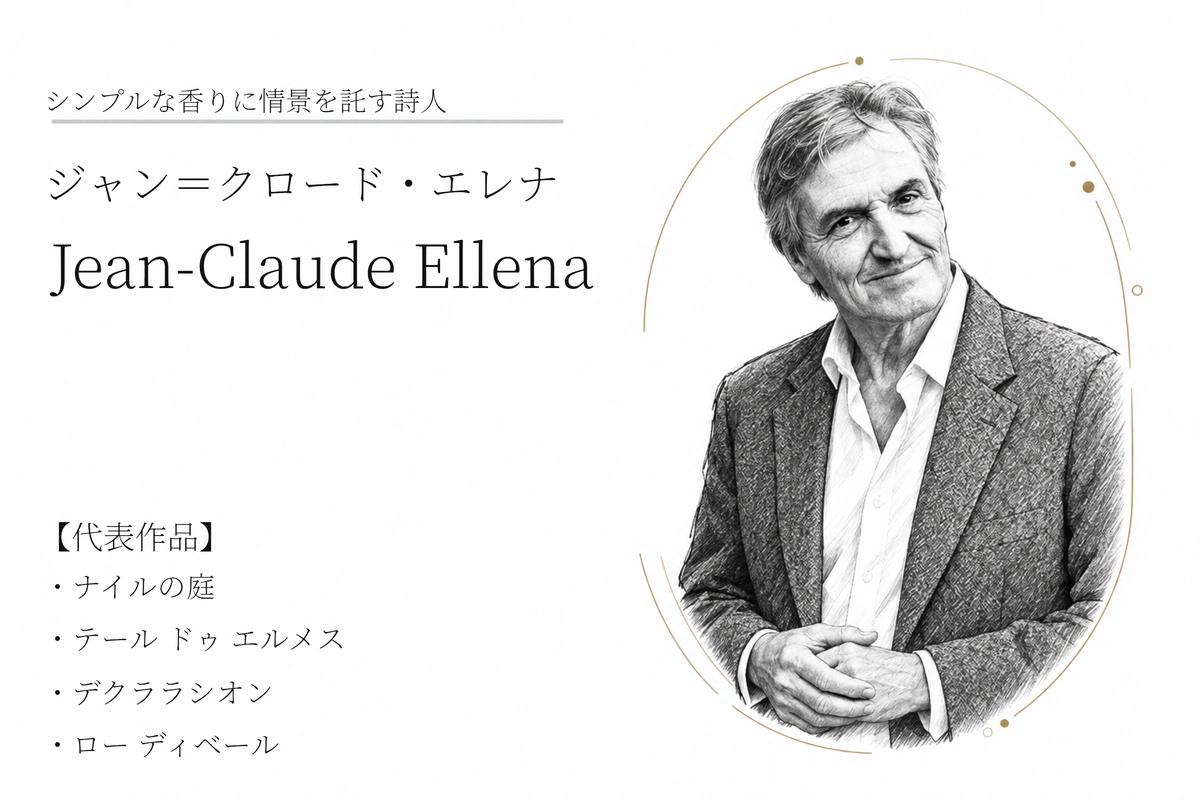
“No perfume expresses the difference between an odor and a fragrance as beautifully as Diorissimo. The perfume originated in the smell of lily of the valley, but is the perfumer’s ultimate task not to turn such a single odor into a perfume? Suppose we receive a smell from nature. We use our senses to interpret it. With the knowledge we have, we can reproduce it. Once we have found a theme or a clue in this way, we must then add something of ourselves. It might be our desire or, at the most complex level, our individuality.” (Jean-Claude Ellena)
—
In 1966, Roudnitska released Eau Sauvage for Dior. It was the first perfume to use Hedione. Not only did it broaden the possibilities of men’s perfume, but it was also worn by many women.
“People often say that the synthetic fragrance material Hedione made Eau Sauvage successful, but that view is wrong. The main element of Eau Sauvage is basil, and adding or subtracting a little Hedione does not change that. When Henri Robert created Cristalle (Chanel, 1974), Robert described it not as an ‘eau fraîche’ but as an ‘eau de basilic.’” (Maurice Roucel)
—
★ Diorella (Dior, 1972)
There have been perfumes of extraordinary originality that influenced perfumers of the preceding generation. The first was Chanel No. 5 (1921), the second Shalimar (1925), and the third Diorella.
Diorella is an exceptional floral, mysterious yet long-lasting. Citrus and ripe fruit create a freshness without any sense of weight, while jasmine and honeysuckle evoke the brightness of spring and the warmth of the sun. This was the first fruity-floral perfume.
The 1960s and 1970s were a period of transition. For Dior, Eau Sauvage was unexpectedly worn by as many women as men, a trend Roudnitska had created. Diorella was called the female version of Eau Sauvage, although Roudnitska disagreed, seeing it instead as an evolution of the 1953 Eau Fraîche.
“If Diorissimo is the daughter of Eau Sauvage, then the structure of Diorella would make it Diorissimo’s great-grandchild. Diorella rearranges a completely different formula.” (Edmond Roudnitska)
Diorissimo, created in 1956, heralded Roudnitska’s new philosophy. This became pronounced in Eau Sauvage in 1966 and finally reached maturity in Diorella. The idea for Diorella had been in Roudnitska’s mind for nearly twenty years. First came an overdose of jasmine, followed by fully ripe fruit notes to add interest in contrast to the warmth of oakmoss. The techniques developed for Diorissimo and Eau Sauvage then made this accord light and fresh. The result was a perfume combining warmth with coolness, and boldness with shyness.
“Diorella is the creation I am proudest of among all the works I have made. It is truly a very, very beautiful perfume.” (Edmond Roudnitska)
The bottle, made of clear glass with a silver frame that seems to reflect light like a mirror, was designed by Serge Mansau.
“As the work was nearing completion, René Bourdon asked to see me. ‘Serge, shall we talk about money?’ I said, ‘I cannot reduce it any further. It cost a great deal. If it is more than you can afford, you should not be looking at a Rolls-Royce.’ ‘No, Serge, let us rewrite this invoice. You have done work worth twice this amount. That is what I will pay you.’ Nothing like that ever happened again.” (Serge Mansau)
—
In 1974, Roudnitska composed Cristalle EDT together with Chanel’s in-house perfumer Henri Robert (1899–1987), who had been at Chanel since 1952.
In later years, Roudnitska devoted time to writing books including The Intimacy of the Perfume, To train the men, myth or reality?, The Aesthetics in Question and The Perfume, published in Japanese as Kaori no Sōzō (“The Creation of Scent”). Roudnitska also sought to protect perfume by asserting its image rights: in other words, the belief that scent was art and should never be copied.
In 1990, Roudnitska released the final creation, Ocean Rain, through Valentino.
Roudnitska’s life ended on June 17, 1996, at the age of 91. Art et Parfum was taken over by Edmond’s son, Michel, and wife, Thérèse.
In 2004, Olivier Maure established a factory called Accords et Parfums near Art et Parfum to support independent perfumers and niche brands. It offers top-quality fragrance materials, as well as computers, databases and software for creating formulas. Brands making perfumes there include L’Artisan, where 80% of compositions are made at the facility, Frédéric Malle, Jean Patou and Parfums Dusita.